Key takeaways
Summary: Long term homeowners in Silicon Valley often face substantial capital gains when selling, which makes tax planning a critical part of the process. The federal exclusion provides some relief, but it typically does not cover the full gain in a high value market like ours. Understanding your true cost basis and exploring legal strategies ahead of time can significantly reduce your tax exposure. Because both federal and California taxes can have a major impact, working with qualified professionals before selling is essential.
Want your own number? Try my capital gains calculator to see roughly what you’d owe and how much you’d walk away with.
If you bought your Silicon Valley home in 1985 for $275,000 and it’s worth $2.8 million today, you’re sitting on roughly $2.5 million in unrealized gain. That’s an extraordinary outcome, and the Bay Area real estate market has genuinely been one of the most powerful personal wealth building engines in American history for long time homeowners.
It also means that when you sell, capital gains tax is one of the most consequential financial considerations you’re going to face. Done right, with proper planning, a knowledgeable tax advisor, and an understanding of the tools available, the tax impact is often far smaller than people fear. Done wrong, or without adequate preparation, it can be a significant and largely avoidable cost.
I work with long time Bay Area homeowners on exactly this question every single day. This guide is my attempt to give you a genuinely complete, honest picture of how this works and what your options actually are.
Let me be clear upfront about one thing. Tax law is complex, individual circumstances vary enormously, the rules change with legislation, and this article cannot substitute for working with a qualified CPA and tax attorney who know California law and know your specific situation. What I can do is give you the conceptual framework and vocabulary to have that professional conversation effectively.
How Capital Gains Tax Works on Real Estate
When you sell a capital asset, including real estate, for more than you paid for it, the difference between the sale price and your cost basis is a capital gain. For real estate you’ve owned for more than one year, that’s taxed as a long term capital gain.
At the federal level, long term capital gains are taxed at preferential rates of 0%, 15%, or 20%, depending on your total taxable income for the year. Most Bay Area homeowners with significant home sale gains will find themselves in the 20% federal bracket for the gain that exceeds the primary residence exclusion. High earners may also owe an additional 3.8% Net Investment Income Tax (NIIT) on top of the base capital gains rate, which brings the federal rate as high as 23.8%.
Then there’s California. Unlike the federal government, California taxes capital gains as ordinary income, at the same rate as wages, interest, and other income. For high earners in California, the top marginal rate is 13.3%, and there is no preferential long term capital gains rate at the state level.
Combined, for a high income Bay Area homeowner, the effective marginal tax rate on capital gains above the exclusion can approach 35% to 37%. On a $2 million taxable gain, that’s $700,000 to $740,000 in taxes. The number is real, and it’s why serious planning matters.
Step One: The Primary Residence Exclusion
The best place to start is the federal tax code’s most valuable gift to homeowners, the primary residence exclusion under IRS Section 121.
Under this provision, you can exclude from federal taxable income up to $250,000 of capital gain if you’re a single filer, or up to $500,000 if you’re married filing jointly. To qualify, you have to have owned the home and used it as your primary residence for at least two of the five years immediately before the sale, and you can only use the exclusion once every two years.
For most Americans, this exclusion eliminates the entire capital gain, or comes close to it. For Bay Area homeowners with decades of appreciation, it eliminates only a portion. A married couple selling a $2.8 million home they bought for $275,000 uses their $500,000 exclusion and still has approximately $2 million of taxable gain remaining. That’s not a reason to despair, it’s a reason to plan.
One important timing note for surviving spouses. A surviving spouse can claim the full $500,000 exclusion, rather than $250,000 as a single filer, if the sale occurs within two years of the spouse’s death. If you’re recently widowed and considering a sale, this timing provision could save you $250,000 in taxable gain, and it’s one of several reasons why discussing timing with a tax advisor early in the process is so valuable.
Related reading: Selling a Silicon Valley Home After Your Spouse Died.
Step Two: Calculate Your Actual Adjusted Cost Basis
Before you conclude that your taxable gain is the full difference between the sale price and the original purchase price, please make absolutely sure you’ve correctly calculated your adjusted cost basis. In most cases, especially for homes owned 30 or more years, the actual basis is meaningfully higher than the original purchase price. And every dollar of basis is a dollar that isn’t taxed.
Your adjusted cost basis includes a few different categories worth walking through carefully.
- Original purchase price. The amount you paid for the home.
- Purchase closing costs. Title insurance, recording fees, transfer taxes paid by the buyer, loan origination fees if applicable, and the various items on your original settlement statement.
- Capital improvements. This is often the biggest category, and the most frequently underestimated. Capital improvements are permanent additions or improvements that add value, extend the useful life, or adapt the home to a new use. Examples include room additions, kitchen remodels (not just cosmetic upgrades), bathroom renovations, new HVAC systems, roof replacements, new windows, pool or spa installation, solar panel systems, landscaping improvements, driveway repaving, and major structural repairs. Routine maintenance like painting, carpet cleaning, and appliance repair does not qualify, and the line between maintenance and improvement can require professional judgment.
- Selling costs. The REALTOR® commission, transfer taxes, escrow and title fees paid by the seller all come off your net proceeds and effectively reduce your taxable gain. On a $2.8 million sale with a 5% commission, that’s $140,000 in selling costs that reduce your gain dollar for dollar.
For a home owned since 1985 in Silicon Valley, the capital improvements list alone can be substantial. A kitchen remodel in 1992, a room addition in 1998, a new roof in 2006, a bathroom renovation in 2014, a solar installation in 2019, new windows in 2021. Add these up over 38 years and it’s entirely plausible to find $150,000, $250,000, or more in capital improvements that increase your basis and reduce your gain.
I strongly encourage every long time homeowner to work through this list carefully before concluding what their gain actually is. Your CPA will need documentation, and permits from the county building department are excellent sources, as are old bank statements and contractor invoices. Go back through your records systematically. It is genuinely worth the time.
The More Homes on the Market Act: Potential Legislative Relief
There is active legislation in Congress, the More Homes on the Market Act, that would increase the primary residence exclusion significantly, potentially to $500,000 for single filers and $1 million for married couples. If enacted, this would meaningfully reduce the tax burden on many Bay Area homeowners with large gains.
This legislation has not been enacted as of this writing. But if you’re considering a sale in the next year or two, it’s worth asking your tax advisor to monitor its status, since the timing of your sale could matter if legislation passes.
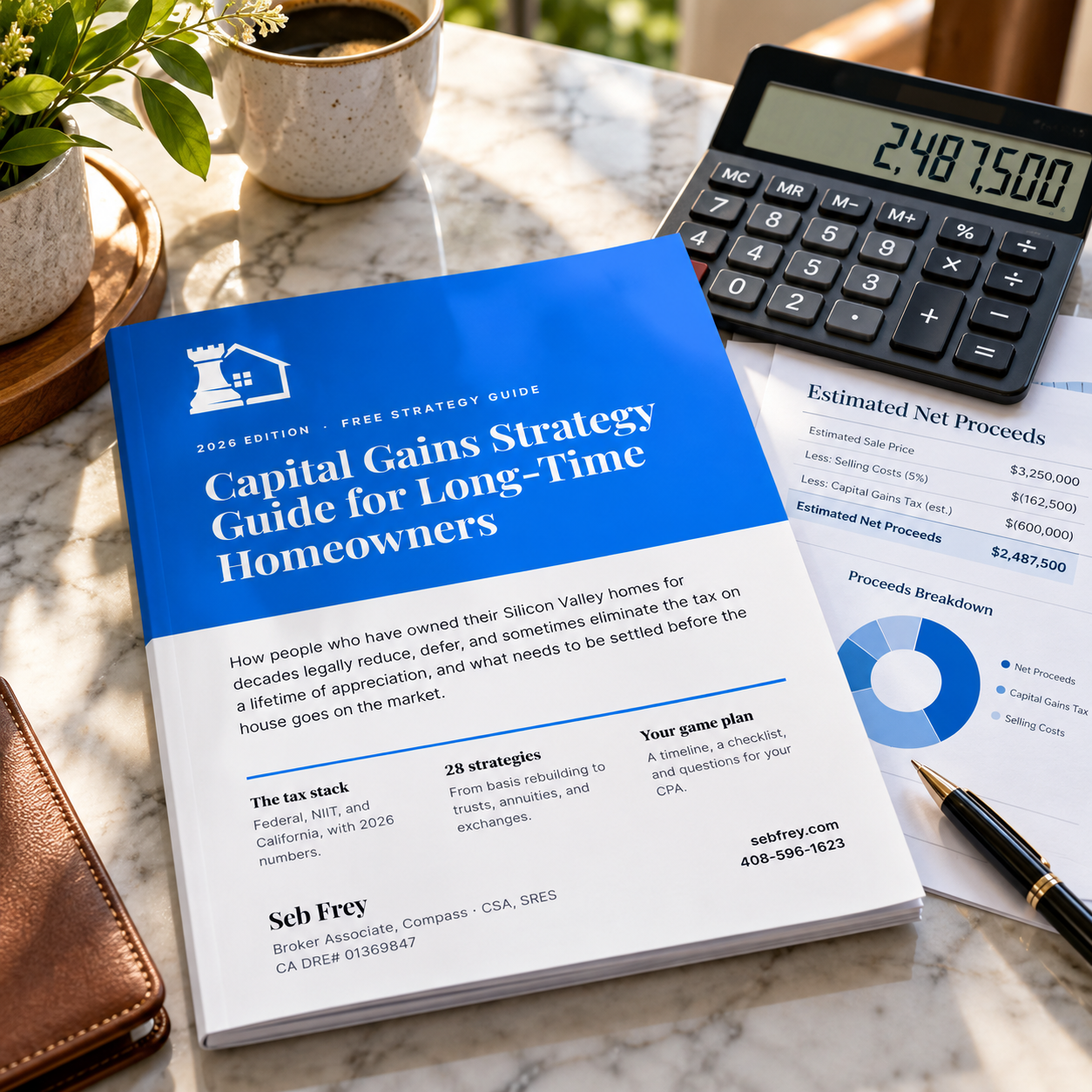
Free 2026 Strategy Guide
28 legal ways long-time owners cut their capital gains tax. Know your options before you list.
After decades in Silicon Valley, your gain can blow past the $250,000 and $500,000 exclusions. The guide walks through each strategy, a real bracket-by-bracket example, and what to settle before you list.
You're all set. Thanks! Your Capital Gains Strategy Guide is on its way to your inbox. If you don't see it in a few minutes, check your promotions or spam folder.
Legal Strategies to Reduce or Defer Capital Gains
Beyond the primary residence exclusion and basis optimization, there are several additional strategies that some homeowners use to reduce or defer capital gains. Let me be direct here. These are not simple or DIY strategies. Each one has requirements, costs, and risks that require professional analysis for your specific situation. And all of them, without exception, need to be set up before you sell, not after. You cannot retroactively apply most of these strategies once the deed has transferred.
Installment Sale
In an installment sale, the seller agrees to receive the purchase price over multiple years rather than in a lump sum at closing. The taxable gain gets recognized proportionally as each payment is received, which spreads the tax liability across multiple years. This can keep you in a lower tax bracket each year and reduce total tax owed. The practical challenge is finding a buyer willing to purchase on installment terms, which is more common in commercial and investment properties and less common in residential, but not impossible. There are also risks related to the buyer’s ability to make future payments that need to be addressed in the contract.
Qualified Opportunity Zone Investment
The IRS’s Qualified Opportunity Zone (QOZ) program allows taxpayers to invest capital gains into designated economically distressed areas through a QOZ fund. Gains invested within 180 days of the sale are deferred until December 31, 2026, or until the QOZ investment is sold, whichever comes first. If the QOZ investment is held for ten years, any appreciation on the QOZ investment itself is permanently excluded from federal tax. This is a sophisticated strategy with specific rules, fund selection considerations, and varying investment quality in the QOZ market. For sellers with very large gains who have other investment goals and a long time horizon, it merits a professional analysis.
1031 Exchange (Investment Property Only)
A 1031 exchange allows investors to defer capital gains by reinvesting the proceeds of an investment property sale into a “like kind” replacement investment property. This does not apply to your primary residence. However, if you have rental property, a vacation home, or other investment real estate with significant appreciation, a 1031 exchange is worth serious consideration. There are strict timelines (45 days to identify a replacement property, 180 days to close), and the mechanics require a qualified intermediary. For the right situation, it’s one of the most powerful deferral tools available.
See Related: Converting your Primary Residence into a Rental Ahead of a 1031 Tax Deferred Exchange
Charitable Remainder Trust (CRT)
A Charitable Remainder Trust is a sophisticated estate planning tool that can be used to address large capital gains. You transfer appreciated property to the trust before the sale, the trust sells the property without recognizing immediate capital gains tax (because trusts are generally tax exempt), you receive an income stream from the trust for a specified period or for life, you receive a partial charitable deduction at the time of the gift, and at the end of the trust term the remaining assets go to one or more charities you’ve designated. CRTs are best suited for homeowners with significant philanthropic intent, large gains, and estate planning goals that align with this structure. They are not appropriate for everyone, and the tax benefits depend heavily on your individual circumstances.
Income Timing and Tax Year Management
Since federal capital gains rates are graduated and depend on total taxable income, the specific year in which you sell can matter quite a bit. Selling in a year when your other income is lower, perhaps early in retirement before required minimum distributions begin, or in a year with fewer other income events, may place more of your gain in a lower bracket. Your CPA can model different timing scenarios to show you what the difference actually looks like in dollar terms. This is one of the most accessible strategies, and it requires nothing more than thoughtful planning around your sale timing.

The California Reality: There Is No State Long Term Rate
I want to dwell on the California dimension for a moment, because it is genuinely significant and often underappreciated by people who are used to thinking only in federal terms.
California taxes capital gains as ordinary income. Period. There is no preferential rate for long term gains at the state level. For someone in the 13.3% top bracket in California, selling a $2.5 million home and recognizing $2 million in gain (after the exclusion) generates approximately $266,000 in California income tax, in addition to the federal capital gains tax. That’s real money.
This is one reason some Bay Area homeowners factor California’s tax environment into their retirement relocation decisions. Moving to a state with no income tax (Nevada, Texas, Florida, Washington, and several others) does not help you avoid California income tax on California real estate. California taxes the gain on California property regardless of where you live when the sale occurs. But for other income, things like pension income, investment income, and future capital gains, state of residence matters enormously.
If you’re considering a relocation partly for tax reasons, please work with a tax attorney who specializes in California residency and domicile issues. California has aggressive rules around establishing new residency, and attempting to minimize California taxes without meeting California’s residency standards is a serious audit risk.
Starting the Process: Understanding Your Numbers
The foundation of any capital gains planning conversation is knowing your actual numbers. What you paid, what you’ve invested in improvements, what the home is worth today, and what the tax picture actually looks like under different scenarios.
A free home valuation gives you the top line sale price to work with. From there, your CPA can model the actual gain, the applicable exclusion, the adjusted basis, and the tax under different scenarios, looking at different timing, different strategies, and different structures. In my experience, when families actually go through this process with professional help, the result is almost always either better than they feared (because of the exclusion, basis adjustments, and selling costs) or clarifying in a way that enables genuinely better decision making. Either way, the exercise is worth it.
I work closely with CPAs and tax attorneys who specialize in exactly this situation, long time Bay Area homeowners with significant capital gains exposure, and I’m happy to connect you with professionals who can help. Reach out any time.
Ready? Get It Sold.

The Capital Gains Library
Each of these articles goes deeper on one piece of the capital gains picture for longtime Silicon Valley homeowners:
- How much capital gains tax you will pay selling a house in California: a worked example
- The community property double step-up for widows and widowers
- The widow’s $500,000 home sale exclusion and the two-year rule
- How to rebuild your home’s cost basis when the receipts are gone
- Moving to assisted living before two years: the partial exclusion
- Sell now or let the kids inherit?
- Selling a former home you have been renting out: the three-year rule
- Will Congress eliminate capital gains tax on home sales? The 2026 update
- Capital gains on selling an inherited house
Frequently Asked Questions
What if I haven’t kept records of all my home improvements over the years?
Start reconstructing what you can. Old permits from your city or county building department are excellent sources, since they’re public records and they often describe the scope of improvement projects. Bank statements, old tax returns, contractor invoices, and even photographs can help establish that improvements were made and what they cost. Your CPA can advise on documentation standards. Even partial records can add meaningful basis, and the effort is almost always worth it.
What if I converted part of my home to a rental property at some point?
The primary residence exclusion only applies to the portion of the home used as a primary residence. If you’ve used part of the home as a rental and taken depreciation deductions, the calculation becomes more complex, and you may face depreciation recapture tax on the portion that was rented. This is a situation that needs a CPA with experience in mixed use property calculations.
My spouse recently passed. Does that affect my exclusion?
Yes, and potentially in your favor. A surviving spouse can claim the full $500,000 exclusion, instead of the $250,000 single filer exclusion, if the home is sold within two years of the spouse’s death. If you’re a recent widow or widower considering a sale, this timing provision is worth discussing with your tax advisor immediately. The two year window is specific and hard. Related reading: Selling a Silicon Valley Home After Your Spouse Died.
Can I donate the home to avoid capital gains entirely?
Donating appreciated property to a qualified charity allows you to avoid recognizing capital gains on the appreciation while also taking a charitable deduction for the fair market value of the donation, subject to AGI limitations. A Charitable Remainder Trust is a more structured version that generates income for you while also providing a charitable deduction and an eventual charitable gift. These are powerful strategies for the right situation, but they require professional planning and they are not appropriate for everyone.
Will the stepped up basis rules change?
There have been legislative proposals to modify or eliminate the stepped up basis for inherited property. As of this writing, the step up remains in current federal law. However, it has been a target of proposed tax reform in various administrations. If you have an inherited property and you’re considering when to sell, monitoring potential legislation with guidance from your tax advisor is reasonable.
If I move to Nevada before selling, do I avoid California income tax on the gain?
No. California taxes the gain on California real property regardless of where the seller resides at the time of sale. Establishing Nevada residency would not help you avoid California tax on a California home sale. California’s nonresident withholding requirements apply specifically to real estate gains on California property. Where residency matters is for other income going forward, not for the sale of California real property itself.
Is there a minimum holding period to qualify for long term capital gains rates?
Yes. To qualify for long term (lower) federal capital gains rates, you have to have held the property for more than one year. For most long time Bay Area homeowners, this condition is obviously met many times over. But it’s relevant if you’re thinking about selling a recently inherited property, where your holding period starts at the date of death rather than the original purchase, or a recently acquired property.
Time to talk to a REALTOR?

Senior Friendly Homes in Silicon Valley South
2
3
4
5
6
7
8
9
10
11
12
13
14
15
16
17
18
19
20
21
22
23
24
25