
For most older Silicon Valley homeowners, the biggest threat to aging in place isn’t the house. It’s the cost of care once help is needed every day. Families are often surprised to learn that Medicare pays for very little of it, and that the bills can reach five figures a month. The good news is that many of my clients have substantial home equity and other resources, and there are ways to use them. This article walks through the real costs and the main ways families pay, and it’s part of my guide to aging in place vs. moving in Silicon Valley. I’m not a financial advisor or elder law attorney, and both should be part of these decisions. If you’re trying to work out how to pay for care for an elderly parent at home, here’s how the money usually comes together in our area.
Key Takeaways
Summary: In-home care for an elderly parent in the Bay Area commonly runs $35 to $45 an hour through an agency, and round-the-clock care runs from about $12,000 a month for a live-in caregiver to $29,000 or more for 24-hour shift care. Medicare doesn’t cover ongoing personal care, so most families combine savings, insurance, home equity, and benefits.
What Care Actually Costs
CareScout’s 2025 Cost of Care Survey put the national median for a non-medical caregiver at $35 an hour, and Bay Area agencies generally run above that, which is why I use $40 an hour for the math below. You can look up figures for your own area with CareScout’s cost of care tool, and your actual numbers will depend on the agency, how many hours you need, and whether your parent needs help overnight.
| Level of help | Rough monthly cost at $40 an hour |
|---|---|
| 4 hours, 3 days a week | About $2,100 |
| 6 hours a day, every day | About $7,300 |
| 12 hours a day, every day | About $14,600 |
| Live-in caregiver (flat daily rate, caregiver sleeps overnight) | Often starts around $12,000 |
| 24-hour shift care (caregivers rotate, someone always awake) | About $29,200 |
Live-in care can cost less than 12-hour shifts because agencies bill it as a flat daily rate and the caregiver gets a sleep break at night. Once a parent needs someone awake overnight, for wandering or frequent trips to the bathroom, that model stops working and the cost jumps to full shift care.
For comparison, CareScout puts the national median for assisted living at $6,200 a month, and Bay Area communities commonly run about $6,500 to $9,000 a month, with memory care more. That’s why the cost of staying home rises sharply as care needs grow. I compare the two paths in my guide to aging in place vs. moving in Silicon Valley.

Free 2026 Checklist for Families
The Parent's Home Transition Plan
Moving Mom or Dad into assisted living or memory care usually happens faster than anyone planned, and the house ends up being the biggest decision on the table. This checklist walks Silicon Valley families through every step in order, from the first conversation and the legal paperwork to paying for care, the cleanout, the sale of the house and the taxes, so nothing important gets missed while you're focused on your parent.
You're all set. Thanks! The Parent's Home Transition Plan is on its way to your inbox. If you don't see it in a few minutes, check your promotions or spam folder.
What Medicare Does and Doesn’t Cover
Medicare covers skilled home health care, such as nursing or therapy after a hospital stay, on a part-time or intermittent basis when certain conditions are met. It generally doesn’t cover custodial care, which is help with daily activities like bathing, dressing, eating, and supervision, and that’s most of what older adults need to stay home. Families who assume Medicare will pay are often caught off guard.
Ways Families Pay
| Source | How it works | Considerations |
|---|---|---|
| Savings and investments | Private pay from retirement accounts and savings | Withdrawals from IRAs are taxable income |
| Long-term care insurance | Pays a daily or monthly benefit after an elimination period | Review the policy now, including benefit amounts, inflation protection, and how to file a claim |
| Home equity line of credit | Borrow against the house as needed | Requires qualifying and monthly payments |
| Reverse mortgage | Access equity with no required monthly mortgage payment while living in the home | Fees, and the loan comes due when the home is no longer the primary residence |
| Renting part of the property or an ADU | Rental income helps cover care | Landlord responsibilities |
| Veterans benefits | Some wartime veterans and surviving spouses qualify for additional monthly benefits for care | Eligibility rules and a look at assets and income |
| Medi-Cal In-Home Supportive Services | Pays for certain in-home help for eligible Medi-Cal recipients, sometimes including family caregivers | Income and asset limits apply, including a $130,000 asset limit for an individual starting in 2026 |
For the home equity options, see the quick guide to reverse mortgages and ways to unlock home equity without a reverse mortgage.
A real example: One seller I represented, elderly and living out of the area, needed the proceeds from her home to pay for her care, and a family member ran the sale for her under her trust and power of attorney. The home was more than 50 years old and almost entirely original, so we spent $950 on a cleanup, published every disclosure on day one and priced below the automated valuation. Four cash offers came in the same day, and it sold for $428,000, way over list price.
How Long Will the Money Last? A Worked Example
Here’s a hypothetical that looks a lot like the families I work with. Mom is 84 and owns her Willow Glen home free and clear, and it’s worth about $2.4 million. She has $400,000 in savings and about $3,500 a month coming in from Social Security and a small pension. Her care needs grow the way they often do, starting with a few hours a day and ending with someone in the house around the clock.
| Year | Care level | Monthly care cost | Monthly gap after $3,500 income | Drawn from savings that year |
|---|---|---|---|---|
| 1 | 6 hours a day | $7,300 | $3,800 | $45,600 |
| 2 | 12 hours a day | $14,600 | $11,100 | $133,200 |
| 3 | 24-hour shift care | $29,200 | $25,700 | $308,400 |
Her savings cover the first two years with about $221,000 left, and that runs out eight or nine months into year three. That’s also before her regular living expenses, property taxes, and the income tax owed on IRA withdrawals, so in real life the savings go faster. At that point the house is the only big asset left, and the family has to decide whether to borrow against it, rent out part of it, or sell. Each of those has real tax consequences, which I cover below, and it’s why I’d much rather have this conversation in year one than in month thirty.
Medi-Cal and IHSS After the 2026 Asset Limit
Starting January 1, 2026, California brought back an asset limit for Medi-Cal: $130,000 for one person, plus $65,000 for each additional household member, according to Justice in Aging’s FAQ on the change. The home your parent lives in is generally exempt, but a second home or rental property counts. For long-term care Medi-Cal, the state can also look back up to 30 months at gifts and transfers, so moving money to the kids right before applying can backfire.
If your parent qualifies, In-Home Supportive Services (IHSS) pays for help with things like bathing, dressing, meals, and housework, and the provider can often be a family member. In Santa Clara County, the Board of Supervisors approved a contract that raises IHSS provider pay by $2 an hour to $22.44 by July 2027, as Local News Matters reported. The number of hours IHSS authorizes comes from a county assessment, and it rarely covers everything a parent with heavy needs requires, so most families still fill the gaps privately.
Families also ask whether Medi-Cal will take the house. California limits estate recovery to assets that pass through probate, which is one more reason a properly funded living trust matters. These rules are technical and they just changed, so this is a conversation to have with an elder law attorney before anyone applies or moves assets.

Free 2-minute family assessment
Worried about Mom and Dad? See If It's Time to Have The Talk.
Answer a dozen quick questions about what you've noticed, the house itself, and who in the family is involved. You'll get an honest read on how urgent things really are and a plan for starting the conversation without a family fight.
Take the Quiz →Rather talk now? Call or text 408.413.3087
Veterans Benefits: Aid and Attendance
Wartime veterans and surviving spouses who need help with daily activities may qualify for the VA pension with Aid and Attendance. As of December 1, 2025, the maximum annual rate for a veteran with no dependents who qualifies for Aid and Attendance is $29,093, about $2,424 a month, and $34,488 a year for a veteran with a dependent spouse, per the VA’s published rates. The actual payment is reduced by countable income, but unreimbursed care costs can be subtracted from that income, so a parent already paying for in-home care may qualify for more than the family expects. There’s also a net worth limit and the application takes time, so start early and work with a VA-accredited representative rather than anyone charging a fee to help your parent qualify.
Paying a Family Member to Provide Care
In a lot of families, one adult child, usually the one who lives closest, ends up doing most of the caregiving, and resentment builds when the siblings who live farther away don’t see what it costs. Paying that child fairly can keep the peace and protect the parent’s Medi-Cal options, but it has to be done right. The cleanest route is a written personal care agreement, signed before the care is provided, that sets a reasonable hourly rate and spells out the duties. Payments made under a written agreement at a fair rate are treated very differently from informal gifts when Medi-Cal looks back at transfers, and the child does have to report the pay as income.
If the parent qualifies for IHSS, the program can pay the family caregiver directly. And an adult child who is still working can take up to eight weeks of California Paid Family Leave to care for a seriously ill parent, with the state replacing roughly 70 to 90 percent of wages up to a weekly cap, according to the EDD.
From my practice: Rental income from a second unit can help a family pay for care. On a country property I sold, the 600-square-foot guest house was a permitted senior unit with its own address, and I pulled local rent comparables to show buyers what it could earn. When a family is weighing whether a parent’s property can carry the cost of care, those rent numbers are where I’d start.
Agency or Private Hire?
Home care agencies handle screening, payroll, insurance, and backup caregivers, and they charge more per hour for it. Hiring a caregiver directly can cost less, but it usually makes the family a household employer, responsible for payroll taxes, wage and hour rules, and workers’ compensation insurance. For many families the agency premium is worth the peace of mind, especially when adult children live far away. If you go the private route, the EDD’s household employer guide walks through the registration and payroll tax side.
The Tax Side of Using the House
This is where Silicon Valley families get tripped up, because so many of our parents bought decades ago and are sitting on enormous gains. If Dad bought in Los Gatos in 1978 for $95,000 and the house is now worth $2.5 million, selling during his lifetime could trigger capital gains far beyond the $250,000 exclusion for a single owner, or $500,000 for a married couple. If the house is held until he passes, his heirs generally get a stepped-up basis to the value at death, and most of that gain disappears for tax purposes. In California, when a married couple holds the home as community property, the surviving spouse can get a step-up on the whole house at the first death, not just half. That’s why borrowing against the house with a HELOC or reverse mortgage to pay for care can sometimes make more sense than selling, even after the interest cost.
Selling isn’t always the wrong move, though. Normally an owner has to have lived in the home for two of the last five years to claim the exclusion, but IRS Publication 523 has a special rule for owners who become physically or mentally unable to care for themselves. If your parent lived in the home for at least one of the five years before the sale, time spent in a licensed care facility counts as living in the home, which gives families more time to sell after a move than most people realize.
The care itself can be deductible too. Under IRS Publication 502, qualified long-term care services for a chronically ill person, provided under a plan of care from a licensed health care practitioner, count as medical expenses, and medical expenses above 7.5 percent of adjusted gross income can be itemized. In some cases an adult child who pays for a parent’s care can deduct it as well. And if one of the kids hopes to keep the house, Prop 19 only lets them keep Mom’s low property tax base if they move in as their primary residence within a year, with the benefit capped at the assessed value plus $1,044,586 for transfers through February 15, 2027, per the Board of Equalization. Run all of this past a CPA before anyone decides.
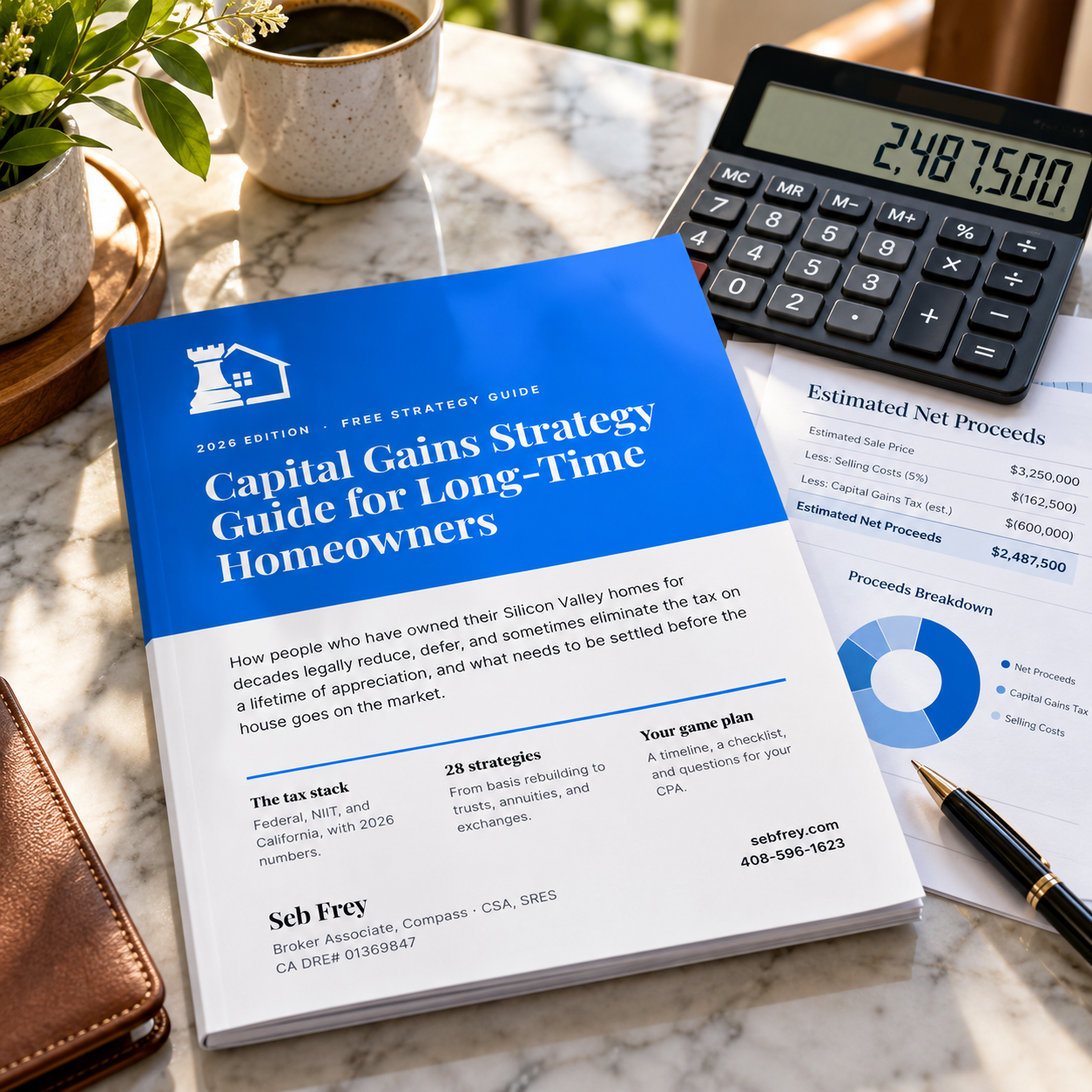
Free 2026 Strategy Guide
28 legal ways long-time owners cut their capital gains tax. Know your options before you list.
After decades in Silicon Valley, your gain can blow past the $250,000 and $500,000 exclusions. The guide walks through each strategy, a real bracket-by-bracket example, and what to settle before you list.
You're all set. Thanks! Your Capital Gains Strategy Guide is on its way to your inbox. If you don't see it in a few minutes, check your promotions or spam folder.
When the Math Turns
At some point, many families find that care at home costs more than a good assisted living or memory care community, and that the parent would also benefit from the social life there. That’s often when selling the house makes sense, and the proceeds fund the next stage. If that’s where you are, see paying for assisted living while the house sells and my guide to aging in place vs. moving in Silicon Valley.
Local Help in Santa Clara and Santa Cruz Counties
Before you hire anyone, call your local Area Agency on Aging. In Santa Clara County that’s Sourcewise, and in Santa Cruz County it’s the Seniors Council of Santa Cruz and San Benito Counties. Both can point you to caregiver resources, benefits counseling, and Medicare help at no cost. If your parent is 55 or older and needs a nursing-home level of care but wants to stay home, look at On Lok PACE, which serves parts of Santa Clara County and coordinates medical care, day center services, and in-home help in one program. PACE is often free for people on Medi-Cal, and others can pay privately.
Your First 30 Days
When care needs show up suddenly, usually after a fall or a hospital stay, families tend to scramble. Here’s the order I’d suggest working through things.
- Find the trust, will, durable power of attorney, and health care directive, and confirm who has authority to act.
- Pull any long-term care insurance policy and call the carrier to open a claim, since most policies have an elimination period before benefits start.
- Get a care assessment from your parent’s doctor or a geriatric care manager so you know how many hours of help are actually needed.
- Add up monthly income, savings, and home equity so you know how long the money lasts at that level of care.
- Check eligibility for VA benefits, IHSS, and PACE before spending down savings.
- Talk with an elder law attorney and a CPA before selling the house, gifting money, or applying for Medi-Cal.
- Hold an honest family meeting about who does what, including whether a sibling will be paid for caregiving.
Frequently Asked Questions
How much does in-home care cost in the Bay Area?
Agency in-home care commonly runs about $35 to $45 an hour. Six hours a day every day is about $7,300 a month at $40 an hour, a live-in caregiver often starts around $12,000 a month, and 24-hour shift care runs about $29,000 a month or more.
Does Medicare pay for in-home caregivers?
Medicare generally covers only part-time skilled home health care, not ongoing custodial help with bathing, dressing, meals, and supervision.
How can I use my house to pay for in-home care?
Common options include a home equity line of credit, a reverse mortgage, or renting part of the property or an ADU.
What is IHSS in California?
In-Home Supportive Services is a Medi-Cal program that pays for certain in-home help for eligible recipients, sometimes including family members as caregivers. Income and asset limits apply.
Is it cheaper to hire a caregiver directly?
Often per hour, but the family usually becomes a household employer responsible for payroll taxes, labor rules, and workers’ compensation insurance.
Can I get paid to take care of my parent in California?
Often, yes. If your parent qualifies for Medi-Cal, IHSS can pay a family member as the caregiver. Families can also pay a relative privately under a written personal care agreement at a fair rate, and working adult children may qualify for up to eight weeks of California Paid Family Leave.
Does long-term care insurance cover in-home care?
Many policies do, but benefits usually start only after an elimination period and once a doctor certifies that your parent needs help with daily activities or has cognitive impairment. Read the policy for the daily benefit, the home care provisions, and any inflation protection, and call the carrier early.
Will Medi-Cal take my parent’s house?
The home your parent lives in is generally exempt from the 2026 asset limit. California limits estate recovery after death to assets that pass through probate, so how the house is titled matters. Talk with an elder law attorney before transferring or selling it.
Free Family Strategy Session
Paying for Mom or Dad's care with the house? Find out how many months of care it will fund.
In a 30-minute call, we'll estimate your parent's net proceeds after selling costs and taxes, map that against the care costs you're looking at, and sort out timing: sell before the move, after it, or bridge the gap. You'll leave with real numbers and a clear order of operations. No listing agreement, no pressure.
Book My Family Strategy Session →Senior Friendly Homes in Silicon Valley South
2
3
4
5
6
7
8
9
10
11
12
13
14
15
16
17
18
19
20
21
22
23
24
25