
Free Buyer Strategy Call
Before you tour a single home,let's build your game plan.
In Santa Cruz County, the buyers who win usually aren't the ones with the biggest offer. They're the ones who knew exactly how they'd compete before the right house ever came up. In 30 minutes we'll talk through your timing, how your down payment and equity comp fit together, and which towns and neighborhoods, from the mountains to the beach, really match the way you live, then put together a plan to win the home you want without overpaying for it.
Book My Buyer Strategy Call →
Want the full market report for Banana Belt?
We want to ensure that you have all the information needed to make the best decisions when it comes to your home goals. When you enter your info below you will get instant access to the area's latest market report, complete with sales and demographic trends.

Silicon Valley Home Search
Stop scrolling stale listings.See what's really for sale today.
A lot of the homes on the big portals went pending last week, and you don't find out until you've already fallen for one. My home search pulls straight from the MLS across Santa Clara and Santa Cruz counties, so every home you see is actually available. Filter by price, neighborhood and home type, save the searches you care about, and be the buyer who already knows the inventory when the right house comes up.
Search Homes For Sale Now →
Local News & Advice
Read helpful resources and articles related to the area.
Introducing Coastside Cohousing in Santa Cruz
takeawaysCoastside Cohousing is not a commune or a traditional retirement community. Residents own their own private homes, but…
West Cliff Drive in Santa Cruz: A Local's Walking Guide
've lived and worked in the Bay Area most of my life, and West Cliff Drive is still…
Cowell Beach in Santa Cruz
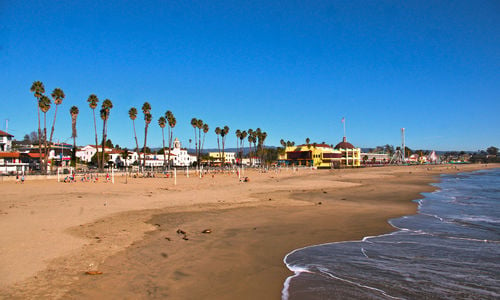
Cowell Beach is the crescent of sand on the west side of the Santa Cruz Wharf, tucked below…
At Home in the Banana Belt
The Banana Belt is the local name for the area east of downtown Santa Cruz, bounded roughly by Soquel Avenue, Highway 1, Morrissey Boulevard and Park Way. It is an informal name rather than an official city designation, and it has stuck for a very practical reason: this pocket sits far enough inland to escape the marine fog layer, and it runs noticeably warmer than the neighborhoods nearer the ocean.
That microclimate is the genuine, checkable distinction here, and it is not a small thing. Summer afternoons that are grey and cold on West Cliff Drive are often sunny in the Banana Belt, and for people who came to Santa Cruz expecting California weather, that difference shapes daily life more than almost any feature of a house.
The housing is largely Craftsman era bungalows and homes from the 1920s through the 1940s on modest lots, with later infill mixed in. Streets are mostly flat, lots are compact, and a good share of the original houses are single story. That combination of level ground and single level living is what makes this one of the more practical parts of Santa Cruz to grow old in.
The neighborhood sits at the boundary of several school districts, which is genuinely unusual and worth understanding. Santa Cruz City Schools serves much of it, with De Laveaga Elementary and Branciforte or Mission Hill Middle among the schools in the area, while the Live Oak and Soquel districts serve ground just to the east. Assignment depends on the parcel, and it affects value, so I verify it on every listing rather than repeating a neighborhood reputation.
De Laveaga Park is close, with its golf course, disc golf course and trails, and it is one of the larger pieces of accessible open space in the city. Downtown Santa Cruz and Pacific Avenue are a few minutes west, and the Soquel Avenue corridor covers everyday shopping.
For services, Dominican Hospital on Soquel Drive is close by, the Downtown Senior Center operates from the London Nelson Community Center on Center Street, the Santa Cruz Public Libraries serve the county on a single card, and the Volunteer Center of Santa Cruz County runs falls prevention, home repair and transportation programs for older residents.
Highway 1 runs along the edge of the neighborhood, which is convenient and, for the streets closest to it, audible. Highway 17 over the mountains to San Jose is reached from there, thirty five to forty five minutes when the road is clear. Santa Cruz METRO runs frequent service along Soquel Avenue.
On price, the typical Santa Cruz home is running around $1.35 million as of late summer 2026, up roughly six percent year over year. Banana Belt bungalows generally sit at or below that figure, which combined with the sunshine and the flat streets makes this one of the better value propositions in the city. My Santa Cruz home prices page tracks the trend and the full Santa Cruz area guide covers the rest of the city.
Older bungalows reward thoughtful preparation before a sale far more than newer houses do, and the difference between a house that has been readied properly and one that has not can be very large in a market moving at this pace. That work, along with capital gains and Proposition 19 planning, is what I handle for older adults and their families. Book a call with me for an honest assessment, or read about my selling process.

