Key takeaways
Summary: Correct pricing protects your strongest window of buyer demand. Overpricing reduces exposure, creates a stale-listing signal, and typically leads to bigger concessions and a lower net sale price.
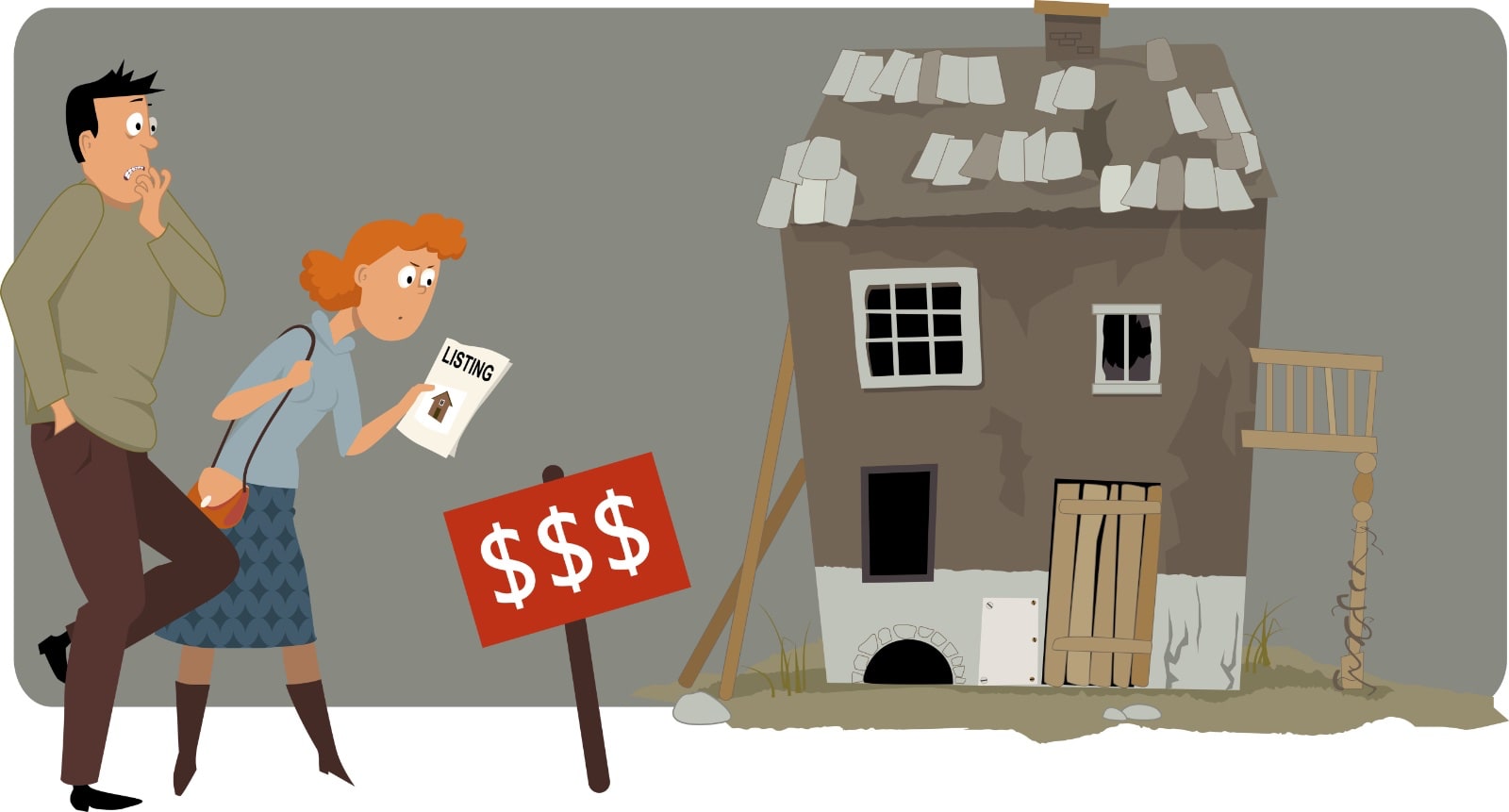
When it comes to selling your home, setting the right price is a critical step. This decision can significantly impact the speed of the sale, buyer interest, and ultimately, the final sale price. However, many sellers fall into the trap of overpricing their homes, hoping to maximize their returns. This article aims to shed light on the potential pitfalls of overpricing and why it (almost) invariably leads to a lower sale price.
Understanding The Concept of Overpricing
Overpricing refers to the practice of listing a property for sale at a price significantly higher than its actual market value. This is often driven by emotional factors, such as the seller’s attachment to the home, or financial needs, such as the desire to make a larger profit, pay off large debts, or cover the cost of a new property. However, overpricing can backfire, leading to several problems that can impact the sale process negatively.
The Psychology Behind Overpricing
Emotional Pricing
One of the main reasons sellers tend to overprice their homes is due to emotional attachment. They may have fond memories associated with the property, have invested a lot in home improvements, or simply believe that their home is unique and should command a premium price. A lot of research has gone into this, and there’s a name for this “emotional pricing” phenomenon: the endowment effect. It’s rooted in the fear of loss, and it is a powerful mechanism that the mind uses to keep us in a “safe” space. It is this fear of loss, usually more than anything else, that makes sellers in Silicon Valley overprice their homes.
I’d also like to point out some research from Wharton School at the University of Pennsylvania which highlights the psychological factors influencing homeowners to overprice their homes. This behavior is driven by the desire to avoid selling a house for less than they paid for it, even if its current market value is lower. Homeowners tend to list their homes at higher-than-market prices, motivated by loss aversion, which is estimated to be 2.5 times more impactful than the prospect of gains
However, buyers and the real estate market, in general, don’t share these emotional connections and base their decisions on what the property is worth to them. While they may love your house, they probably love it less than you do. The price that they offer will be much more in line with their own perception of the home’s value, and it will in almost all cases be less than yours.
Financial Needs
Another common reason for overpricing is the seller’s financial needs. They may need a specific amount from the sale to afford their next home or cover other expenses. Unfortunately, buyers won’t pay more than market value just because the seller needs extra money. The market determines the selling price, not the seller’s financial requirements.
Simply put, you should not set a list price based on how much you need to get out of the property when you sell. You cannot price based on what you paid for it, or how much money you put into it, or how much you still owe on the property. This is another classic mistake that homeowners make, and it often means that they are unable to sell their home – and won’t, until they are forced to by financial circumstances. Sadly, when they do end up selling, it is often at a lower price (often significantly lower) than they would have been able to sell for, had they priced the home competitively from the get-go.
Misinterpretation of Market Value
Some sellers may misinterpret their home’s market value, leading to overpricing. They might base their asking price on unreliable sources, like an inflated Zillow Zestimate, or compare their property to dissimilar, higher-priced homes in the market. A realistic understanding of the local real estate market and a comprehensive comparative market analysis (CMA) can help avoid this pitfall.
Many homeowners won’t trust their REALTOR’s CMA, because they may suspect that the Realtor is biased in favor of underpricing the home. Of course, that may be true, and that’s not a bad thing – but it may not answer the question that you are really wanting to know which is, objectively, what is market value for your home?
If you really want an objective opinion, you may want to consider having your home professionally appraised. An appraisal is not a fact – it’s just an opinion, like a CMA. However, it is an expert opinion, and it’s also being given by someone who has no financial interest in the sale of your Silicon Valley home, so you may find it to be a more reliable estimate.
Sell As-Is. Sell Easy. Sell Smart!
The Impact of Overpricing Your Home
Overpricing your home will in almost all cases have several negative consequences, ranging from longer time on the market to lower final sale price. Here’s a detailed look at these impacts.
Longer Time on the Market
Overpriced homes tend to stay on the market longer than correctly priced properties. Buyers and real estate agents can easily identify overpriced listings based on their higher days on market, and often avoid them. The longer a property sits on the market, the more it is perceived as undesirable, leading to fewer offers. This is a fact. When your home is on the market a long time, the only buyers who will come and see it are those who just can’t find any other homes they’d rather see.
Lower Final Sale Price
Contrary to what many sellers believe, overpricing doesn’t lead to a higher final sale price. Instead, it usually results in a lower sale price. As time passes, sellers may have to make significant price reductions to attract buyers, which can lead to selling at a price lower than the original market value. We have done the research, and it is a statistical fact that homes which need even one price reduction before they sell, sell for 8-10% less per square foot than homes which require no price reduction.
Limited Buyer Pool
Overpricing limits the pool of potential buyers. Most buyers have a budget range, and overpriced properties may fall outside their limit, leading to fewer viewings and offers. Even if a seller is open to negotiations, the high list price can deter buyers from even considering the property.
Think of it this way: pricing is the result of supply versus demand dynamics. The higher the price, the fewer buyers will be looking for homes like yours in that price range. Therefore, setting a higher price reduces demand for your home, and as everyone knows, the law of supply and demand dictates that when supply is high and demand is low, lower prices are the result.
Weak Negotiating Position
When your home is overpriced, one of the surest ways to recognize that is because it sits on the market, unsold, while other homes “similar” to yours are selling. It will be clear to anyone (except perhaps you) that the home is overpriced. Buyers will know that the field is clear, there is no competition from buyers for your home at the price you are asking, and that they will have the upper hand.
After all, they can buy any home – and not just in your neighborhood, but anywhere in the same market area. They have many options: you, the seller, have really only two options: sell the house, or don’t sell the house.
That is not a power dynamic that favors you as a seller. When buyers feel that there is no heat of competition, they will offer what they want, and be very tough when it comes to negotiating the terms as well.
Because you will be in the weaker negotiating position, it is almost inevitable that your home will sell for a lower price than if you had buyers competing against each other to purchase your home.
Common Sense Shows Overpricing Doesn’t Help You Sell for More
If you ask me, I’ll tell you that its a plain and clear fact that overpricing a home does not help anyone sell a home for more. If that were possible, why wouldn’t everyone just simply ask a gazillion dollars for their home? If overpricing were any benefit, everyone would just ask more money for their homes, and they would get more for them, right? Wrong! But should there be any doubt, to help illustrate that point, I’m going to turn your attention to the home in the picture below.
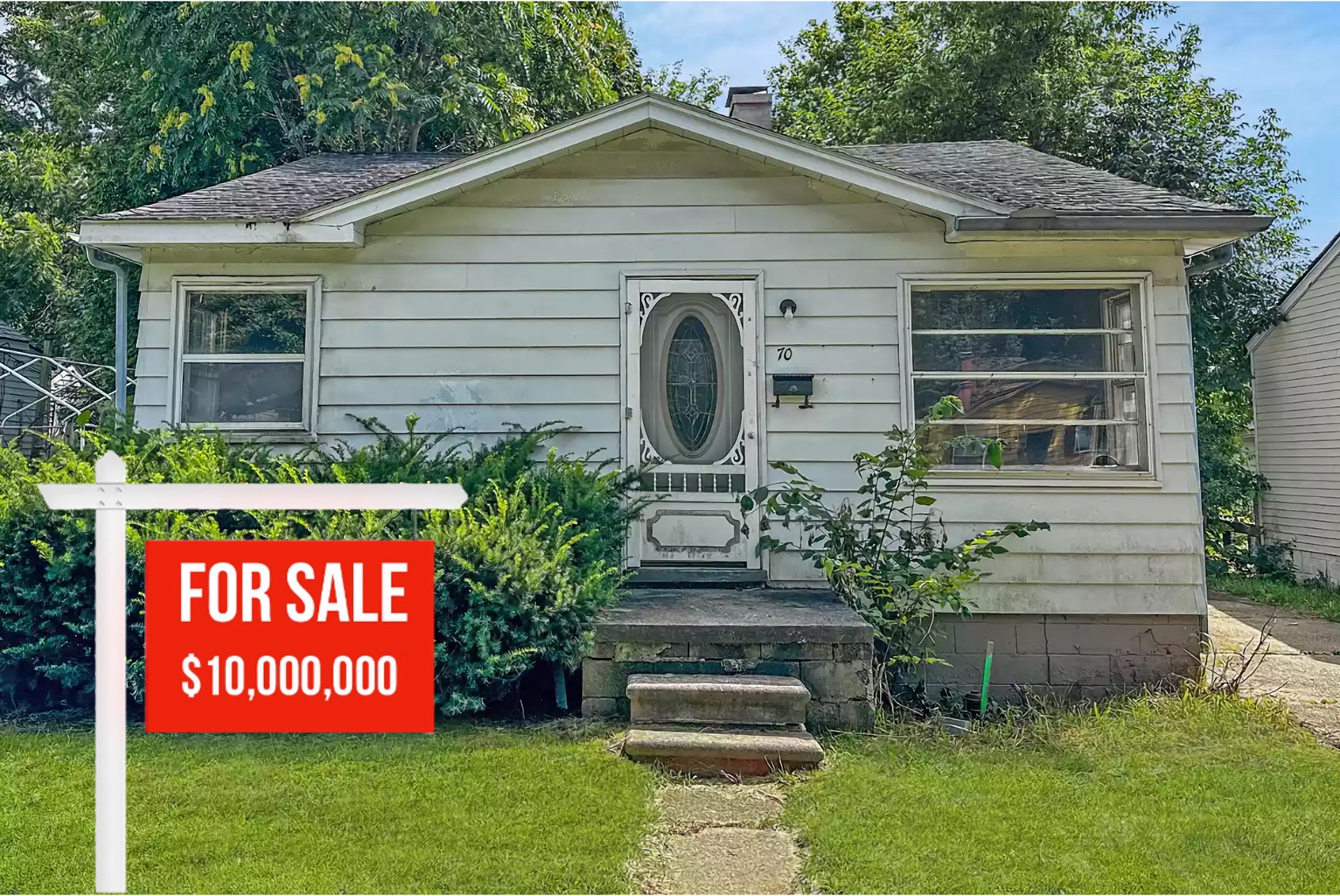
This is a real house, it’s in Pontiac, Michigan – a suburb of Detroit. It was built in the 1940s, it’s about 750 square feet, two bedrooms, and one bathroom, on a ~6,000 square foot lot. I don’t know all that much about the Detroit real estate market, but I know that prices in the Bay Area are way, way higher for every kind of real estate imaginable. So what if, in an effort to sell the home for more money, the sellers chose to list it for sale at, say, $10,000,000?
Do you think there’s any chance that asking so much more than it’s worth would help it sell for more money – even a dollar more?
No, of course not – because clearly, the value is not there, and it’s nowhere close. But you don’t even have to grossly overprice your home by that much to understand the concept: buyers need to see the value that’s evidently being sought in the asking price – and increasing the list price will not make buyers see more value you in your home. In Silicon Valley and the Bay Area in general, buyers feel that sellers typically expect to get at least asking price, if not more – so they are especially discouraged from even making a “lowball” offer on a property they feel is even somewhat overpriced.
In practice, overpricing will lead buyers to put off making an offer, because they feel the seller is being unreasonable and is not truly interested in selling the home. This will lead to longer days on market, and, statistically, a much lower sale price than if it had been priced correctly, where the market would recognize the value at list price.
Conclusion
While the temptation to overprice your home can be strong, it’s essential to resist this urge. Overpricing can lead to a longer time on the market, fewer offers, lower final sale price, and potential issues with appraisals. Instead, focus on understanding the local market, conducting a thorough CMA, and working with a skilled real estate agent to price your home correctly from the start. This approach will increase your chances of a quick, successful sale and maximize your return on investment.
Frequently Asked Questions
Why does overpricing in Silicon Valley usually backfire?
Isn’t it smart to price high so I have room to negotiate?
How do I know if my home is overpriced?
What’s the real harm in “testing the market” for a couple weeks?
Do price reductions fix an overpriced listing?
Why do some homes still sell over list price?
How should I price if my home needs work?
Will overpricing hurt me more in a normalizing market than in a hot market?
What’s the best way to choose the right list price in my neighborhood?
What if I need a certain number to make my next move work?
Time to talk to a REALTOR?

San Jose Luxury Homes For Sale
2
3
4
5
6
7
8
9
10
11
12
13
14
15
16
17
18
19
20
21
22
23
24
25