
Key takeaways
Summary: The More Homes on the Market Act matters because it addresses one of the biggest hidden obstacles facing older Bay Area homeowners: the tax hit that can come with selling a long-held home. For homeowners who are ready to simplify life, reduce maintenance, or unlock equity for retirement, this proposed change could meaningfully improve the math.
Want your own number? Try my capital gains calculator to see roughly what you’d owe and how much you’d walk away with.
If you’ve owned your home in the Bay Area for a few decades, there’s a good chance you’re sitting on an incredible amount of equity. On paper, it may even feel a little surreal. A house that, even back then, seemed expensive when you bought it might now be worth ten times what you paid. But when homeowners start thinking about selling after 30 or 40 years, that excitement often gives way to a different feeling entirely.
I see this conversation happen all the time with clients who are in their 60s, 70s, and older. They love the neighborhood and they’ve built a life in their home, but the house itself no longer fits the way they live today. The kids are long gone, most of the people you used to know have moved on, and the yard feels like a chore instead of a joy. Keeping up with cost and maintenance on a large home simply isn’t as appealing as it used to be.
Then the conversation turns to taxes, and everything suddenly gets complicated.
Unfortunately, the federal capital gains exclusion (more on that below) for selling a primary residence has been stuck at the same level since 1997. In a “typical” housing market (that is, lower cost-of-living areas) that might not matter much, but in Silicon Valley and the greater Bay Area it has become a surprisingly big issue. The optimal size of the excluded gain simply simply hasn’t kept up with the reality of home price here.
That’s where a proposed piece of legislation called the More Homes on the Market Act comes in. If it eventually becomes law, it could change the financial equation for many long-time homeowners who have been reluctant to sell because of the potential tax consequences. Before we talk about what the bill proposes, it helps to understand why the current system has become such a problem for homeowners who bought their homes decades ago.
The Shrinking (Relative) Benefit of the Tax Exclusion
Under current federal tax law, homeowners can exclude a portion of their gain when they sell their primary residence. For a single homeowner, the exclusion is $250,000. For married couples filing jointly, it’s $500,000. If that doesn’t seem like a lot of money, that’s because those numbers were set almost thirty years ago. When Congress created this rule in 1997, the intent was to simplify the tax treatment of home sales.
In most parts of the country, those limits easily covered the gain on a typical median-priced home. At that time, the median home price in California was under $200,000, and even in Silicon Valley most homes were a small fraction of the cost they are today. The problem is that the size of the capital gains tax exclusion was never indexed to inflation. The cost of housing steadily climbed, and then accelerated dramatically during the tech boom…and again during the pandemic housing surge.
Yet the $250K/$500K exclusion stayed frozen in time. For many homeowners across the country that hasn’t been a major issue, but in the Bay Area it’s a completely different story. Here, long-time homeowners often have gains that dwarf the exclusion limit. That small size of that exclusion means that the tax due on the capital gains is in many cases prohibitive to selling.
Capital Gains Taxes Can Take an Oversize Bite
Let me give you an example that will probably sound familiar if you’ve lived here for a while. Imagine a couple who bought their home in Santa Clara County in the late 1980s for $300,000. At the time it felt expensive, but they stretched a bit and made it work. Over the years they raised their kids there, remodeled the house over time, and eventually paid off the mortgage.
Fast forward to today and the house might be worth $2.5 million, or much more in many the more expensive parts of Silicon Valley. When long-time homeowners start thinking about selling, they naturally assume that most of the equity will be theirs to use for the next phase of life. They have long memories, and in many cases, they’ll remember the old pre-1997 tax rules where it was easier to escape the gain.
Then they talk to their accountant and discover that the tax situation is more complicated. The gain on that home might be around $2.2 million. Under current law they can exclude $500,000, which leaves roughly $1.7 million potentially subject to federal capital gains tax. California then taxes the gain as regular income at the state level, which adds another layer of tax on top of that.
When homeowners see the numbers written out, the potential tax bill can feel shocking. Even people who have built substantial equity often don’t have hundreds of thousands of dollars sitting around in cash to comfortably cover that tax liability. That realization alone is enough to make many homeowners decide to stay where they are.
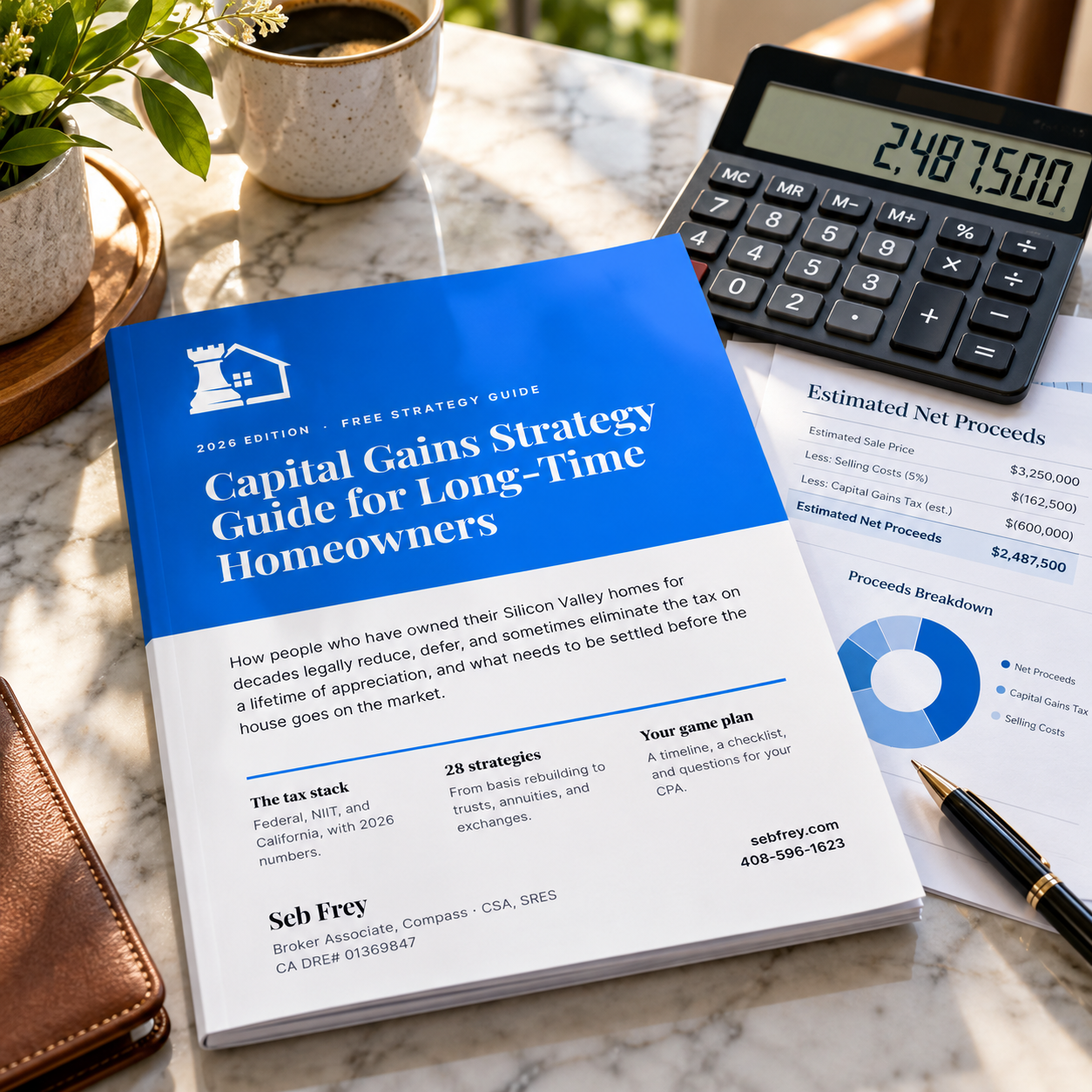
Free 2026 Strategy Guide
28 legal ways long-time owners cut their capital gains tax. Know your options before you list.
After decades in Silicon Valley, your gain can blow past the $250,000 and $500,000 exclusions. The guide walks through each strategy, a real bracket-by-bracket example, and what to settle before you list.
You're all set. Thanks! Your Capital Gains Strategy Guide is on its way to your inbox. If you don't see it in a few minutes, check your promotions or spam folder.
The Housing “Lock-In Effect”
Economists call this the lock-in effect, and it’s quietly shaping housing markets across the country. When the tax consequences of selling become too large, homeowners simply stay put. Even if they would prefer a smaller home, a different location, or a simpler lifestyle, the financial cost of moving feels too high.
In the Bay Area, this effect has become particularly noticeable because so many homeowners bought their properties decades ago before the dramatic appreciation we’ve seen here. The result is that many homes that would normally come onto the market never do. That reduces housing supply and makes it harder for younger buyers to find homes. In other words, a tax rule that was originally intended to simplify things has unintentionally contributed to the housing shortage.
A Study on the Lock In Effect
A widely cited economic study by Hui Shan found strong evidence that tax policy has a direct impact on whether homeowners decide to sell their homes. Analyzing decades of sales data before and after the Taxpayer Relief Act of 1997 (which created the current $250,000 (single) and $500,000 (married) capital gains exclusion on primary residences), the researcher found a clear “lock-in effect.” When homeowners face large capital gains tax bills, they tend to stay put rather than sell.
After the 1997 reform raised the exclusion, home sales increased significantly among owners whose gains fell under the new limits, suggesting many people had been delaying a move because of the tax consequences. This research is particularly relevant to today’s debate over the More Homes on the Market Act, which proposes doubling the capital gains exclusion for homeowners who have lived in their property for many years.
In high-appreciation markets like the Bay Area, it’s common for longtime homeowners to face gains well above the current $500,000 cap. As a result, many older homeowners who might otherwise downsize stay in place because selling would trigger a massive tax bill. The study’s findings strongly suggest that raising the exclusion could unlock a significant number of homes that are currently “trapped” by the tax code, increasing housing inventory and making it easier for families to move into homes that better fit their needs.
What the More Homes on the Market Act Proposes
The More Homes on the Market Act is designed to address exactly this issue. The core proposal is straightforward. The bill would double the capital gains exclusion for the sale of a primary residence. If passed, the new limits would become $500,000 for single filers and $1 million for married couples filing jointly. That change alone would bring the exclusion much closer to where it might have been if it had been adjusted for inflation over the past thirty years.
But the bill also includes something equally important. It proposes indexing the exclusion to inflation going forward so that the limit gradually increases over time instead of remaining fixed for decades. That kind of adjustment would prevent the same problem from happening again in the future.
Why the More Homes on the Market Act Matters Especially in Silicon Valley
While the bill applies nationwide, it has particularly strong implications for homeowners in California, especially those here in Silicon Valley. The reason is simple: our home values are dramatically higher than most parts of the country. It’s extremely common for homeowners here to have gains well over $1 million, and in many cases the gains can be much larger than that.
In other parts of the United States, the current exclusion still covers most of the gain on a typical home sale. In the Bay Area, however, it often barely scratches the surface. That’s why lawmakers from California have been some of the most vocal supporters of updating the exclusion.

Simple Strategy Guide
The Downsizing Guide for Bay Area Seniors
What to keep, what to let go, and how to get your home ready for today's buyers without a costly remodel, so you protect your equity and move on your own timeline.
You're all set. Thanks! The Downsizing Guide is on its way to your inbox. If you don't see it in a few minutes, check your promotions or spam folder.
How the Calculations Can Change
Let’s go back to our earlier example. If the couple selling their $2.5 million home currently faces a taxable gain of roughly $1.7 million after the exclusion, doubling the exclusion to $1 million would reduce their taxable gain to about $1.2 million. That doesn’t eliminate the tax entirely, but it significantly changes the math. In many cases it could reduce the federal tax burden by hundreds of thousands of dollars. Put another way: if the seller is in a 33% tax bracket (combined state and federal), a $1.7 million gain would result in a tax bill of $561,000.
If the exclusion were raised to $1 million, the taxable gain would drop down to $1.2 million, for a tax bill of $396,000 – a savings of $165,000. For some homeowners, that difference could be enough to make downsizing or relocating financially realistic. As the study by Hui Shan cited above shows us, healthy tax incentives will bring more inventory onto the market, while providing tax relief to America’s middle class. Given how common it is to have gains well in excess of a $1 million limit in high cost-of-living areas like the Bay Area, it’s no surprise that many people feel like the More Homes On The Market act don’t go far enough.
Dave Ramsey’s Proposal to Unlock Housing Inventory
Dave Ramsey is a nationally known personal finance expert, radio host, and author whose advice on debt, investing, and financial planning reaches millions of Americans. In a discussion about the housing shortage, Ramsey argued that outdated federal tax rules are quietly contributing to the lack of homes for sale. In February 2026, Ramsey suggested raising that limit dramatically – possibly up to $2 million, well in excess of the proposed $1 million limit in the More Homes On The Market Act – so longtime homeowners can sell without facing a large tax bill.
His argument is that many people, particularly those who bought decades ago in expensive markets (like the Bay Area), are staying put because selling would trigger a significant tax hit. Increasing the exemption, he believes, would encourage more homeowners to sell and could help release additional housing inventory onto the market.
Marjorie Taylor Greene’s Proposal to Eliminate the Home-Sale Capital Gains Tax
Representative Marjorie Taylor Greene (now out of congress, of Jewish Space Lasers fame) has proposed a far more aggressive approach to the capital gains issue. Her legislation, called the No Tax on Home Sales Act would eliminate the federal capital gains tax entirely for the sale of a primary residence. The idea behind her proposal is that if homeowners could sell their primary residence without any federal capital gains tax at all, more people (especially long-time owners and seniors sitting on large amounts of equity) might finally decide to move. Supporters say this would unlock housing inventory and help ease supply shortages in tight markets, while critics argue the benefits would mostly go to higher-income homeowners with large gains on expensive homes.
Downsizing Doesn’t Always Mean Leaving the Bay Area
One thing I often remind homeowners is that downsizing doesn’t necessarily mean leaving the region entirely. Some homeowners choose to remain in the same community but move into a smaller home or a property with less maintenance. Others move into a single-level home that better fits their long-term needs. There are also many homeowners who choose to relocate to areas with a lower cost of living so their housing equity can support a more comfortable retirement. Every situation is different, but the common thread is that selling the family home creates options.
Where the Legislation Stands Right Now
As of early 2026, the More Homes on the Market Act has been introduced in Congress but has not yet been passed into law. The proposal has bipartisan sponsorship and support from major housing organizations, including the National Association of REALTORS®. That kind of support is encouraging, but tax legislation often moves slowly through Congress. There’s also the possibility that provisions like this could eventually be included in a broader tax reform package rather than passing as a standalone bill. For homeowners, the key takeaway is that this proposal is worth watching because it could eventually change the financial landscape of selling a long-held home.
What Homeowners Should Be Thinking About Today
Even though the law hasn’t changed yet, it’s still valuable for homeowners to understand their current tax position and how different scenarios might affect them. Many people assume the tax consequences of selling are worse than they actually are, while others underestimate them entirely. The truth usually falls somewhere in the middle. There are also existing strategies that can sometimes reduce the taxable gain on a home sale. Improvements to the home can increase the cost basis, and certain selling expenses may also reduce the gain. Every homeowner’s situation is unique, so it’s important to look at the numbers carefully before making any decisions.
The Bigger Picture for Long-Time Bay Area Homeowners
For many people who bought their homes decades ago, the house represents much more than just a financial investment. It’s the place where family memories were made and where entire chapters of life unfolded. That emotional connection is real, and it’s one reason many homeowners stay in their homes long after their needs have changed.
But sometimes the next stage of life calls for something different. A smaller home, a simpler lifestyle, or a move closer to family can all be positive transitions when the timing is right. If the More Homes on the Market Act – or something like it – eventually becomes law, it could make that transition easier for many homeowners who currently feel financially locked into their homes.
Jimmy Panetta’s March 2026 Update on the More Homes on the Market Act
I’ve seen Jimmy Panetta around at various events over the years, most recently March of 2026 when he came to speak at the Evergreen Rotary Club in San Jose. I’ve heard his pitch a few times, and I’ve seen him mention this Act before. But I had heard that the REALTOR® lobby in Washington DC felt this act would be at least coming up for a vote in mid-2026.
With this in mind, I availed myself of the opportunity to ask him how likely it would be they would get it passed this year. Panetta declined to answer that directly, and wouldn’t even give it even 50/50 odds when prompted (he gave no odds at all). He did say serious people are working on it, and that the Congressional Budget Office had estimated its cost at $44 billion over 10 years. He stressed that this $44 billion would have to be paid for somehow, and that would be part of whatever legislation. He also indicated they may need to qualify the entitlement, for example, setting a minimum age and/or length of ownership to qualify for the increased exclusion.
Final Thoughts
The housing market in the Bay Area has changed dramatically over the past few decades, but the tax rules governing home sales have not kept pace. For homeowners who purchased their homes long ago, the outdated capital gains exclusion has become an unexpected barrier to selling. The More Homes on the Market Act represents an attempt to modernize that rule and bring it closer to the realities of today’s housing market.
Whether or not the bill ultimately passes, it highlights an issue that many long-time homeowners are already facing. Understanding how taxes affect the sale of your home is an essential part of planning the next phase of your life. For some homeowners, the numbers may confirm that staying put is the right decision. For others, they may reveal that moving to a home that better fits your lifestyle is more achievable than you thought.
The most important step is simply understanding the options and running the numbers before making a decision.
Free Cash-Out Strategy Call
You've spent decades building equity. Let's make sure you take as much of it with you as possible.
Selling a long-held California home and moving somewhere new comes down to a few big questions. We'll look at what your home should sell for, what you'll actually net after taxes and costs, and how to time the sale with your next purchase so you're never stuck in between. You'll leave with real numbers and a plan, whether or not you hire me.
Book My Cash-Out Strategy Call →
Senior Friendly Homes in Silicon Valley South
2
3
4
5
6
7
8
9
10
11
12
13
14
15
16
17
18
19
20
21
22
23
24
25