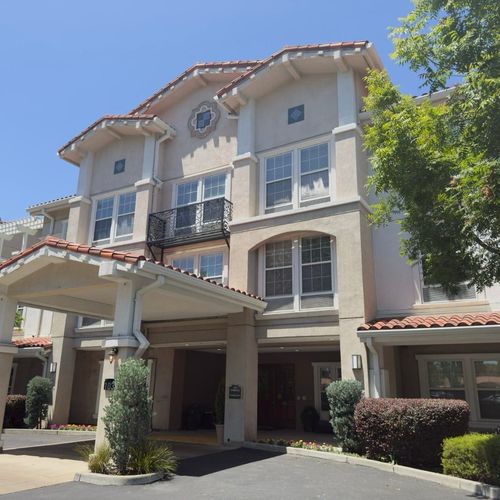
If you’re the adult child who’s been fielding worried calls about Mom forgetting her pills, or you’re the one who’s noticed the stairs at home have gotten harder than you’d like to admit, you’ve probably started typing “assisted living near Los Gatos” into a search bar late at night. I’d like to talk about one of the communities that comes up, Ivy Park at Los Gatos, and give you the view from both sides of the table: what the community offers day to day, and what the move means for the house you’d be leaving behind.
In the tour video above I walk through the building, so you can get a feel for the common areas and apartments before you ever pick up the phone. What follows is the context I’d want a friend to have going in, including the questions I’d ask on a visit and the real estate decisions that usually travel alongside a move like this.
Where it is and why the address matters
Ivy Park sits at 400 Blossom Hill Road, right next to Vasona Lake County Park, which puts it in a residential stretch of town rather than off a freeway ramp or in a strip of office parks. That matters more than people expect, because the families who visit most are usually the ones for whom visiting is easy. When lunch with Dad can turn into a walk along the lake or a short drive to a café in town, visits tend to feel like normal life instead of an obligation squeezed into a Sunday.
The Los Gatos Creek Trail runs through Vasona, and the park’s picnic areas and lakeside paths are the kind of places where grandkids don’t need to be convinced to come along. For a resident who still likes to get outside, being next door to that much green space is a real quality of life advantage over a community surrounded by parking lots. For a family member coming from San Jose, Campbell or Saratoga, Blossom Hill is a familiar, easy route.
Help For A Sudden Move to Assisted Living

Two levels of care in one building
Ivy Park is licensed in California as a Residential Care Facility for the Elderly (RCFE), and it offers assisted living plus a dedicated memory care neighborhood the community calls Evergreen at Ivy. Assisted living here means help with the activities of daily living, such as bathing, dressing, medication management and getting around safely, while residents keep as much independence as they can. Memory care adds a team trained to support people living with Alzheimer’s disease and other forms of dementia, in a setting designed around those needs.
The reason I point this out is that care needs almost never stand still. Someone who moves in needing a little help with medications may, a few years later, need a more structured environment, and when both levels live under the same roof the change can happen without packing up and starting over somewhere new. Familiar caregivers, the same dining room and the same neighborhood go a long way toward easing a transition that’s already hard. On your tour, ask specifically how a move from assisted living to Evergreen is decided, who’s involved in that conversation, and whether the monthly cost changes.
If memory loss is part of your family’s story, the Alzheimer’s Association has solid, free guidance on what good dementia care looks like and what to ask any memory care community, and it’s worth reading before you tour anywhere.
Apartments and everyday life
One of the first things families ask me is whether a place will feel like a home or a hospital wing, and that’s a fair worry. Ivy Park offers studio, one-bedroom and two-bedroom floor plans, which gives residents room to bring the recliner, the family photos and the dresser that’s followed them through three houses. Accessibility is built into the design so walkers and wheelchairs work without the rooms feeling clinical, and when so much of a person’s day is spent in their own space, that personal feel makes a big difference.
The services side is where assisted living earns its keep, because it takes the chores and logistics off the table so the day can be about something else. Details change over time, so treat this as a snapshot and confirm what’s included in the monthly rate. Here’s what the community lists as part of daily life:
- Three chef-prepared meals a day, served in the community’s restaurant, Vine at Ivy
- Housekeeping and laundry service
- Scheduled transportation for appointments and errands
- An emergency call system in each apartment
- A full-time activity director coordinating exercise, games like bingo and poker, happy hours and regular outings
- Outdoor courtyards and decks, plus easy access to the park next door
Transportation deserves a bit more attention than it usually gets. When the community handles rides to the doctor or the pharmacy, those trips stop falling entirely on the adult child with a job and kids of their own, and the resident keeps a sense of getting out into the world instead of waiting for someone to be free. Dining works the same way; three meals a day at a shared table is nutrition, but it’s also the backbone of a social routine.
Ivy Park builds personalized care plans for each resident and updates them as needs change. The best way to judge how well that works is to ask how often plans are reviewed, how families are kept in the loop, and what happens when a family raises a concern.
Free Guide: Selling a Home You’ve Owned for Decades

What it costs, and where the money usually comes from
Assisted living in Los Gatos runs well above the national average, which won’t surprise anyone who’s priced a house here. Published estimates I’ve seen for Ivy Park range from the mid-$5,000s to roughly $7,000 a month as a starting point, as of September 2026, and the real number depends on the apartment size and the level of care. Treat those figures as a rough starting line rather than a quote, and get current pricing in writing directly from the community.
Ivy Park works on a monthly rental model, so there’s no large entrance fee like you’d see at a continuing care retirement community. That changes the math on the house in a helpful way. Instead of needing a big lump sum on day one, most families are really asking how long the proceeds from selling the family home can cover the monthly cost, and a paid-off Los Gatos or Campbell house can stretch a long way when it’s the funding source.
There’s a handful of real estate issues I walk through with nearly every family in this spot. None of them are complicated on their own, but they interact, and getting the order right can save real money and a lot of stress. These are the big ones:
Capital gains. If your parent has owned and lived in the home as a primary residence for at least two of the last five years, the IRS Section 121 exclusion lets them exclude up to $250,000 of gain if single, or $500,000 for a married couple filing jointly. With homes that were bought decades ago, gains often exceed that, so a conversation with a CPA before listing is time well spent. Timing matters too, because the two-of-five-year clock starts running once your parent moves out.
Move first or sell first. With a rental community, moving first is often the gentler path, since your parent can settle in while the house is prepared and sold without them living through showings. The tradeoff is carrying the monthly rent and the house expenses at the same time for a few months, and there are bridge options that can help if cash is tight. Compass Concierge can also front the cost of prep work like paint, flooring and landscaping, repaid at closing, so the house can sell for more without anyone writing a big check up front.
Prop 19 probably isn’t your tool here. California’s Prop 19 lets homeowners 55 and older carry their property tax base to a replacement home they buy anywhere in the state. Moving into a rental assisted living apartment isn’t buying a replacement home, so that benefit doesn’t apply to this move, though it can matter if a spouse is buying a smaller place nearby.
The house full of memories. Selling as-is is a perfectly reasonable choice when a parent’s health is changing fast, and sorting forty years of belongings is often the hardest part of the whole process emotionally. I usually suggest deciding what goes to the new apartment first (floor plans help), then family keepsakes, then everything else. If you’d like to see how I approach this with families, my page for seniors and their families lays out the process.
How I’d tour Ivy Park (or anywhere else)
Brochures and websites all look good, so the visit is where you learn the most. Try to go around a mealtime, when the building is at its busiest and most natural. Then pay attention to the things a floor plan can’t show you:
- How staff speak to residents, and whether they use names and make eye contact
- Whether the dining room feels social and relaxed or rushed
- Staff training, turnover, and what medical support is on site or on call
- A look at more than one apartment size so you know the real range
- Exactly how a move from assisted living into Evergreen memory care is handled
Before you sign anything, look up the community’s license and inspection history on the California Department of Social Services facility search. Ivy Park’s RCFE license number is 435202953, and the public record shows inspection visits and any citations, which gives you a factual picture to go along with your impressions from the tour.
You can reach the community through Ivy Park at Los Gatos’ official website to set up a visit. Give yourself time on the tour, sit in a common area for a few minutes, and let your parent weigh in on how it feels, because this decision works best when it’s one they’re part of rather than one that’s made for them.
Frequently Asked Questions
What levels of care does Ivy Park at Los Gatos offer?
Ivy Park offers assisted living and memory care in the same community, with memory care in a neighborhood called Evergreen at Ivy. Assisted living covers help with daily activities like bathing, dressing and medications, while memory care is designed for people living with Alzheimer’s or other dementia. It isn’t a skilled nursing facility, so ask the community which medical needs it can and can’t support.
Is there an entrance fee at Ivy Park?
Ivy Park works on a monthly rental model rather than the large entrance fee used by continuing care retirement communities. Monthly cost depends on apartment size and care level. Confirm current pricing, deposits and any community fees directly with Ivy Park, since those can change.
Can we use the sale of the family home to pay for assisted living?
Yes, and it’s one of the most common ways families fund this kind of move. Because Ivy Park is a monthly rental, the question becomes how many years the sale proceeds can cover rather than whether you can make a big upfront payment. Check with a CPA on the Section 121 capital gains exclusion, and think through whether moving first or selling first fits your family’s cash flow.
What happens if my parent needs memory care after moving into assisted living?
Because both levels of care are in one community, a resident can often transition to Evergreen at Ivy without moving to a new place. The decision usually involves an assessment and a conversation with the family. Ask on your tour how that process works and how the monthly cost changes.
How can I check Ivy Park’s license and inspection history?
Assisted living and memory care communities in California are licensed as RCFEs by the Department of Social Services. You can search Ivy Park’s license, 435202953, on the CDSS Community Care Licensing facility search to see inspection visits and any citations. It’s a good habit to do this for every community you’re considering.
If your family is weighing a move to Ivy Park and wondering how the house fits into the plan, I’m happy to talk it through with no pressure and no obligation. Call or text me at 408-596-1623, or book a time to chat with me whenever it suits you, and we’ll figure out a timeline that works for everyone.
This article is for general education only; please confirm pricing, availability and care details directly with the community, and note that I’m not an attorney or CPA.
Time to talk to a REALTOR?

Senior Friendly Homes in Silicon Valley South
2
3
4
5
6
7
8
9
10
11
12
13
14
15
16
17
18
19
20
21
22
23
24
25