If you’re starting to look at assisted living or memory care on the west side of Silicon Valley, Sunrise of Cupertino is almost certainly going to come up in your search. Sunrise of Cupertino is one of the newer senior living buildings in the area, it’s run by one of the best-known names in the industry, and it sits in a part of the valley where a lot of families already live, work and shop. The brochure will show you the dining room and the courtyard. What I want to give you here is the stuff families actually ask me about: where it really is, what it costs, what’s included, how the care works, and how people usually pay for it when most of the family’s money is tied up in the house.
Key Takeaways
Summary: Sunrise of Cupertino is an assisted living and memory care community operated by Sunrise Senior Living at 581 E. Fremont Ave. in Sunnyvale, near the Cupertino border. Opened in 2023, the three-story building serves more than 110 residents and offers 24-hour care, chef-prepared meals, a hydroponic micro-farm, a salon, a fitness center and scheduled transportation. Published starting rents in late 2026 run from roughly $8,900 to $14,900 a month depending on suite type and care level, plus care fees. This guide from Silicon Valley senior real estate specialist Seb Frey covers location, care, pricing, what’s included, and how families typically pay for it.
Sunrise of Cupertino at a Glance
Before we get into the details, here’s the quick version you can screenshot and send to your siblings.
- Address: 581 E. Fremont Ave., Sunnyvale, CA 94087
- Operator: Sunrise Senior Living, founded in 1981
- Care offered: Assisted living and memory care
- State license: Residential Care Facility for the Elderly, RCFE #435202903
- Opened: October 2023
- Building: Three stories, 81,017 square feet, designed for more than 110 residents
- Phone: 408-962-2982 (residents and families) and 408-430-0173 (pricing and availability)
- Pets: Pet friendly, with details handled community by community
Is Sunrise of Cupertino Actually in Cupertino?
This is the first thing that trips people up, so let’s clear it up. The community carries the Cupertino name, but its official address is 581 E. Fremont Avenue in Sunnyvale, in the 94087 ZIP code. That stretch of south Sunnyvale sits right up against Cupertino, and plenty of locals think of the whole area as one neighborhood, so the name makes sense once you’ve driven it. If you plug “Cupertino” into your GPS you’ll end up in the wrong spot, though, so use the Fremont Avenue address.
The location is a big part of the appeal. You’re close to El Camino Real and Highway 280, a few minutes from downtown Sunnyvale and historic Murphy Avenue, and an easy drive to Cupertino, Los Altos and Mountain View. For medical care, Sunrise points to El Camino Health’s Mountain View hospital, Valley Health Center Sunnyvale and Kaiser Permanente’s Santa Clara Medical Center as the nearby options. For a family where one adult child works at a tech campus off 280 and another lives in Saratoga, that’s a pretty friendly spot for visits.
Sunrise also runs a second community nearby, Sunrise of Sunnyvale on South Knickerbocker Drive, just a few miles away. If one building has a waitlist for the suite type you want, it’s worth asking about the other.
The Building and the Feel of the Place
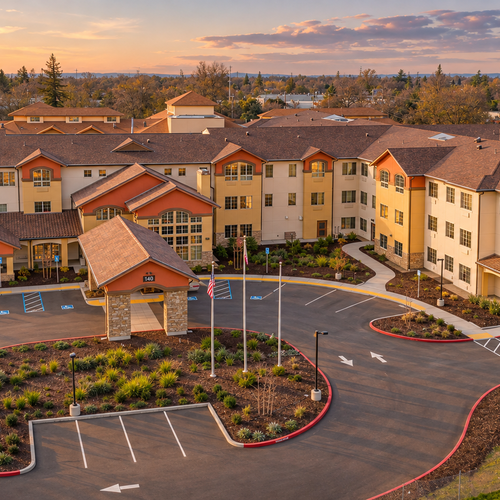
Sunrise of Cupertino opened its doors in October 2023, when its founding residents moved in. According to the grand opening announcement, the building is about 81,000 square feet across three floors, with a contemporary craftsman exterior in stone and wood, which you can see in the photo above. Inside, the design leans mid-century modern, with geometric tile around the parlor fireplace and a palette of blues, greens, coral and gold. It doesn’t feel like a hospital, and that matters more than people expect when Mom or Dad walks in for the first time.
There’s also an outdoor art installation called “Sunflower Sky” by artist Michael Kalish, and the landscaping out front is full of roses, purple flowers and young trees. Newer buildings like this one tend to have wider hallways, better lighting and more accessible bathrooms than the older communities in the valley, which is a real quality-of-life difference for someone using a walker or wheelchair.
Levels of Care: Assisted Living and Memory Care
Sunrise of Cupertino offers two levels of care under one roof. It doesn’t offer independent living or skilled nursing, so if you’re comparing it against a continuing care retirement community, keep that in mind. If you’re still sorting out which level of care fits, my guide to independent living vs. assisted living vs. memory care in Silicon Valley walks through the differences.
Assisted Living
Assisted living is for someone who’s still fairly independent but needs a hand with daily things like bathing, dressing, medications or getting to meals. Before move-in, Sunrise does a needs assessment (in person or virtually) and builds a personalized care plan, and caregivers are on site 24 hours a day. Suites come as studios, one-bedrooms and two-bedrooms, and each one has a kitchenette, closet space, a bathroom designed for safety and an emergency alert system. The one- and two-bedroom suites add a separate living area, which is a nice option for a couple or for someone who wants room for a favorite recliner and a few pieces of family furniture.
Memory Care
Memory care at Sunrise runs through its Reminiscence program, which is designed for people living with Alzheimer’s disease and other forms of dementia. Memory care suites include a work area, closet space, a safety-designed bathroom and emergency alerts, and there’s a companion suite option for residents who share. The Reminiscence program has its own activity calendar, separate from assisted living, built around structure and familiar routines.
If a parent is showing early signs of memory loss, it’s smart to tour memory care even if they’re moving into assisted living. Asking now how a resident transitions between the two, and what that does to the monthly cost, saves you a stressful scramble later. The Alzheimer’s Association’s guide to residential care has a good list of questions, and I’ve written about moving a parent with dementia or cognitive decline from the family and housing side.

Moving to assisted living?
Need move-in money in a hurry?
Move-in fees and first months' rent can top $20,000 within days. Compass Concierge can now cover them, repaid when the house sells.
See How It Works →Need help today? Call or text 408.413.3087
Dining and the Micro-Farm
Food is where a lot of communities win or lose a family, and Sunrise puts real effort here. Meals are chef-prepared and can be eaten in the dining room or in the suite, and the team uses tableside tablets to match menu choices to each resident’s dietary needs. Diabetic, pureed, fortified and low-sodium diets are all on the list, and there’s a bistro with snacks like popcorn, cookies and fresh fruit for between-meal grazing.
The detail that gets the most attention on tours is the Babylon hydroponic micro-farm. Residents can help plant, tend and harvest herbs and greens, and the kitchen uses what they grow. For someone who spent forty years gardening in a Cupertino backyard, that kind of thing matters. There’s also a community garden outside for people who’d rather have their hands in actual dirt.
Amenities and Daily Life
Here’s what Sunrise lists for day-to-day life at this community. It’s a solid lineup for a building this size.
- 24-hour personalized care and emergency response systems in every suite
- A beauty salon, fitness center and massage room
- A parlor, entertainment room, activity room and bistro
- Outdoor spaces and a courtyard
- Scheduled transportation for appointments and outings
- Fitness classes, art and music, book and walking clubs, movie and game nights, social hours, live entertainment, concerts and local excursions
- A family engagement app and Sunrise CareConnect for coordinating health care
The family app is worth asking about on your tour. When siblings are spread between San Jose, Portland and Austin, being able to see updates in one place cuts down on a lot of group-text stress.
What Does Sunrise of Cupertino Cost?
Let’s talk money, because this is where most families start. As of November 2026, Sunrise publishes these starting monthly rates for this community on its website:
- Assisted living studio: from about $8,900 a month
- Assisted living one-bedroom: from about $10,300 a month
- Assisted living two-bedroom: from about $12,200 a month
- Memory care companion suite: from about $10,900 a month
- Memory care studio: from about $11,900 a month
- Memory care one-bedroom: from about $14,900 a month
Those are starting rates, and they’re not the whole bill. Sunrise says the rent includes things like meals, daily programs, housekeeping and trash removal, while personal care services in assisted living are priced separately after the care assessment. Memory care rates include the Reminiscence program fee and medications. Ask for a written estimate that shows the base rent, the care level, any one-time community fee and how increases have run over the last couple of years, so nobody’s surprised in year two.
For context, the Genworth and CareScout Cost of Care Survey put the national median for assisted living at $70,800 a year in 2024, or roughly $5,900 a month, up 10% from the year before. Silicon Valley runs well above that, and new construction with this level of finish sits toward the top of the local range. Prices change, so treat my numbers as a starting point and confirm current rates directly with the community.
How Families Usually Pay for It
Here’s the part nobody on the tour is going to walk you through. Medicare doesn’t pay for long-term custodial care like assisted living rent, so most families pay privately using some mix of savings, pensions, long-term care insurance and, for veterans or surviving spouses, the VA’s Aid and Attendance benefit. In this part of the valley, though, the biggest asset by far is usually the house. A longtime owner in south Sunnyvale or Cupertino might have bought for a fraction of today’s value, and that equity can fund years of care.
Selling the home is often the cleanest way to pay, but timing is everything. Most families can’t comfortably carry $10,000 or more a month in rent on top of the house for very long, so the sale and the move-in need to be planned together. I wrote a whole piece on paying for assisted living while the house sells, and if a reverse mortgage is already on the property, read what happens to a reverse mortgage when a parent moves to assisted living before anyone signs a lease.
Taxes matter too. The IRS home sale exclusion shields up to $250,000 of gain for a single owner and $500,000 for a married couple, but a house bought decades ago in Cupertino can blow right past that. If you’re 55 or older and thinking about buying something smaller instead, California’s Prop 19 lets you carry your property tax base to a replacement home. Talk with your CPA before you list, and if you’d like a feel for what the house might bring, my Cupertino home prices and Sunnyvale home prices pages are updated regularly.

Free Guide for Families
Selling Mom or Dad's Home to Pay for Care?
Bay Area assisted living runs $7,800 to $8,300 a month, and the house is usually the only asset big enough to cover it. This guide walks you through timing the sale, who has legal authority to sign, the capital gains rules for seniors in care, and how a sale affects Medi-Cal and VA benefits, so the decision gets made from strength instead of in a crisis.
Read the Family Guide →Who Sunrise of Cupertino Is a Good Fit For
In my experience, a community like this tends to work best for a few kinds of families. The first is the longtime west valley homeowner who wants to stay close to their doctors, their church or temple, and their grandkids’ soccer games, and isn’t interested in moving to the Central Valley or out of state to save money. The second is the couple where one spouse needs more help than the other, since the one- and two-bedroom suites give them room to stay together. The third is the family that sees memory care on the horizon and wants a building where a parent can move from assisted living to the Reminiscence neighborhood without changing addresses.
It’s probably not the right fit for someone who’s fully independent and just wants a smaller place with a social calendar, since there’s no independent living here. In that case, a 55+ community or an independent living building may be a better match, and my guide to senior housing options in the Bay Area lays out the choices. If you’d like to see how Sunrise stacks up against other communities I like, check out my favorite assisted living communities in Silicon Valley and my write-up on Ivy Park at San Tomas in West San Jose.
Tips for Touring Sunrise of Cupertino
A tour is a sales presentation, and that’s fine, but you’ll learn a lot more if you go in with a plan. Here’s what I tell families.
- Visit at mealtime. Lunch tells you more about a place than any brochure. Watch how staff talk to residents and how long people wait for help.
- Bring the person who’s moving, if you can. Their gut reaction matters, and they’ll notice things you won’t.
- Ask about staffing. How many caregivers are on each shift, how long has the care team been there, and who’s in charge overnight?
- Get the care pricing in writing. Ask how care levels are assessed, how often they’re re-assessed and what typically triggers an increase.
- Look up the license. Every assisted living community in California is licensed by the Department of Social Services, and you can review any facility’s record on the CDSS Care Facility Search using RCFE #435202903.
- Come back a second time. An unscheduled weekend visit feels different from a guided weekday tour.
For a more detailed list, my article on how to vet an assisted living facility in the Bay Area goes deeper, and if you’d like a professional to narrow the list for you, a senior placement specialist can help at no cost to most families.

Free 2-minute family assessment
Worried about Mom and Dad? See If It's Time to Have The Talk.
Answer a dozen quick questions about what you've noticed, the house itself, and who in the family is involved. You'll get an honest read on how urgent things really are and a plan for starting the conversation without a family fight.
Take the Quiz →Rather talk now? Call or text 408.413.3087
Planning the Move Out of the Family Home
Choosing the community is only half the job. The other half is the house: deciding what comes along, what goes to family, what gets sold or donated, and when to put the home on the market. A studio or one-bedroom suite at Sunrise is a fraction of the size of a four-bedroom ranch in Rancho Rinconada or Ortega Park, so the downsizing conversation needs to start early.
I’d start with my checklist for moving a parent into assisted living, then look at getting rid of a lifetime of stuff before selling and what to do with the things nobody wants. That’s the work I do every week with families through what I call the Best Move Method, which starts with figuring out what Mom or Dad actually needs and only then decides whether, when and how to sell. My goal is always the same: I’ll help you make your next move the best one yet.
Frequently Asked Questions
Where is Sunrise of Cupertino located?
Sunrise of Cupertino is at 581 E. Fremont Ave., Sunnyvale, CA 94087. Even though it carries the Cupertino name, the official address is in south Sunnyvale near the Cupertino border, close to El Camino Real, Highway 280 and downtown Sunnyvale’s Murphy Avenue.
What levels of care does Sunrise of Cupertino offer?
The community offers assisted living and memory care. Memory care follows Sunrise’s Reminiscence program for people living with Alzheimer’s and other dementias. It doesn’t offer independent living or skilled nursing.
How much does Sunrise of Cupertino cost?
As of November 2026, Sunrise lists assisted living from about $8,900 a month for a studio, $10,300 for a one-bedroom and $12,200 for a two-bedroom. Memory care starts around $10,900 for a companion suite, $11,900 for a studio and $14,900 for a one-bedroom. Assisted living care services are priced separately after an assessment, so confirm current rates and fees with the community.
What’s included in the monthly rent?
Sunrise says the rent includes chef-prepared meals, daily programs, housekeeping and trash removal. Memory care rates also include the Reminiscence program fee and medications. Personal care in assisted living is billed based on the resident’s care plan.
When did Sunrise of Cupertino open?
Sunrise of Cupertino celebrated its grand opening in October 2023, when its first residents moved in. The three-story building is about 81,000 square feet and is designed for more than 110 residents.
Is Sunrise of Cupertino licensed?
Yes. It’s licensed by the California Department of Social Services as a Residential Care Facility for the Elderly, license number 435202903. You can look it up on the CDSS Care Facility Search website.
Does Medicare pay for Sunrise of Cupertino?
No. Medicare doesn’t cover the cost of living in assisted living or memory care. Most families pay privately using savings, long-term care insurance, VA benefits or proceeds from selling the family home.
Are pets allowed at Sunrise of Cupertino?
Sunrise describes the community as pet friendly. Ask about size limits, fees and what happens to the pet if a resident’s care needs change.
Can we sell Mom’s house to pay for Sunrise of Cupertino?
Yes, and that’s how many Silicon Valley families pay for it. The key is coordinating the sale with the move-in so the family isn’t carrying the house and the rent for months. A senior real estate specialist can help you time it, prepare the home and plan for capital gains taxes.
Free Family Strategy Session
Paying for Mom or Dad's care with the house? Find out how many months of care it will fund.
In a 30-minute call, we'll estimate your parent's net proceeds after selling costs and taxes, map that against the care costs you're looking at, and sort out timing: sell before the move, after it, or bridge the gap. You'll leave with real numbers and a clear order of operations. No listing agreement, no pressure.
Book My Family Strategy Session →Senior Friendly Homes in Silicon Valley South
2
3
4
5
6
7
8
9
10
11
12
13
14
15
16
17
18
19
20
21
22
23
24
25