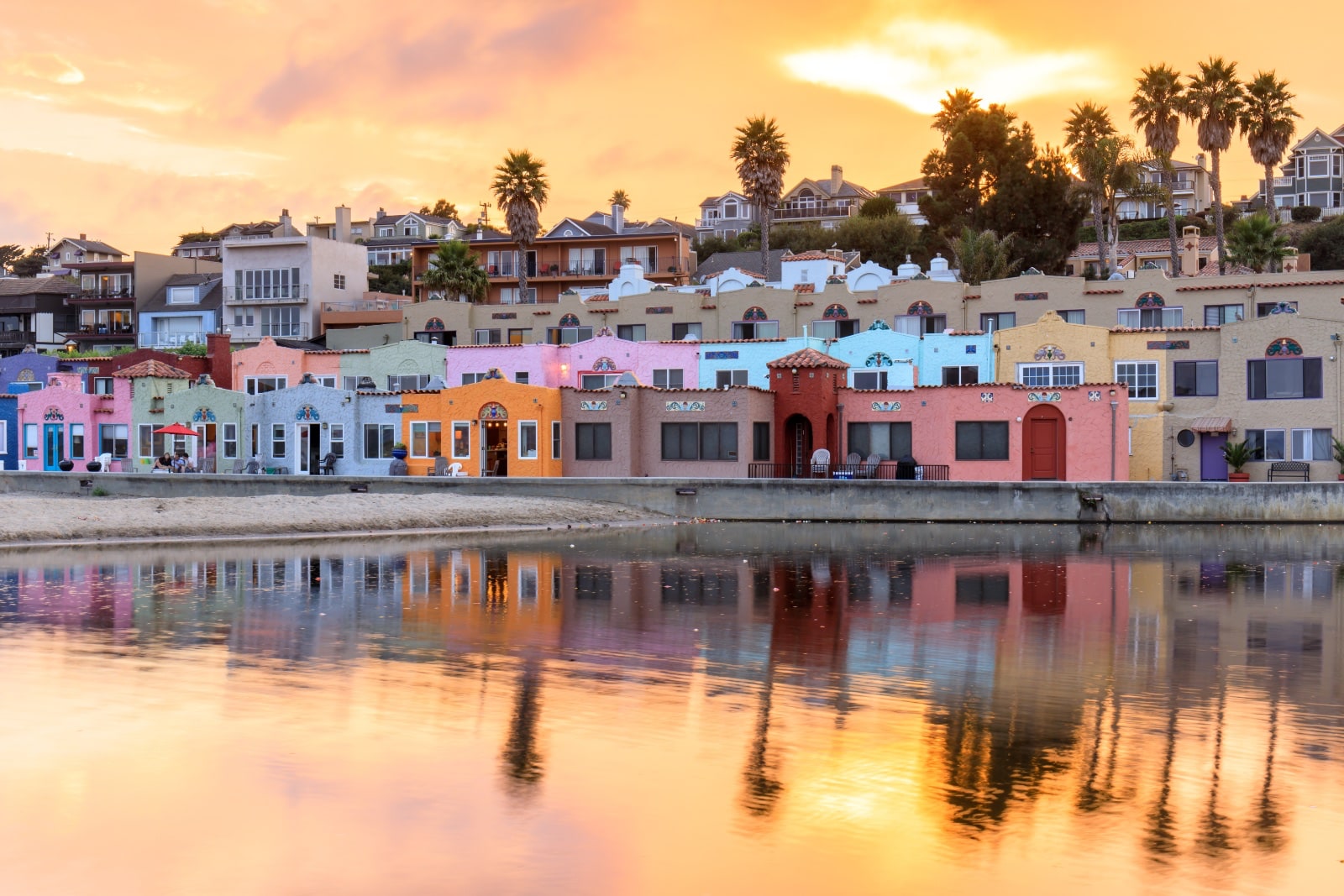
I’ve shown property in just about every corner of Santa Cruz County over the past two decades, and Capitola stops people differently than anywhere else. There’s a moment that happens, usually on a first visit, when someone rounds the corner onto the Esplanade and sees the Capitola Venetian buildings stacked against the beach with the bay opening up beyond them, and they just go quiet. I’ve watched it happen more times than I can count. It’s a genuinely beautiful place, and the beauty isn’t incidental — it’s load-bearing. It’s what makes people decide to stay.
Here’s the real story on what living in Capitola actually looks like.
Population
About 9,800 people live in Capitola. That number has been remarkably stable over the years, which tells you something: this isn’t a place people leave. The town sits at the mouth of Soquel Creek where it meets the Monterey Bay, and essentially every square foot of buildable land has been spoken for for decades. The result is a city with a fixed character rather than a place that’s still figuring out what it wants to be.
Free Listing Alerts
Be First to See New Homes Before Everyone Else
Good homes rarely sit for long, and the best ones are often in contract before the weekend. Tell me where to send them and I'll email you new listings as soon as they hit the MLS.
You're all set. Thanks! New listings will start landing in your inbox. If you don't see the first one, check your promotions or spam folder.
The population skews toward people who made a deliberate choice to live here — not people who defaulted to it. That self-selection produces a particular kind of community: engaged, locally proud, and genuinely invested in the place.
Geographic Size
Capitola covers 1.7 square miles. It is, by any objective measure, tiny. And that compactness is one of its most important features.
The walkable core — the village, the esplanade, the beach, the creek — is all accessible on foot from most addresses in town. For residents who want to reduce their car dependence, Capitola’s geography makes that genuinely possible rather than aspirational. Soquel Creek defines the northern edge, the Pacific defines the southern one, and within those boundaries you have a complete, functioning community at pedestrian scale.
Landmarks in Capitola
The Capitola Venetian Hotel is the image most people carry when they think of Capitola — the stacked, colorfully painted buildings right above the esplanade, the Venetian-inspired architecture, the views over the bay. It was built in the 1920s and has been the visual anchor of the village ever since. It’s not just photogenic; it’s the physical expression of what Capitola has always been: a place designed to make people feel like they’re somewhere special.
The Capitola Wharf stretches out into the bay and has been doing so in various forms since the 19th century. Today it’s a working fishing pier with shops and restaurants, and an unusually good spot to watch the pelicans work the water. Walk it at low tide on a weekday morning and you’ll understand why people write about this town the way they do.
Capitola Village itself functions as a landmark. The concentration of independent boutiques, galleries, and restaurants along the colorful main street — all with that Venetian architectural motif — is rare enough in California that it draws visitors from across the Bay Area specifically to walk through it. For residents, it’s just downtown. That’s a nice problem to have.
Live by the Beach
The Esplanade is the social center of Capitola’s outdoor life — a beachfront promenade that hosts the farmers market, festivals, art shows, and the kind of casual daily foot traffic that gives a place its pulse. And Soquel Creek, where it meets the beach, offers a quieter counterpoint: a freshwater tidal area that draws birds, kayakers, and anyone who wants five minutes of genuine stillness.
The History of Capitola
The Ohlone people were here first, as they were throughout most of what is now Santa Cruz County. Spanish missionaries arrived in the 18th century and left a lasting imprint on the regional landscape and culture. The town itself, however, is really the creation of Frederick Hihn, a German-born entrepreneur who bought the land in the 1860s with an explicit vision of building a seaside resort destination. He named it Camp Capitola — the name eventually shortened — and developed it deliberately as a leisure destination for visitors coming down from San Francisco.
It worked. By the late 19th century, Capitola was a legitimate resort town, drawing the Bay Area’s well-heeled residents for summer retreats. The Venetian Hotel’s construction in the 1920s cemented the town’s architectural identity. As the 20th century progressed, what had been a seasonal resort evolved into a year-round residential community, with the tourist economy becoming one layer of the town’s character rather than the whole thing.
What’s striking about Capitola’s history is the continuity. The Venetian buildings are still there. The wharf is still there. The village layout Hihn designed is recognizable in the streets today. Most coastal towns this popular have been thoroughly redeveloped over the past century. Capitola hasn’t, which is both remarkable and central to its appeal.
Schools in Capitola
Capitola’s public schools fall under two districts depending on grade level. The Soquel Union Elementary School District covers kindergarten through eighth grade, with a reputation for genuine community involvement and strong teacher retention — which in my experience is the most reliable indicator of a school district’s health.
Life’s a Beach

New Brighton Middle School is well-regarded locally, with an engaged faculty and a curriculum that takes seriously both academic rigor and the social complexity of middle school. Soquel High School, operated by the Pajaro Valley Unified School District, covers the high school years with a college-prep focus, AP course offerings, and strong extracurricular programming.
The school culture here reflects the town itself: less high-pressure than the Silicon Valley side of the mountains, more emphasis on the whole student. For families weighing that tradeoff consciously, Capitola schools tend to land well.
Climate
Monterey Bay is one of the most effective natural air conditioning systems on earth, and Capitola benefits from it directly. Summer temperatures run in the mid-60s to low 70s Fahrenheit. Winter temperatures are mild — 50s during the day, rarely below 40 at night. Rain falls in winter, keeps everything green, and then largely disappears for the summer.
The fog pattern here is gentler than in Santa Cruz proper or the North Bay. Capitola gets the morning marine layer but it typically burns off by mid-morning. Most days, by noon, you have clear sky and usable sunshine. For outdoor-oriented living — and outdoor orientation is essentially the point of being here — the climate delivers consistently.
For older adults evaluating climate as a health factor, Capitola’s mild, stable temperatures and absence of extreme heat or cold is a genuine advantage. Joints tend to behave better at 65 degrees than at either extreme.
Parks and Recreation
Jade Street Park anchors the inland recreational life — a well-maintained neighborhood park with sports fields, playgrounds, and a community center that hosts a steady calendar of programming. It’s a few blocks from the beach scene, which gives it a slightly more local, less touristy feel.
Capitola Beach is the obvious draw, and it earns the attention. The beach itself is protected by the curve of the bay, which keeps the surf gentler than the more exposed beaches to the north and south. That makes it a better option for swimmers, for people who want to wade rather than bodysurf, and for anyone who finds heavy surf physically limiting.
Santa Cruz County Home Search
Stop scrolling stale listings. See what's really for sale today.
A lot of the homes on the big portals went pending last week, and you don't find out until you've already fallen for one. My home search pulls straight from the MLS across Santa Cruz and Santa Clara counties, so every home you see is actually available. Filter by price, neighborhood and home type, save the searches you care about, and be the buyer who already knows the inventory when the right house comes up.
Search Homes For Sale Now →
The Esplanade fronting Capitola Village functions as a public gathering space year-round — flat, accessible, and almost always populated with people walking, watching the water, and generally doing what people at the edge of the Pacific do. For residents who want a daily walk with a destination, the esplanade-to-village loop is hard to beat.
Soquel Creek offers kayaking, paddleboarding, and bird watching in a more protected freshwater-to-tidal-zone environment than the open beach. It’s an underutilized resource that locals know about and visitors rarely find.
Restaurants in Capitola
The dining scene is small, well-curated, and anchored by the village location. The best restaurants here have views that are doing real work.
Shadowbrook is in a category of its own. Built into a hillside above Soquel Creek, accessible by a cable car from the street, the restaurant is a genuine Silicon Valley institution with a following that stretches back decades. The setting is dramatic, the food is serious, and the overall experience is the kind that people remember. For a celebratory dinner or a first impression on someone visiting the area, there is no better option in Capitola and few better options in the county.
Zelda’s on the Beach offers something different: front-row Pacific views, a menu built around fresh seafood and California-inflected dishes, and an atmosphere that earns its beachfront location. There are restaurants with better ocean views than Zelda’s, but not many in Santa Cruz County, and almost none where the food matches the setting this consistently.
Margaritaville brings a more festive, tropical energy to the esplanade — outdoor seating, strong margaritas, a menu with genuine south-of-the-border character. It’s the right option for a casual lunch with a group or a warm evening when you want the beach atmosphere to do most of the work.
Shopping in Capitola
Capitola’s retail landscape divides naturally into two experiences.
Private Access
See the Santa Cruz Homes That Never Hit Zillow
A lot of the best homes in Santa Cruz County change hands quietly, before they're ever listed. Get free access to our off-market homes database and see what's available right now.
You're in. Thanks! Taking you to the off-market homes database now.
Capitola Village is where you go for the experience as much as the purchase. Independent boutiques, local art galleries, specialty shops, and enough variety that a slow browse through the main street feels genuinely rewarding rather than repetitive. The inventory leans toward coastal lifestyle, art, gifts, and clothing — the kind of shopping that’s pleasant whether you buy anything or not.
The Capitola Mall on 41st Avenue handles the practical end of retail — national brands, department stores, the kind of errand-running infrastructure that fills out daily life. It’s not glamorous, but it’s useful, and its proximity to the village means residents have access to both ends of the retail spectrum within a short drive.
Annual Festivals and Events
The Capitola Art and Wine Festival has been running for over 40 years and is the most significant annual event in the town’s calendar. The village streets close to traffic and fill with regional artists, live music, and wine from throughout California. It draws a serious crowd — tens of thousands over the two-day run — but the village setting keeps it from feeling like a generic festival transplanted to a parking lot. The location is the point.
The Capitola Begonia Festival is a more unusual tradition. Tuberous begonias have been grown commercially in the Capitola area for well over a century, and the festival — featuring elaborate floral floats on Soquel Creek — is the kind of hyper-local celebration that could only exist in a community with this particular combination of history, horticulture, and civic pride. It’s genuinely unlike anything else in the region.
Best Walkable Neighborhoods in Capitola
Given the town’s compact size, walkability is high across the board — but the character varies.
Capitola Village is the most walkable address in town. You’re steps from restaurants, the beach, the esplanade, the farmers market, and the whole social infrastructure of the town. It’s also the most expensive real estate in Capitola, and the trade-off — smaller lots, more foot traffic, higher prices — is worth knowing about before you fall in love with the address.
Buying in Santa Cruz County?
Buying a home is tough. You don't have to go it alone.
In a low-inventory, multiple-offer market, strategy and speed matter as much as budget. I'll guide you from your first showing to the keys in your hand.
Get the Help You Need →Rather talk now? Call or text 408.413.3087

The Jewel Box neighborhood sits just above the village and offers something slightly different: quieter streets, older cottage-style homes, and the kind of walkable residential neighborhood where people actually know their neighbors. The proximity to the village remains, but the immediate environment is calmer. For older adults who want village access without living directly on top of the tourist activity, this neighborhood often ends up being the answer.
Capitola for the 60+ Community
This is worth addressing directly, because Capitola comes up frequently in conversations with the older adults and families I work with.
The physical environment here is unusually well-suited to aging in place. The terrain is flat in the village and along the beach. The walkable core reduces car dependence meaningfully. The mild climate eliminates the physical stress that comes with temperature extremes. And the community’s size and character — small enough to feel knowable, stable enough to have genuine social continuity — provides the kind of social fabric that matters enormously to quality of life as we age.
Healthcare infrastructure is solid. Dominican Hospital in Santa Cruz is the primary hospital serving the area, about 15 minutes away. El Camino Health and Stanford Health Care are accessible via Highway 17 for specialized care. The density of excellent primary care physicians in Santa Cruz County is higher than most people expect.
The housing stock in Capitola includes a meaningful number of single-story homes, particularly in the Jewel Box and surrounding neighborhoods, that adapt well for aging in place. And for those looking to right-size — selling a larger inland home and moving to something smaller but better-located — Capitola’s appeal holds value in a way that protects the investment over time.
If you’re evaluating whether Capitola makes sense for your next chapter, or helping a parent think through a coastal move, I’d welcome the conversation.
Living in Capitola
I’ve been in this business long enough to have watched clients move to Capitola, raise families there, and now be thinking about whether to stay as their needs evolve. The consistent thread is that people don’t leave unless they have to. The town’s combination of physical beauty, genuine community, and a walkable lifestyle that works across age groups is durable in a way that most real estate markets aren’t.
It’s not the lowest-cost option in Santa Cruz County — it never has been. What you’re paying for is a place that was deliberately designed to be beautiful and livable, that has maintained its character over more than a century of California development pressure, and that delivers a daily quality of life that justifies the investment.
If you want to talk through what the Capitola market looks like right now, what neighborhoods fit your specific situation, or what a move here might actually involve, call or text me at 408-596-1623, or book a call here.
Gorgeous Capitola Homes for Sale
2
3
4
5
6
7
8
9
10
11
12
13
14
15
16
17
18
19
20
21
22
23
24
25
Free Buyer Strategy Call
Before you tour a single home, let's build your game plan.
In Santa Cruz County, the buyers who win usually aren't the ones with the biggest offer. They're the ones who knew exactly how they'd compete before the right house ever came up. In 30 minutes we'll talk through your timing, how your down payment and equity comp fit together, and which towns and neighborhoods, from the mountains to the beach, really match the way you live, then put together a plan to win the home you want without overpaying for it.
Book My Buyer Strategy Call →