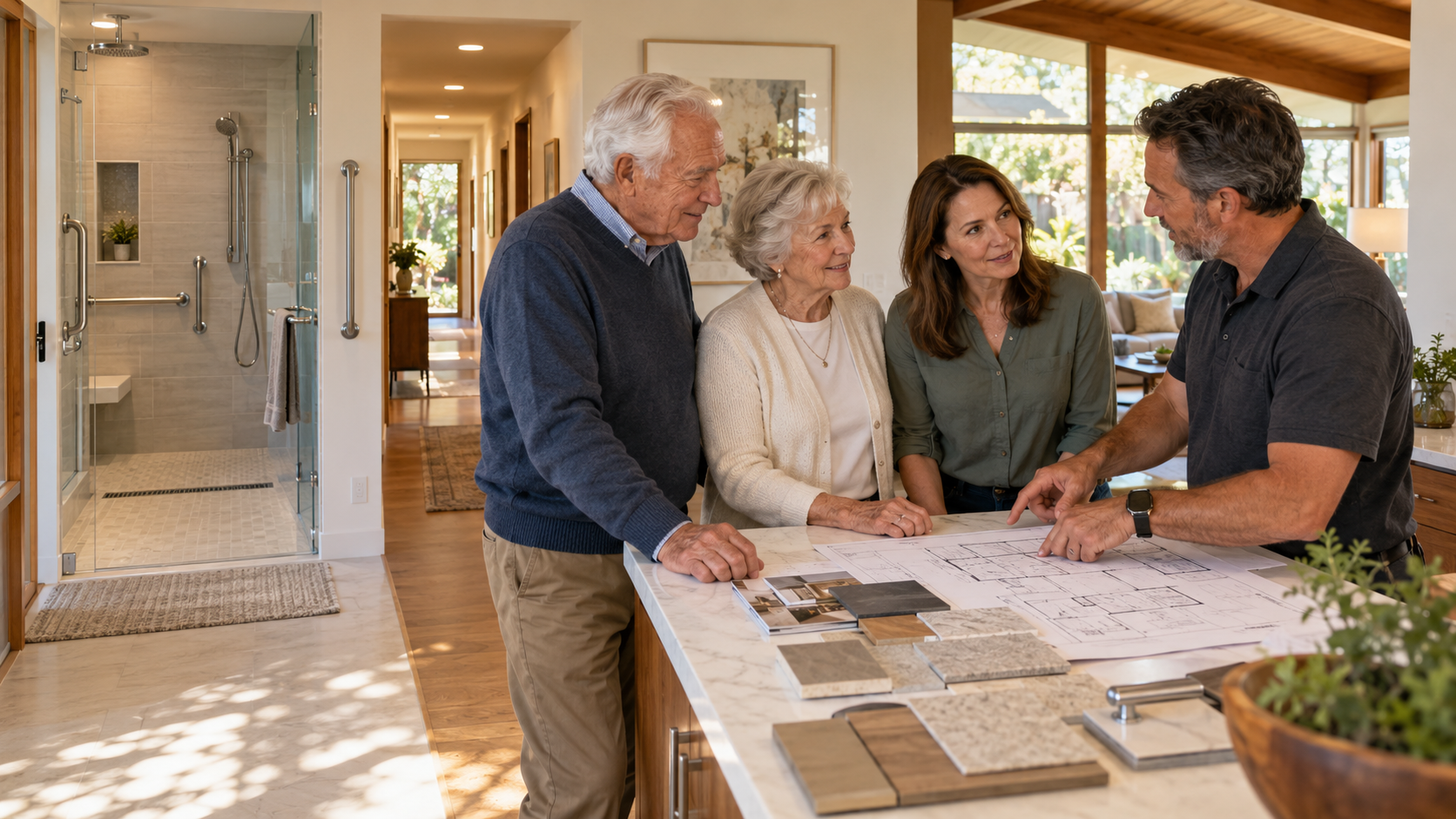
When a homeowner tells me they want to stay put, my first question is whether the house can be made safe for the next ten or fifteen years, and what that’s going to cost. Some homes need a few grab bars and better lighting, while others need a new bathroom, a ramp, and a bedroom on the main floor. As a Certified Aging-in-Place Specialist (CAPS) and Seniors Real Estate Specialist (SRES) with more than 23 years and 460+ closed sales in Silicon Valley, I walk through houses with clients, their adult children, and their contractors to separate what matters from what’s nice to have.
You’re in good company if you want to stay. AARP’s 2024 Home and Community Preferences Survey found that 75% of adults 50 and older want to remain in their current homes, yet the Harvard Joint Center for Housing Studies found that only about 3.5% of U.S. homes have all three basic accessibility features: a no-step entry, single-floor living, and wide halls and doorways. This article gives realistic 2026 cost ranges for the most common modifications in Silicon Valley, shows where to start, and covers who can help pay. It’s part of my guide to aging in place vs. moving in Silicon Valley.
Key Takeaways
Summary: The aging-in-place modifications that matter most target the bathroom, stairs, entry, lighting, and living on one floor. Small fixes cost a few thousand dollars, while curbless showers, elevators, and main-floor suites run from tens of thousands to hundreds of thousands of dollars in Silicon Valley. Get local bids, hire a licensed contractor with accessibility experience, and check VA, Medicare Advantage, Medi-Cal, tax, and property tax options before you pay entirely out of pocket.
From my practice: A house someone has lived in for 62 years can have safety problems nobody notices anymore. On one mountain home I sold, the veranda deck had rotted, which was a real safety issue and the first thing anyone walked onto, and the buyer’s inspection listed about 40 safety items. I paid a contractor to rebuild the deck and later installed smoke and CO detectors, all repaid at closing. If the plan is to stay, fix the path in and out of the house first.
If the numbers point toward selling instead, here’s how I help families as a Silicon Valley senior real estate specialist.
Typical Aging-in-Place Modification Costs in Silicon Valley (2026)
These are general ranges based on projects my clients have taken on and local contractor bids. Bay Area labor and permit costs run well above national averages, and your numbers will depend on the house, the finishes, and the contractor, so treat these as a starting point and get two or three local bids.
| Modification | Typical range | Notes |
|---|---|---|
| Grab bars, installed | A few hundred dollars each | Must be anchored into framing or blocking, never just drywall |
| Stair and entry railings | A few hundred to a few thousand dollars | Railings on both sides of stairs are ideal |
| Lighting improvements | A few thousand dollars | The night path from bed to bath matters most |
| Comfort-height toilet | Under $1,500 in most cases | Often paired with grab bars |
| Lever handles and faucets | Modest | Easier on hands with arthritis |
| Curbless walk-in shower conversion | Roughly $15,000 to $40,000 or more | Slab and plumbing layout drive the cost |
| Doorway widening | A few thousand dollars per door | More if the wall is load-bearing |
| Entry ramp | A few thousand to $15,000 or more | Grading, length, and materials vary |
| Straight stair lift | Several thousand dollars | The simplest way to keep using a second floor |
| Curved stair lift | Often $10,000 to $20,000 or more | Custom-built rail for each staircase |
| Porch or vertical platform lift | Roughly $5,000 to $20,000 or more | An option where a ramp won’t fit |
| Home elevator | Often $40,000 to $80,000 or more | Needs space and structural work; the IRS generally treats elevators as adding home value |
| Main-floor primary suite | Often $150,000 to $400,000 or more | Permits and design time add months |
Selling a longtime home?
More support. Less stress.
Concierge-level help for homeowners 60+ and their families: project planning, vetted providers, hands-on logistics, and home prep with zero upfront cost.
See How It Works →Rather talk now? Call or text 408.413.3087

Where to Start: The Bathroom, Stairs, and Night Path
Falls are the main reason home safety matters so much after 65. According to the CDC, more than 14 million older adults, about 1 in 4, report a fall every year, and the age-adjusted fall death rate for older adults rose 21% between 2018 and 2024. The bathroom is a hot spot. A CDC study of emergency room visits found that 81% of nonfatal bathroom injuries were caused by falls and about two-thirds happened in or around the tub or shower, and injury rates climbed with age, with people 85 and older most often hurt getting on or off the toilet.
If the budget is limited, I suggest starting there: grab bars by the toilet and in the shower, a non-slip shower floor, night lighting from the bedroom to the bathroom, and secure railings on every step, inside and out. Those changes cost relatively little and address the biggest risks. From there, the question becomes whether daily life can happen on one floor, and if it can’t, whether a stair lift, an elevator, or a main-floor suite makes more sense than a move.
Mid-Century Homes Have Specific Issues
Many Silicon Valley homes were built in the 1950s and 1960s, and they often have step-down living rooms, narrow halls, small bathrooms with tub-shower combinations, and a step or two at every exterior door. Eichlers bring their own considerations, including slab floors with radiant heat that complicate plumbing changes. Knowing this up front helps set realistic budgets, and if you’re weighing a move instead, see my guide to single-level homes in Silicon Valley for what to look for.
A real example: Mid-century homes come with a predictable list. On a single-story pool home that was nearly 60 years old, we found a furnace more than 40 years old, an old electrical panel, a past sewer backup, and some termite damage, and the pool had none of the drowning-prevention features California now requires home inspectors to check for. We fixed the health and safety items first and documented everything else with costs attached. If you’re modifying a mid-century house to stay in it, start the same way: safety, then systems, then comfort.
Accurate Home Price Data Is Just a Click Away!

Live MLS Data
What Are Homes Actually Selling For Right Now?
Median price, days on market, and how many homes are selling over asking, pulled straight from current MLS data for your neighborhood.
See the Live Sales Data →Paying for Aging-in-Place Modifications
Savings or home equity
A HELOC, a cash-out refinance, or a reverse mortgage can fund larger projects. Keep in mind that the FHA-insured HECM reverse mortgage only lends against home value up to $1,249,125 in 2026, which is below what most Santa Clara County houses are worth, so read reverse mortgage vs. selling your Silicon Valley home before you decide.
Veterans benefits
The VA’s Specially Adapted Housing grant pays up to $126,526 in fiscal year 2026 for veterans with certain severe service-connected disabilities, and the Special Home Adaptation grant pays up to $25,350. Through VA health care, the HISA benefit adds up to $6,800 over a lifetime for medically necessary changes like grab bars and roll-in showers, or $2,000 for non-service-connected conditions.
Medicare Advantage extras
Original Medicare doesn’t cover grab bars, ramps, or other home modifications, and it only pays for certain durable medical equipment a doctor prescribes for use at home. Some Medicare Advantage plans add bathroom safety devices or a small allowance as a supplemental benefit, so check your plan’s Evidence of Coverage.
Medi-Cal Community Supports
Medi-Cal managed care plans can cover home modifications such as ramps and grab bars for members who qualify, under CalAIM’s environmental accessibility adaptations benefit. If a parent is on Medi-Cal or heading that way, read what happens to your home when a parent goes on Medi-Cal.
Local nonprofit help
Rebuilding Together Silicon Valley provides home repairs and accessibility modifications for low-income older adults in Santa Clara County. Some South Bay cities also run their own home modification or minor repair programs, so it’s worth a call to your city’s housing department.
Medical expense deduction
IRS Publication 502 says improvements like entrance ramps, widened doorways, bathroom grab bars and railings, lowered cabinets, and modified stairways usually don’t increase a home’s value, so the full cost can count as a medical expense. Elevators and other improvements that do add value are deductible only to the extent the cost exceeds the increase in value, you have to itemize, and only medical expenses above 7.5% of adjusted gross income count, so ask your CPA.
Property tax exclusion
Under Revenue and Taxation Code Section 74.3, California excludes construction that makes an owner-occupied home more accessible for a severely and permanently disabled resident from reassessment. The disabled resident doesn’t have to be the owner, but you’ll need to file form BOE-63 with the county assessor along with a physician’s certification. See the property tax exclusion for accessibility improvements for the details.

Choosing a Contractor
Look for a licensed contractor with experience in accessibility work, ideally someone who also holds the CAPS designation from the National Association of Home Builders. In California, any job of $1,000 or more in labor and materials requires a contractor licensed by the CSLB, and you can check a license, its bond, and any complaints on the CSLB website in a couple of minutes. Ask for references from similar projects and confirm permits will be pulled, since most structural, plumbing, and electrical work needs one, and unpermitted work causes problems when the house is eventually sold.
For larger projects, have an occupational therapist assess needs before anyone draws plans. An OT evaluation often prevents expensive changes that don’t solve the real problem, and a written recommendation from a doctor helps document medical necessity for a tax deduction or a property tax exclusion claim.
When Modifications Aren’t Enough
Sometimes the honest answer is that the house can’t be made to work at a reasonable cost. A two-story layout with no room for a main-floor suite, a long flight of exterior stairs, or a need for daily in-home care can push the ten-year cost of staying well past the cost of moving. I walk through those trade-offs in the 7 warning signs it’s time to move, what in-home care costs in Silicon Valley, and how Prop 19 lets homeowners 55 and older take their property tax base with them.
Technology can stretch the timeline too, as long as you buy what actually works. I cover that in smart home technology for aging in place, and if the family is still figuring out how to start the conversation, try my “Is it time to talk to Mom and Dad about the house?” quiz.
Do Modifications Hurt Resale?
Well-designed accessibility features, such as a beautiful curbless shower or a main-floor suite, often appeal to a wide range of buyers in Silicon Valley, including the many buyers planning for aging parents. Industrial-looking ramps and institutional fixtures can detract, but they’re easily removed before a sale, and buyers here also notice whether the work was permitted and well finished. For the full stay-or-move decision, see my guide to aging in place vs. moving in Silicon Valley.
Sources and Further Reading
- CDC: Older Adult Falls Data
- CDC MMWR: Nonfatal Bathroom Injuries Among Persons Aged 15 and Older
- AARP: 2024 Home and Community Preferences Survey
- Harvard Joint Center for Housing Studies: Housing a Growing Population of Older Adults
- IRS Publication 502: Medical and Dental Expenses
- California Revenue and Taxation Code Section 74.3
- Santa Clara County Assessor: BOE-63 Disabled Persons Claim
- VA: Disability Housing Grants for Veterans
- VA: Home Improvements and Structural Alterations (HISA)
- AARP: Does Medicare Cover Home Safety Equipment?
- California DHCS: CalAIM Community Supports
- CSLB: Licensing Threshold Rises to $1,000 (AB 2622)
- NAHB: Certified Aging-in-Place Specialist (CAPS)
- Rebuilding Together Silicon Valley
Free 3-minute decision check
Stay, downsize, or move away? Find out which one costs you the least.
For longtime Bay Area owners, the wrong call can cost six figures in taxes, remodeling, or years of higher living costs. Answer a dozen quick questions and see all three paths side by side, with a rough dollar figure for what each one would cost you or free up.
See My Best Path →Rather talk now? Call or text 408.413.3087
Frequently Asked Questions
How much does it cost to make a home accessible for aging in place in Silicon Valley?
Simple changes like grab bars, railings, lever handles, and lighting usually total a few thousand dollars. A curbless shower often runs $15,000 to $40,000 or more, a home elevator $40,000 to $80,000 or more, and a main-floor primary suite $150,000 to $400,000 or more, because Bay Area labor and permit costs run well above national averages.
What aging-in-place modifications matter most?
Bathroom safety comes first, followed by secure railings on every step, good lighting on the path from bed to bath, a step-free entry, and getting daily living onto one floor. CDC research shows most bathroom injuries are falls, and about two-thirds happen in or around the tub or shower.
Does Medicare pay for home modifications?
Original Medicare generally doesn’t pay for grab bars, ramps, or other home modifications, although Part B may cover certain prescribed durable medical equipment. Some Medicare Advantage plans offer bathroom safety devices or an allowance as a supplemental benefit, and Medi-Cal managed care plans can cover home modifications for qualifying members.
Are home accessibility improvements tax deductible?
Often, yes, if you itemize. IRS Publication 502 says ramps, widened doorways, grab bars, railings, and similar improvements usually don’t add value, so the full cost can count as a medical expense, while elevators are deductible only to the extent the cost exceeds the added value. Only medical expenses above 7.5% of adjusted gross income are deductible, so check with your CPA.
Will accessibility improvements raise my property taxes in California?
Not if they qualify under Revenue and Taxation Code Section 74.3. Construction that makes an owner-occupied home more accessible for a severely and permanently disabled resident can be excluded from reassessment when you file form BOE-63 with the county assessor and a physician’s certification.
Are there grants for aging-in-place home modifications in the Bay Area?
Eligible veterans can get VA grants of up to $126,526 (Specially Adapted Housing) or $25,350 (Special Home Adaptation) in fiscal year 2026, plus HISA benefits of up to $6,800. Rebuilding Together Silicon Valley helps low-income older adults in Santa Clara County with repairs and accessibility modifications, and some cities run their own programs.
How much does a stair lift or home elevator cost?
A straight stair lift typically costs several thousand dollars installed, while a curved stair lift often runs $10,000 to $20,000 or more. A home elevator in Silicon Valley often costs $40,000 to $80,000 or more once space and structural work are included.
Do accessibility modifications hurt resale value?
Well-designed features like curbless showers and main-floor suites often appeal to Silicon Valley buyers, including those planning for aging parents. Institutional-looking fixtures can be removed before a sale, and permitted, well-finished work holds up best.

Time to talk to a REALTOR®?
Book a Call with Seb
Selling, buying or just weighing your options? Pick a time that works for you and we'll talk it through.
Pick a Time →Rather talk now? Call or text 408.413.3087
Senior Friendly Homes in Silicon Valley South
2
3
4
5
6
7
8
9
10
11
12
13
14
15
16
17
18
19
20
21
22
23
24
25