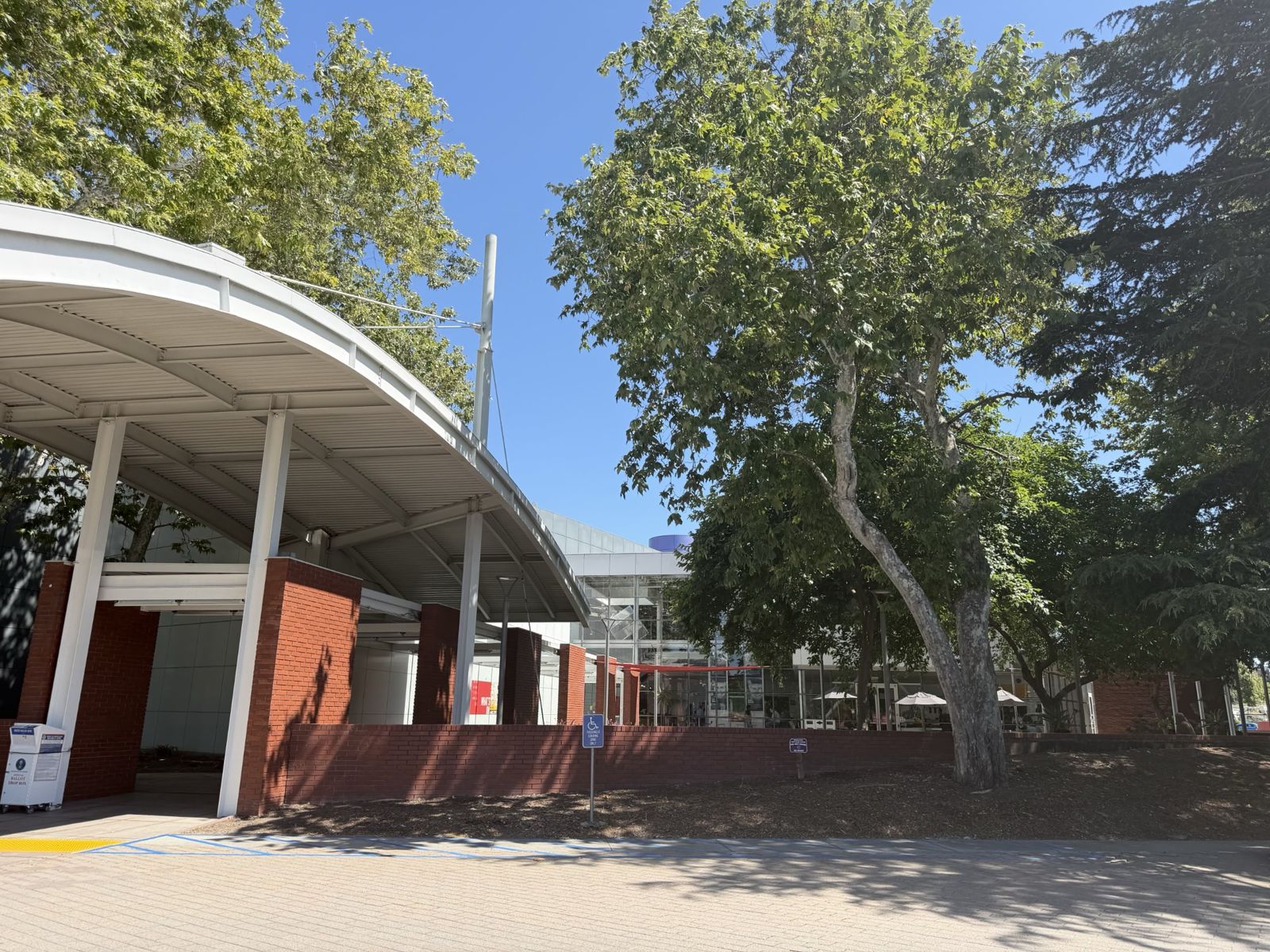
I’m a Bay Area native, and I’ve spent more than 23 years selling homes in Mountain View and the rest of Silicon Valley, so I’ve driven past the Computer History Museum on Shoreline Boulevard more times than I can count. On a recent visit I finally took my time, walked every gallery with a camera, and read the signs the way you’re supposed to. What struck me is that you aren’t just looking at old machines and circuit boards in there. You’re walking through the physical history of Santa Clara County itself, and every exhibit helps explain how a valley of prune and apricot orchards became the place where the world’s technology gets built.
This guide is part walking tour, part history lesson, and part explanation of why your house (or the one you’re hoping to buy) costs what it does. The photos are all mine, the history comes from the museum’s own signage and the sources I’ve linked, and the real estate perspective comes from two decades of working with families in these neighborhoods. Whether you’re a longtime homeowner, a tech buyer who just moved here, or a grandparent looking for a good rainy day outing, the museum is worth the trip, because computer history is Silicon Valley history, and Silicon Valley history is the story of the Bay Area.
Key Takeaways
Summary: The Computer History Museum in Mountain View is the world’s leading museum of computing, run as a nonprofit from a former Silicon Graphics building just off Highway 101. Its Revolution exhibition walks visitors through about 20 galleries covering 2,000 years of computing, from Hollerith’s punched card tabulator and UNIVAC to Seymour Cray’s supercomputers, minicomputers, Moore’s Law, the Apple II and IBM PC, Atari, Silicon Graphics, the dot-com bust, and the handhelds that led to the smartphone. For Bay Area homeowners and buyers, it’s also the clearest explanation of how Santa Clara County went from orchards to some of the most valuable real estate in the country. Plan on three to four hours, and check computerhistory.org for current tickets and special exhibits.
Table of Contents
- Visiting the Computer History Museum: The Essentials
- Why Mountain View Is the Right Home for This Museum
- Start at the Beginning: Punched Cards and the 1890 Census
- The Early Giants: UNIVAC and the Birth of the Computer
- Seymour Cray and the Race for Speed
- Minicomputers Brought Computing to the Lab and the Office
- Real-Time Computing: Guiding Missiles and Moonshots
- Moore’s Law and the Chip That Changed Everything
- The Personal Computer Revolution Happened Here
- Atari, Pong, and the Video Game Boom
- Silicon Graphics, Pixar, and the Workstation Era
- The Dot-Com Boom, the Bust, and the Pets.com Sock Puppet
- Handhelds and the Road to the Smartphone
- Tips for Planning Your Visit
- Frequently Asked Questions About the Computer History Museum
Visiting the Computer History Museum: The Essentials
The museum sits at 1401 N. Shoreline Boulevard in Mountain View, just north of Highway 101 and a short drive from the Googleplex and Shoreline Amphitheatre. According to the museum’s visitor page, it’s open Wednesday through Sunday from 10 a.m. to 5 p.m. and closed Monday and Tuesday, with holiday closures posted online. Admission is ticketed, and prices and discounts change, so check the museum’s hours and admission page before you go. You can reach the front desk at (650) 810-1010.
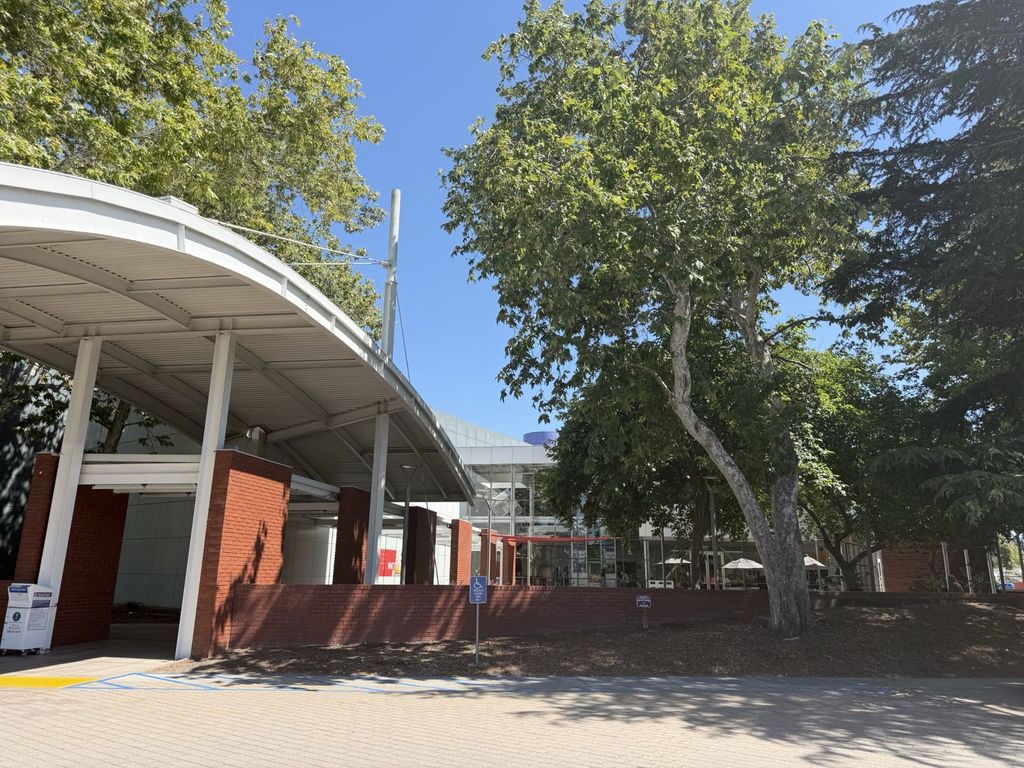
The entrance on Shoreline Boulevard, framed by mature sycamores. The building was originally part of the Silicon Graphics campus.
Right now the museum’s major exhibits are Revolution: The First 2000 Years of Computing, Make Software: Change the World!, and Chatbots Decoded: Exploring AI. Revolution is the one most people come for, and it’s the one I’ll walk you through here. It opened in January 2011 after a roughly $19 million renovation and covers about 25,000 square feet across numbered galleries, which makes it easy to follow chronologically. If you want to see everything without rushing, give yourself three to four hours.
Start in the Lobby
The lobby is bright and open, with a soaring ceiling and tall banners honoring the museum’s newest Fellows. When I visited, the banners featured the 2026 class: Jeff Hawkins, Donna Dubinsky, and Ed Colligan of Palm for their handheld computers and smartphones, John Chowning for inventing FM audio synthesis, Brewster Kahle for his work on online search and the Internet Archive, and venture investor Mark Stevens as the Silicon Valley Laureate. You can read about the whole class on the museum’s 2026 awards page.
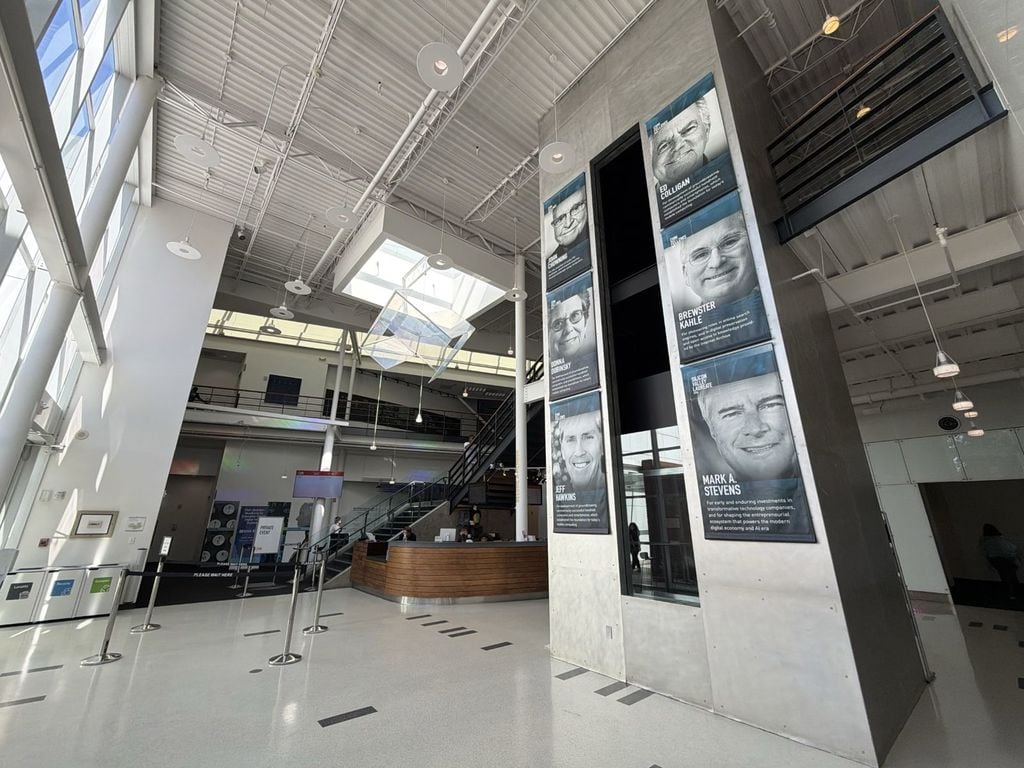
The lobby honors the 2026 CHM Fellows, including the Palm team that helped invent the modern smartphone.
Why Mountain View Is the Right Home for This Museum
The museum didn’t start here. It grew out of a collection Gordon Bell began at Digital Equipment Corporation, which opened to the public in Massachusetts in 1979 and later became The Computer Museum in Boston. A West Coast history center opened at Moffett Field in the late 1990s, the organization took the Computer History Museum name in 2000, and in 2002 it moved into this building, which had been part of the Silicon Graphics campus. The museum’s own history page tells the full story. Landing in Mountain View made perfect sense, because this town is something of a pilgrimage site if you understand what happened here. William Shockley opened Shockley Semiconductor Laboratory on San Antonio Road in 1956. The eight engineers who left him founded Fairchild Semiconductor in 1957, and two of them, Robert Noyce and Gordon Moore, started Intel in Mountain View in 1968 before it moved to Santa Clara. Silicon Graphics built its campus here, and Google later took over the former SGI headquarters on Amphitheatre Parkway to create the Googleplex. When you walk into this museum, you’re standing in the middle of the neighborhood where a lot of that history happened. If you’re curious what it’s like to actually live here, my guide to living in Mountain View, California covers the neighborhoods, and the nearby Rengstorff House shows you what the town looked like back when it was farmland.
Accurate Home Price Data Is Just a Click Away!

Live MLS Data
What Are Homes Actually Selling For Right Now?
Median price, days on market, and how many homes are selling over asking, pulled straight from current MLS data for your neighborhood.
See the Live Sales Data →Start at the Beginning: Punched Cards and the 1890 Census
The early galleries surprised me the most. Long before silicon, the problem was data, and the U.S. Census was drowning in it. Herman Hollerith’s punched card tabulator was built to process the 1890 census, and it worked so well that his company eventually became part of IBM. The exhibit has an original tabulator with its rows of round dials, set against a huge map of the United States and a wall of black and white photos of clerks punching cards by hand.
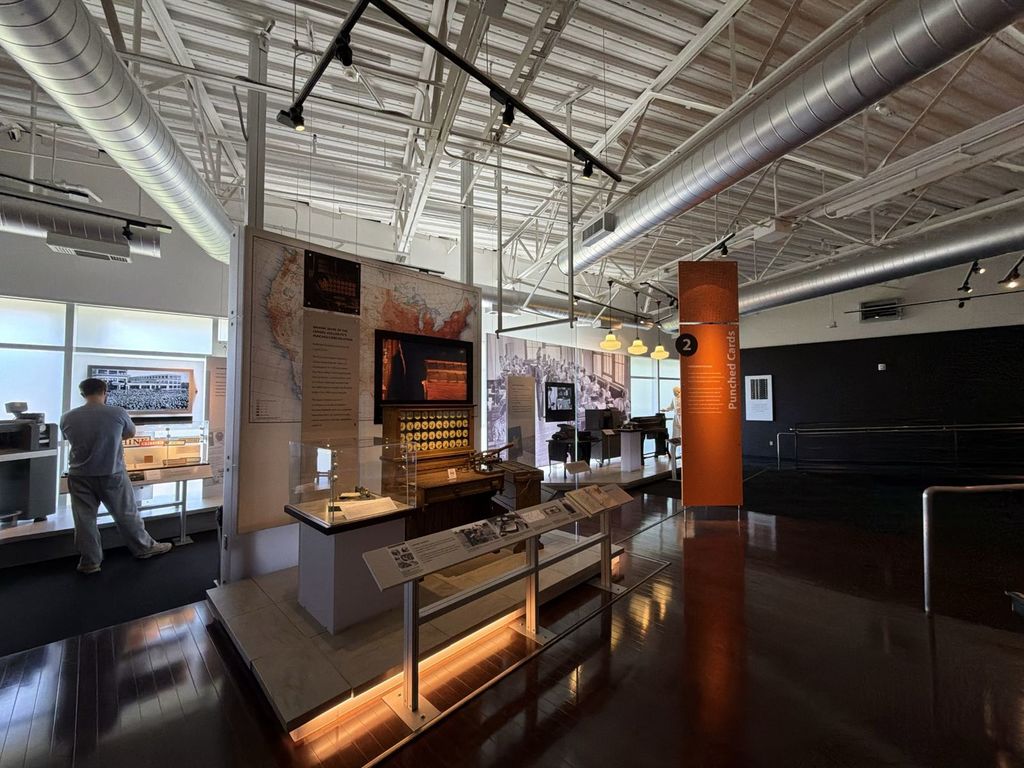
Gallery 2, Punched Cards, features Hollerith’s tabulator, the machine that made sense of the 1890 census.
Right nearby is one of my favorite displays in the building, a punched card system used for a 1940s and 1950s survey of British plants and animals. Researchers in the field wrote on cards, clerks punched the data in, and machines sorted and printed it into an atlas of where every species grew. It’s a lovely reminder that computing has always been about organizing the world’s information, decades before anyone used that phrase about a search engine.
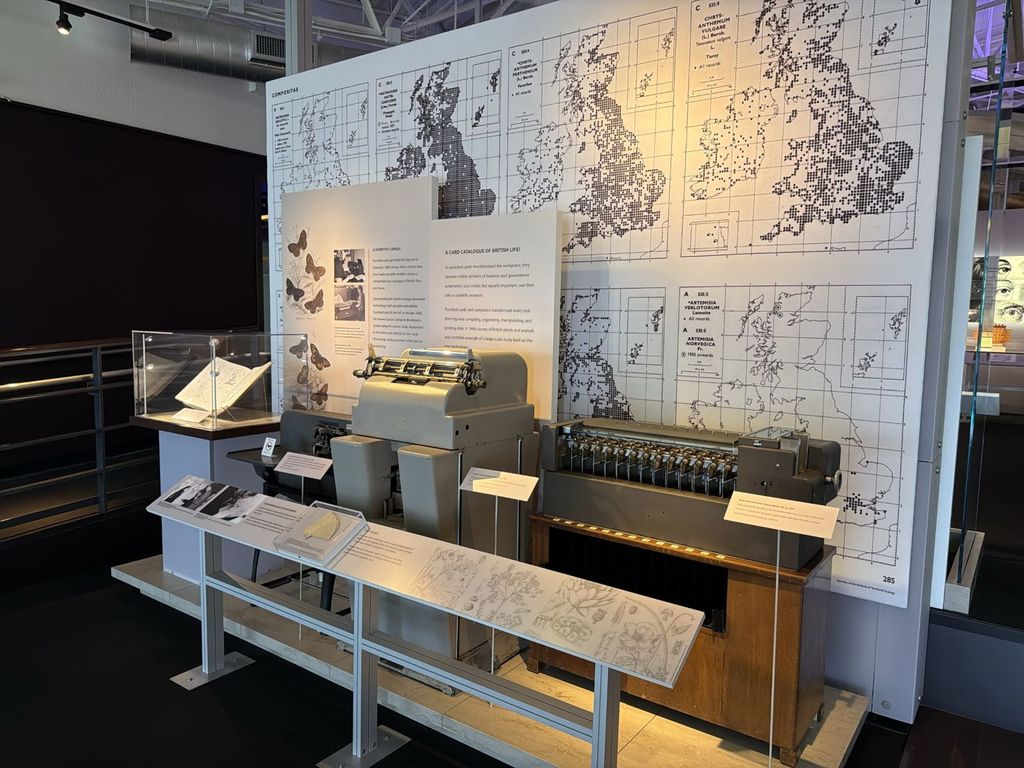
Punched card machines from the Powers-Samas company, used to map the distribution of British plants.
The Early Giants: UNIVAC and the Birth of the Computer
From there the galleries move into the first electronic computers, the room-sized machines built for governments, universities, and big corporations. This part of the museum is darker and moodier, with UNIVAC components and early memory systems in lit cases. These were the machines that made “computer” a household word in the 1950s, even though almost nobody actually saw one.
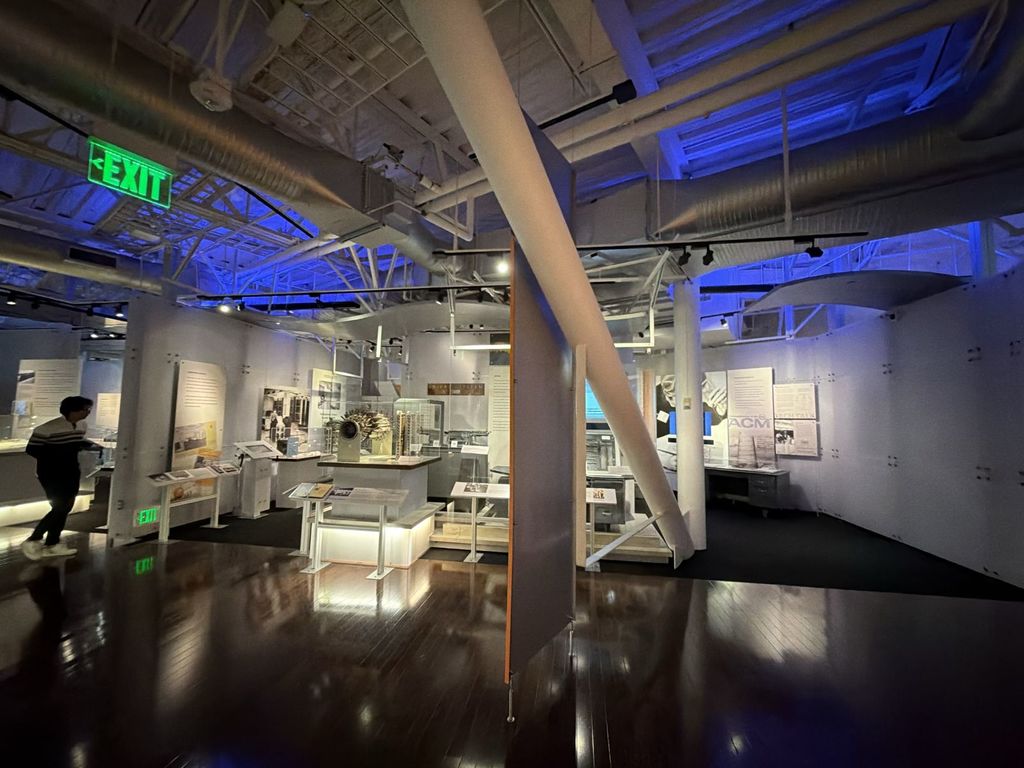
The early computer galleries include UNIVAC components and the first commercial machines.
Seymour Cray and the Race for Speed
Seymour Cray gets a well-deserved spotlight. Before he started his own company, he designed machines at Control Data Corporation, including the compact CDC 160-A, which you’ll find here beside the Laboratory Instrument Computer, or LINC, a 1962 design from MIT’s Lincoln Laboratory that many historians consider an ancestor of the personal computer. Look at the open LINC cabinet and you’ll see thousands of hand-wired connections, which tells you more about what building a computer used to mean than any sign could.
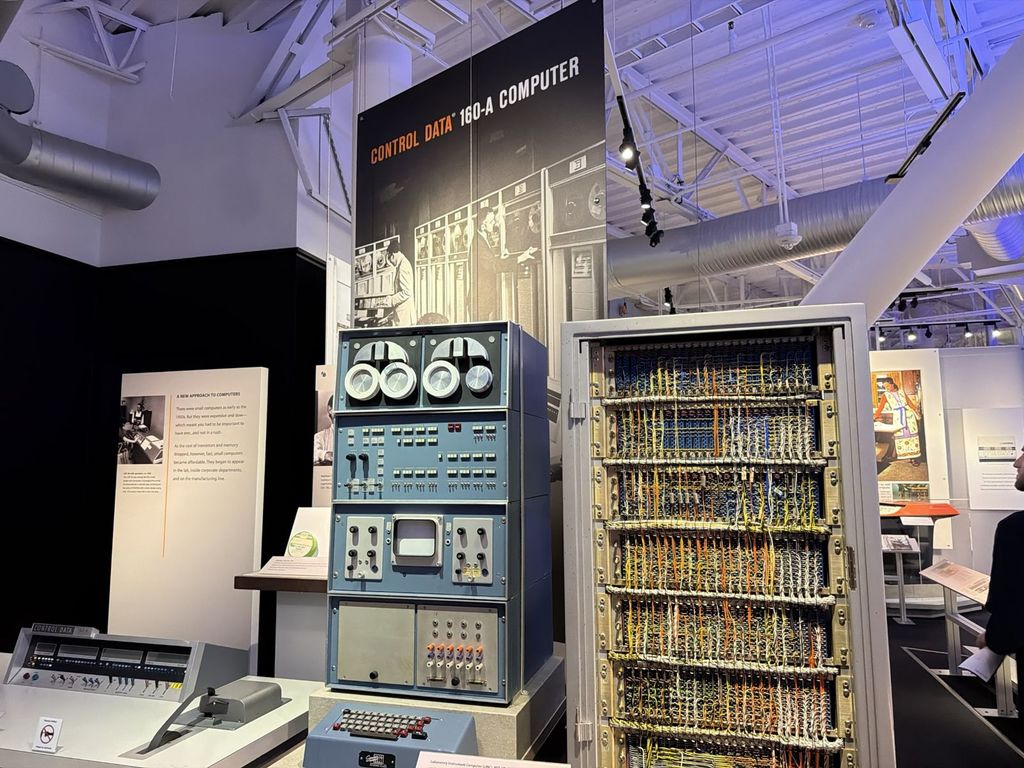
The Control Data 160-A and the hand-wired LINC, early steps toward smaller, more personal machines.
The Cray-1 is the showstopper. Introduced in 1976, it was the fastest computer in the world, and its curved tower with a padded bench around the base, which hid the power supplies and cooling, made it look more like furniture than a computer. A short animated film plays alongside, explaining how Cray built his lab near his home in Chippewa Falls, Wisconsin, so he could work in peace.
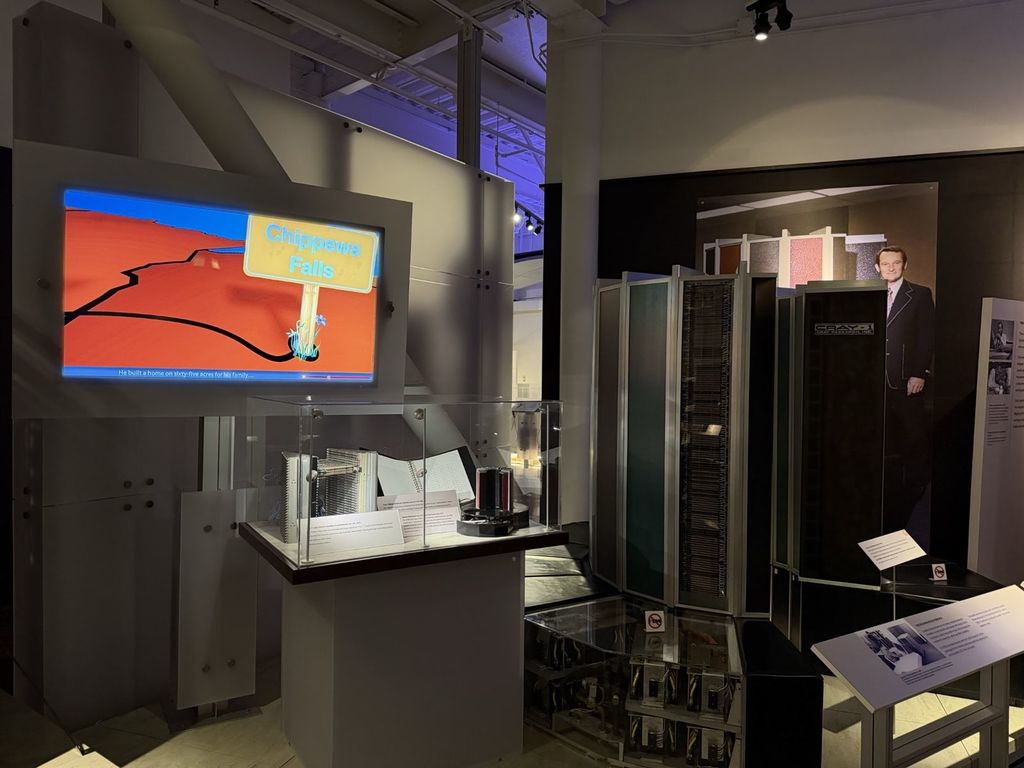
The Cray-1, with Seymour Cray and a short film about his Chippewa Falls lab.
The Supercomputers gallery also displays a Cray-1A, serial number 6, donated by Lawrence Livermore National Laboratory, along with the wiring and cooling hardware that made these machines run. It’s worth a slow lap. Those same national labs and defense contracts helped pull engineering talent to the Bay Area for decades.
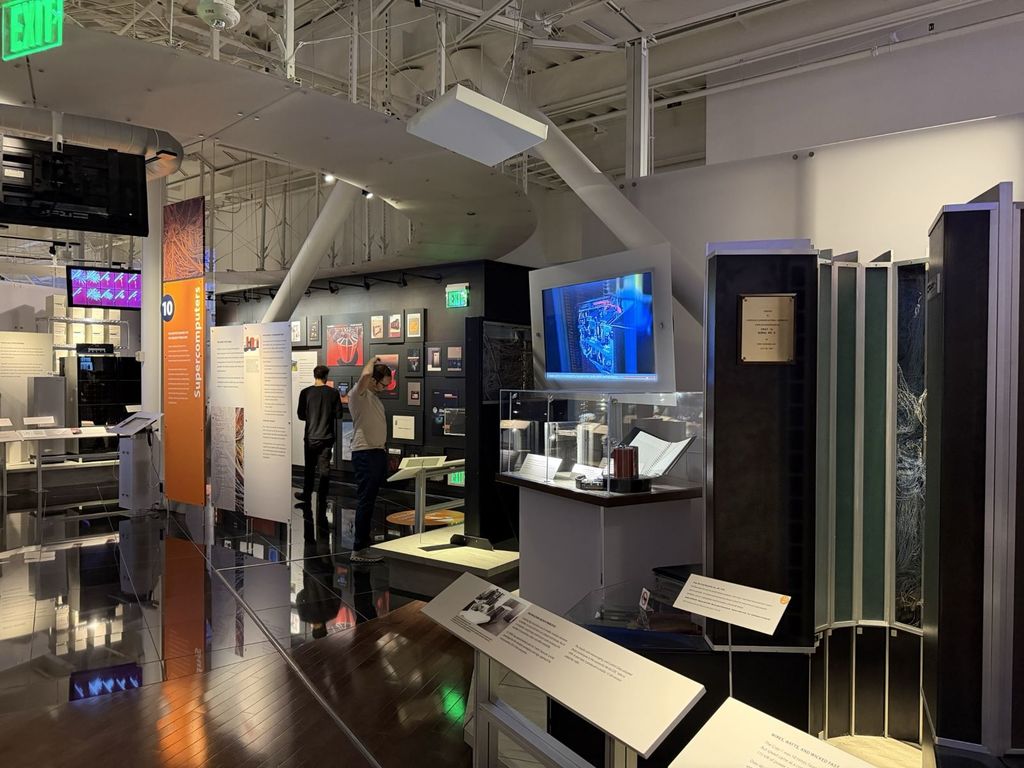
Gallery 10, Supercomputers, with Cray-1A serial no. 6 from Lawrence Livermore National Laboratory.
Minicomputers Brought Computing to the Lab and the Office
As transistors and memory got cheaper in the 1960s and 1970s, computers shrank from room-sized to refrigerator-sized, and suddenly a lab, a factory, or a corporate department could own one. This gallery is bathed in purple light and lined with machines like the Wang 2200, the SDS 920 from Scientific Data Systems, and the Prime 300/400. One sign describes how banks moved from rooms full of bookkeepers to timesharing terminals, which is a nice reminder of how many ordinary jobs these machines changed.
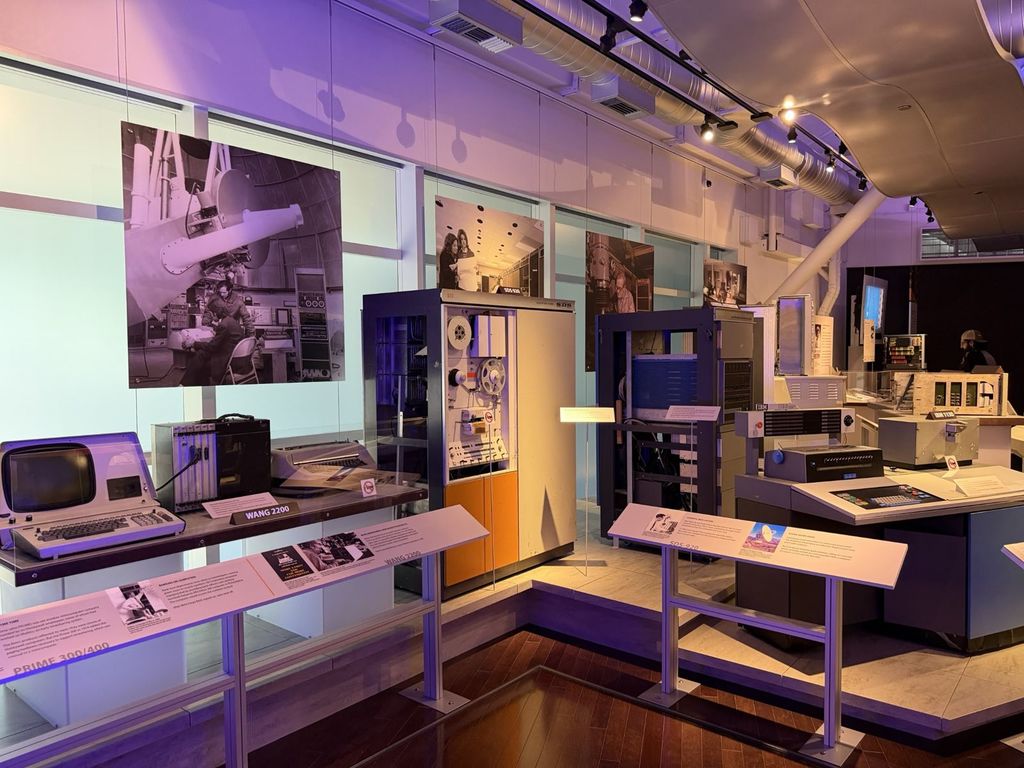
The Wang 2200 and SDS 920, part of the minicomputer wave that brought computing into labs and offices.
Around the corner you’ll find the IBM 1130, introduced in 1965 for engineers and scientists, along with a General Automation machine and a display on how physicists in Belgium used several minicomputers together to collect experimental data. It’s easy to rush past this section on the way to the personal computers, and I’d encourage you not to.
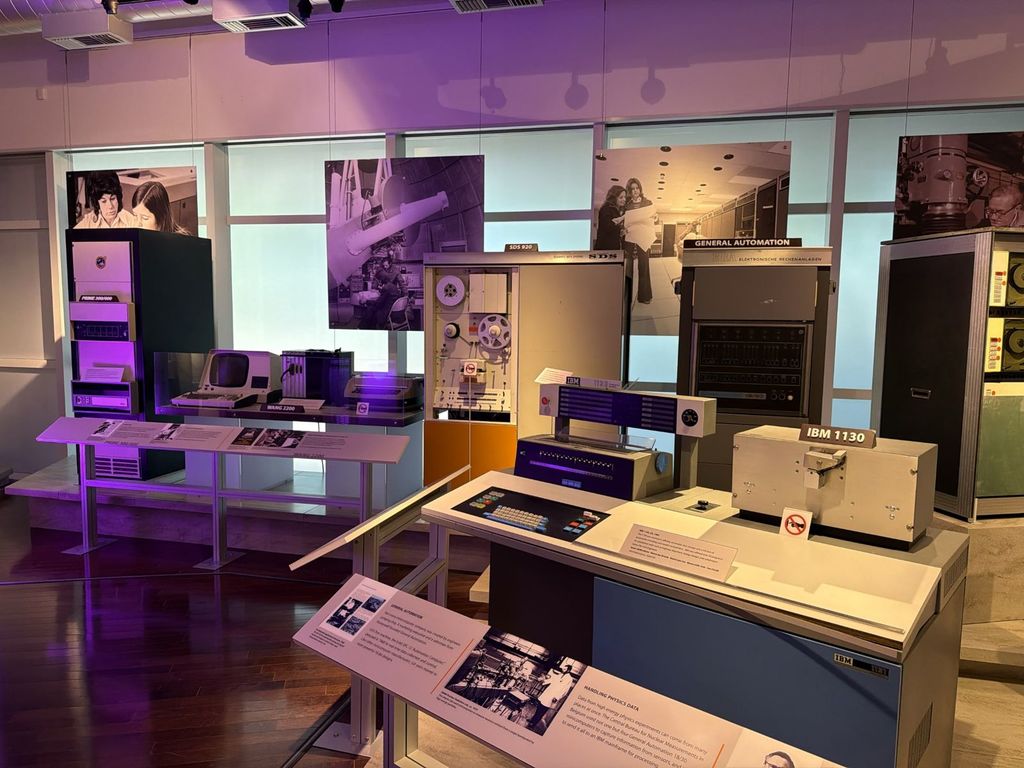
The IBM 1130 and General Automation exhibits show how minicomputers spread through science and industry.
Real-Time Computing: Guiding Missiles and Moonshots
The real-time computing gallery covers the computers that had to work instantly, in flight, with no room for error, from bombsights to missile guidance systems to the space program. A full-size missile body with its guidance electronics exposed sits beside a model moon, and nearby displays show how guidance computers shrank over time. This story is deeply local. Lockheed moved its Missiles and Space division to Sunnyvale in 1956, right next to Moffett Field, and it became one of the region’s largest employers, pulling thousands of engineers into the South Bay and helping fill new subdivisions in Sunnyvale, Mountain View, and Santa Clara.
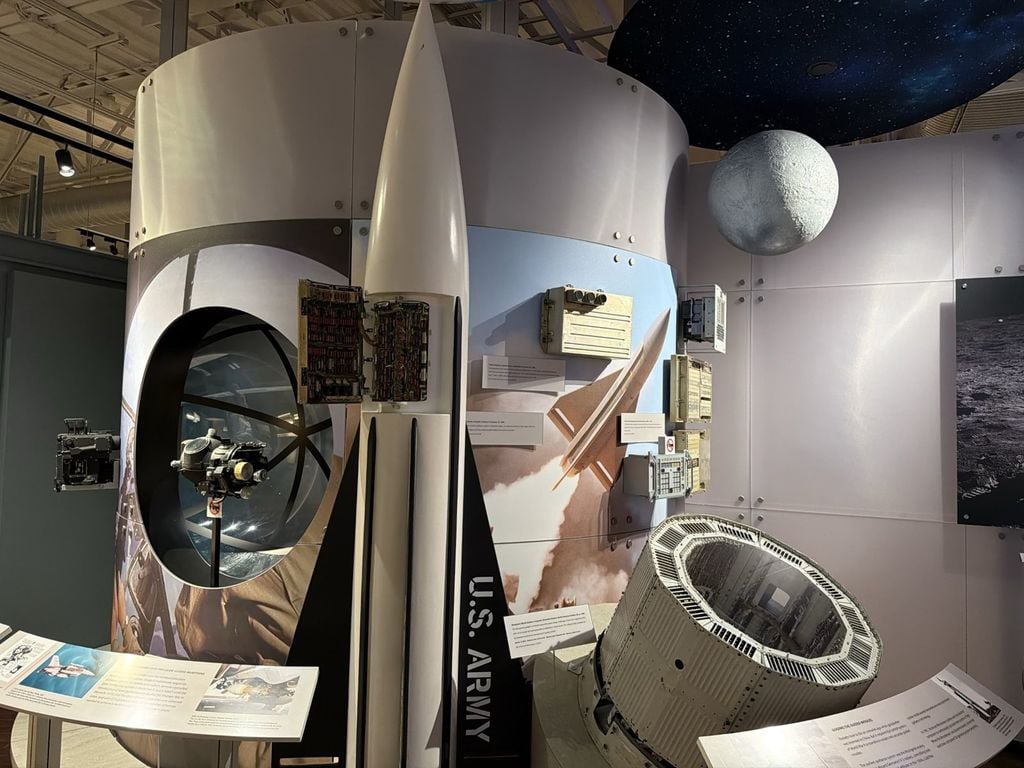
The real-time computing gallery traces guidance computers from early bombsights to missiles and spaceflight.
Moore’s Law and the Chip That Changed Everything
The Moore’s Law display is one of the most photographed spots in the building, and for good reason. In 1965, while he was director of research and development at Fairchild Semiconductor, Gordon Moore predicted that the number of components on an integrated circuit would double every year, and in 1975 he revised that to roughly every two years. A glowing red line climbs the wall as transistor counts go from a handful in the 1960s to billions, and a row of silicon wafers below shows the chips getting bigger and denser.
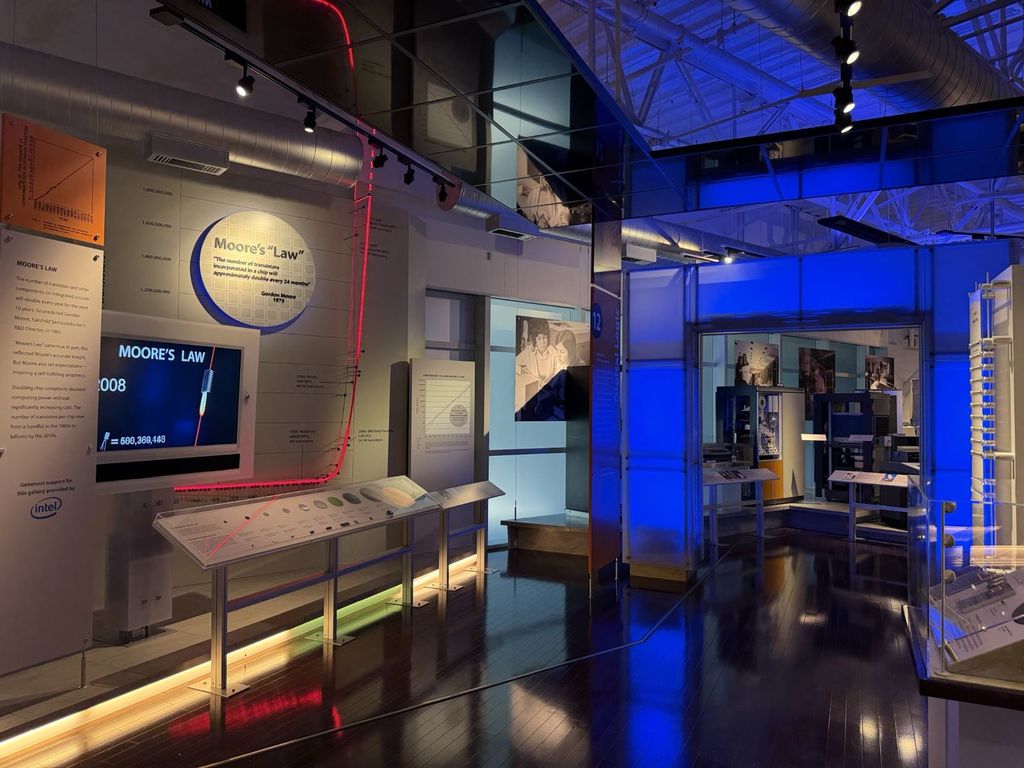
The Moore’s Law wall, where a red line tracks transistor counts climbing from a handful to billions.
As the sign points out, Moore’s prediction became a self-fulfilling prophecy, because the whole industry organized itself around keeping up. If you want one idea that explains why Santa Clara County’s economy kept reinventing itself, this is it. Every doubling made new products possible, and every new product meant new companies, new jobs, and more demand for housing within commuting distance of the chip makers.
The Personal Computer Revolution Happened Here
Walk into the personal computer gallery and you’re confronted with the machines that changed everything. There’s the Kenbak-1, often called the first personal computer, the January 1975 issue of Popular Electronics that put the Altair 8800 on its cover, a newsletter from the Homebrew Computer Club (which first met in a Menlo Park garage that same year), and shelves of Commodores, Ataris, Radio Shack TRS-80s, Apples, IBMs, and clones like the Franklin Ace 100.
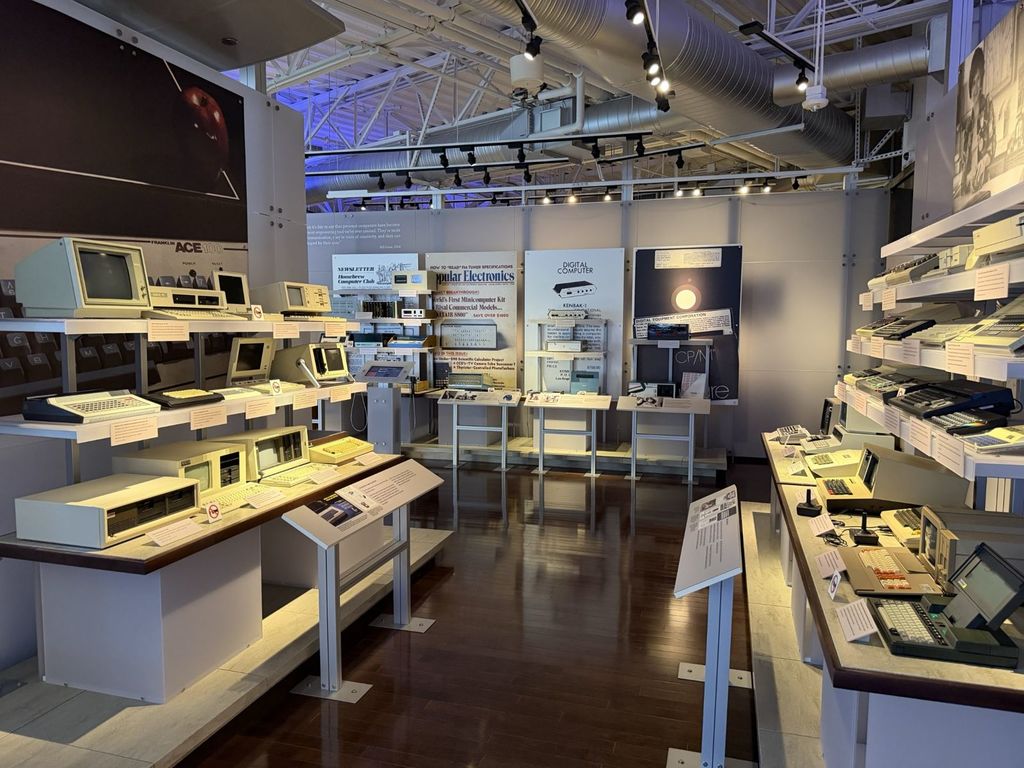
The personal computer gallery, with the Altair 8800, the Homebrew Computer Club newsletter, and the Kenbak-1.
Steve Wozniak’s Apple II, released in 1977, deserves special attention. It wasn’t the only ready-to-use personal computer that year, since the Commodore PET and TRS-80 arrived in 1977 too, but it came fully assembled with a keyboard, color graphics, and BASIC built in, and you could plug it in and start working without being an engineer. It cost $1,298, which was expensive, but it was affordable in a way earlier computers never were. A floppy disk drive arrived in 1978, and in 1979 the VisiCalc spreadsheet turned the Apple II into a legitimate business tool. Accountants and small business owners started buying them, and a hobbyist’s toy became a tool for commerce. That shift had a direct real estate consequence. Once businesses took personal computers seriously, the companies building them needed engineers, office parks, and housing for the people they were hiring, and they needed all of it close together. Orchard land got rezoned for commercial and residential use, and families who had farmed fifty acres of prunes in Cupertino could sell to developers and retire comfortably. That pattern repeated itself across the valley through the 1970s and 1980s.
Moving to Silicon Valley?
IBM Entered the Game and Changed Everything
The IBM PC arrived in August 1981. IBM was established, corporate, and trustworthy, so when it put its name on a personal computer, companies that had been skeptical suddenly paid attention. The PC shipped with PC DOS, an operating system Microsoft licensed to IBM while keeping the right to sell its own version, MS-DOS, to other manufacturers. That deal helped turn Microsoft from a scrappy software company into an essential part of the industry, and it opened the door to the flood of PC clones you’ll see on the shelves here.
Software Put PCs to Work
Look up when you reach the software gallery. A big arch of glowing software boxes hangs overhead, with familiar names like Word, Access, Quicken, Windows, and Office alongside long-forgotten titles. The sign below explains how software companies exploded in the 1980s as PC users demanded programs for every task, and how easy floppy disks made piracy “child’s play,” especially for games.
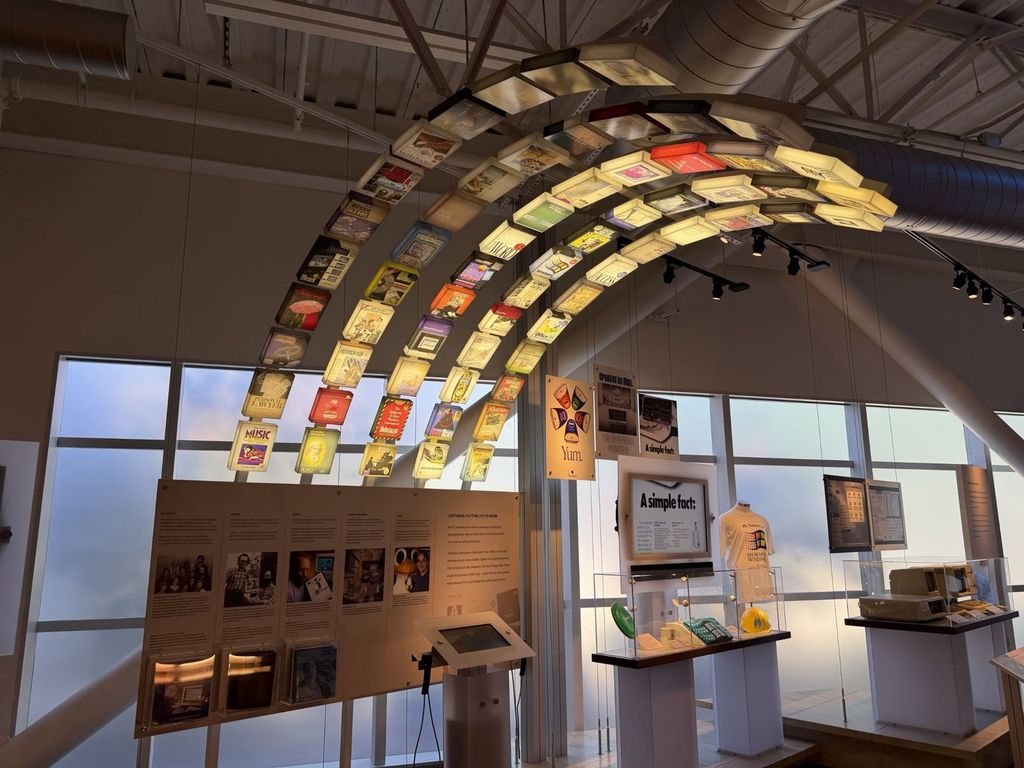
The software arch, a wall of the programs that turned PCs into everyday tools.
The Xerox Alto, the Macintosh, and a Pirate Flag
One of the most important machines in the building is the Xerox Alto, created in 1973 at Xerox’s Palo Alto Research Center. It combined a mouse, removable storage, Ethernet networking, a graphical user interface, and WYSIWYG (“what you see is what you get”) printing, so for the first time a computer spoke a visual language ordinary people could understand. Xerox’s headquarters were back east, and the company never figured out how to sell the Alto’s ideas as a mainstream product. Apple did. Steve Jobs toured PARC in 1979, and those ideas shaped the Lisa and the 1984 Macintosh. Look for the Macintosh team’s pirate flag. In 1983, programmer Steve Capps commissioned it, and Susan Kare, the designer behind the Mac’s original icons, painted the rainbow Apple logo as the eye patch. It flew over the team’s building in Cupertino after Steve Jobs told them it was better to be pirates than to join the navy. That’s the lesson of the Alto and the Mac in one image. The Bay Area’s edge has never been that its companies are smarter. It’s that they’re better at taking powerful ideas and turning them into products people actually want to buy.
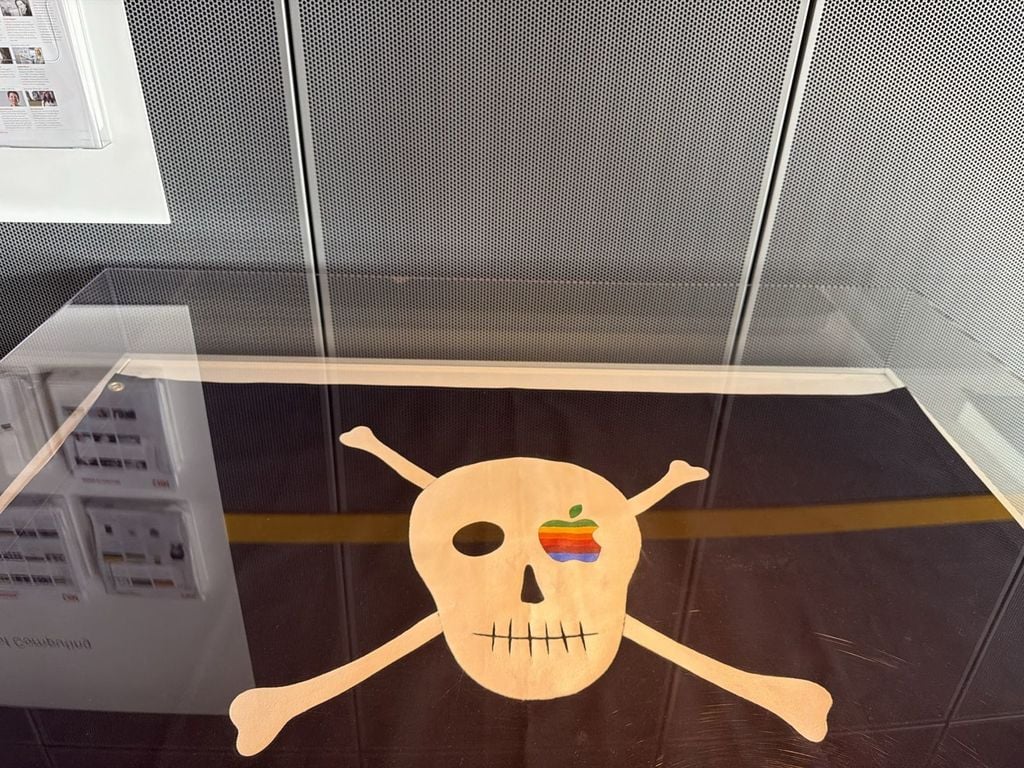
The Macintosh team’s pirate flag, with Susan Kare’s rainbow Apple logo as the eye patch.
Could you use a Helping Hand?

Atari, Pong, and the Video Game Boom
The gaming section is where grandkids tend to light up. According to the museum’s sign, Nolan Bushnell and Ted Dabney founded Atari in June 1972, and five months later its first product, Pong, changed gaming forever. In 1977 Atari introduced the Video Computer System and went on to sell millions of game cartridges over the next 15 years, and Warner Communications had already bought the company in 1976, which told everyone entertainment giants saw something valuable happening in the South Bay. The exhibit features the Atari 2600 and the Atari 400 and 800 home computers under a giant piece of Space Invaders box art.
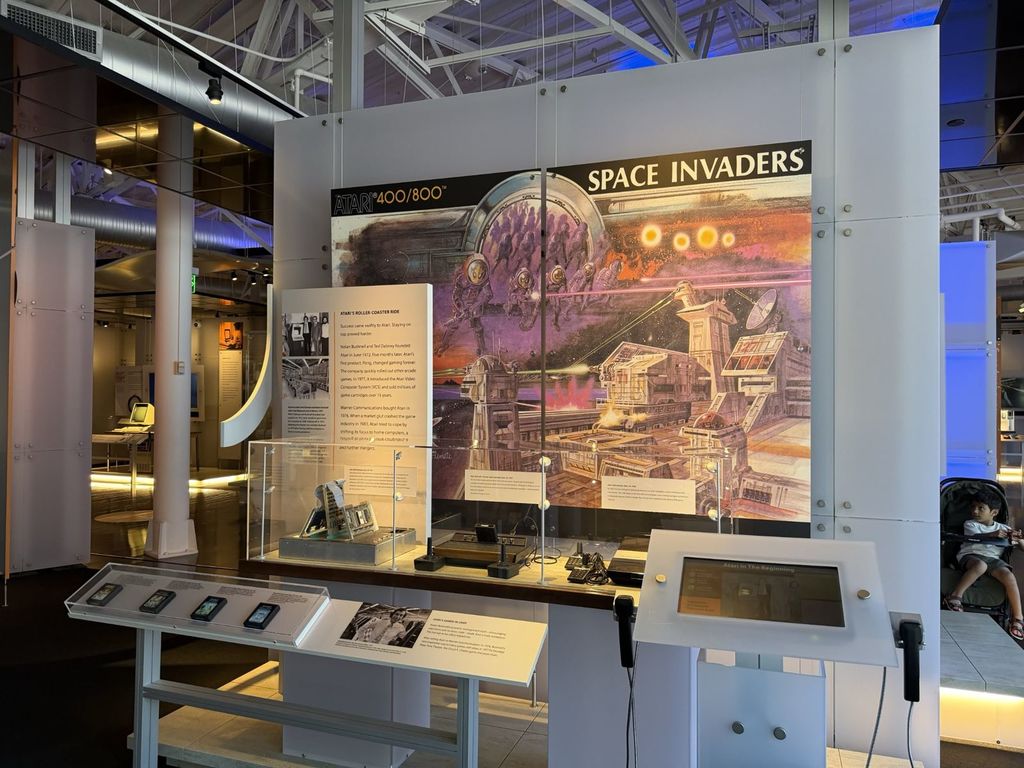
Atari’s roller-coaster ride, with the 2600 console and the Atari 400/800 home computers.
Bushnell’s next act was local too. He founded Pizza Time Theatre, which became Chuck E. Cheese, and opened the first one in San Jose in 1977. When a market glut crashed the video game industry in 1983, Atari tried to pivot into home computers and struggled. But the crash came right as the personal computer market was exploding, so the people and money that left gaming flowed into PCs and software. The ecosystem didn’t collapse, it pivoted, and that ability to redirect talent toward whatever is working next is a big reason South Bay neighborhoods held their value through downturns that would have hollowed out other regions.
Silicon Graphics, Pixar, and the Workstation Era
This gallery has special meaning given the building you’re standing in. Stanford professor Jim Clark founded Silicon Graphics in 1982 with a group of graduate students and staff, and its powerful graphics workstations became the tools of choice for film studios, engineers, and scientists. The display includes SGI machines, a Pixar Image Computer in its distinctive gray case, a Monsters, Inc. poster, and exhibits on Sun Microsystems and AutoCAD. SGI’s success helped fill Mountain View’s office parks in the 1990s, and when SGI faded, Google moved into its old Amphitheatre Parkway campus.
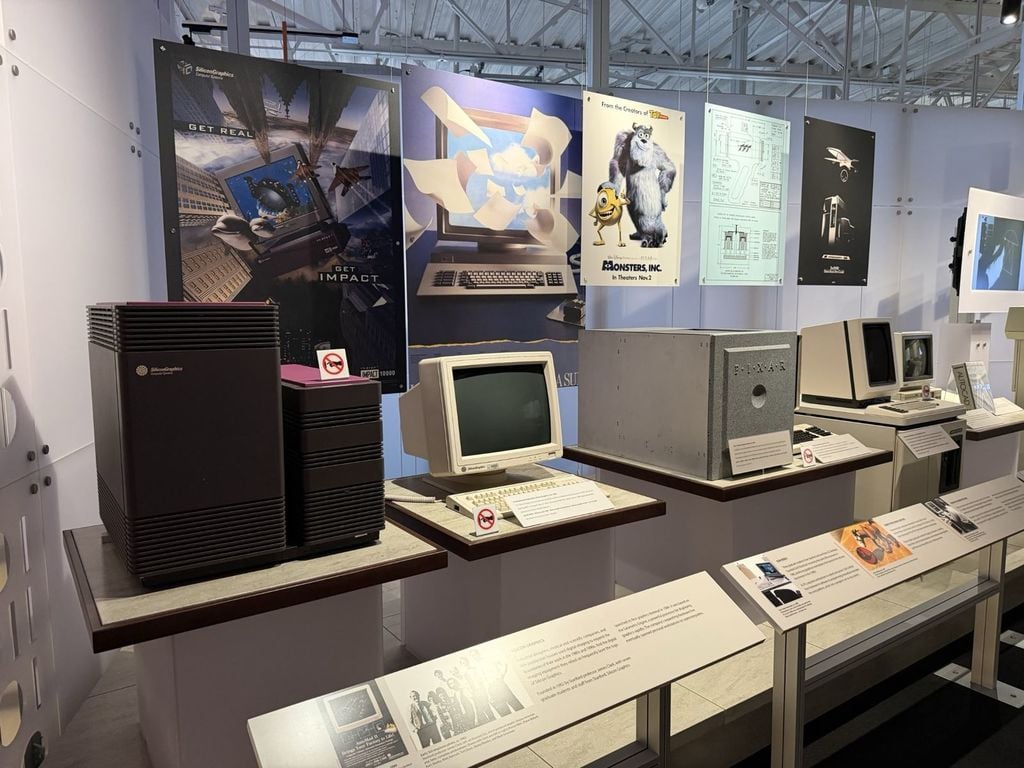
Silicon Graphics workstations and the Pixar Image Computer, the tools behind a generation of digital film.
The Dot-Com Boom, the Bust, and the Pets.com Sock Puppet
The museum also documents the web boom and the crash that followed. The “Marketing the Web” display notes that, aside from gambling and adult sites, many web companies had no clear business model and focused on building name recognition while hoping to raise more money. A stock chart on the wall shows the Nasdaq spiking around 2000 and falling back. The case below holds the famous Pets.com sock puppet, a BrandEra.com frisbee, a dot-com edition of Monopoly, and other promotional swag from companies that spent millions on advertising and then disappeared. Pets.com itself shut down in November 2000, less than a year after going public.
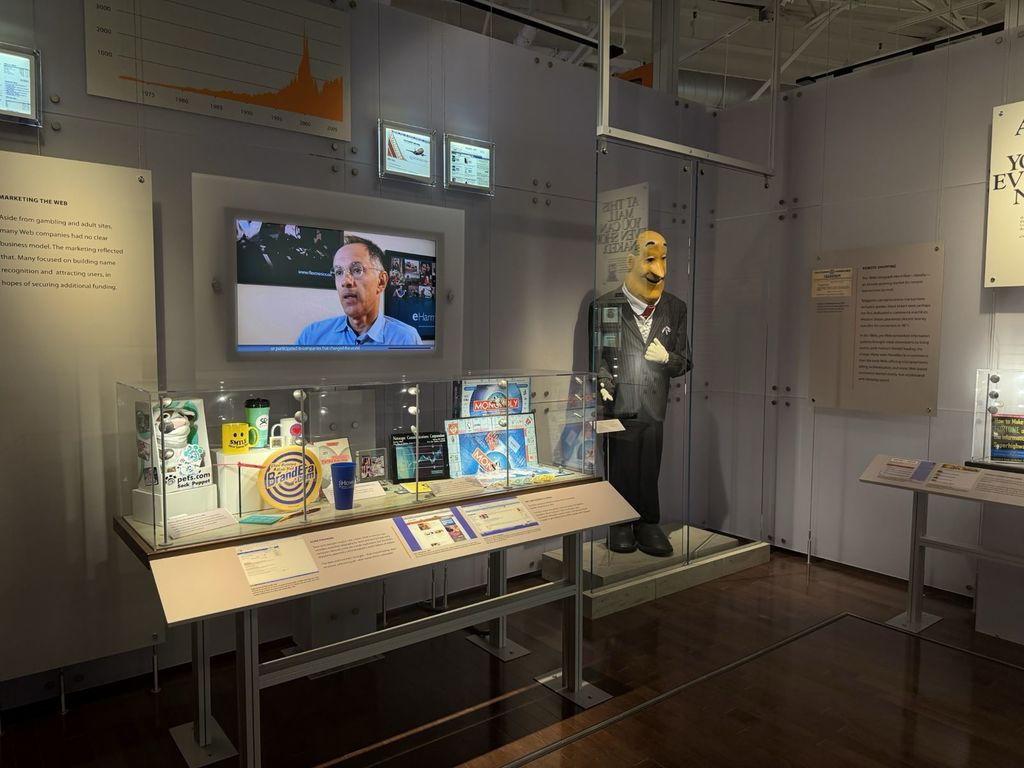
The dot-com display, with the Pets.com sock puppet and a Nasdaq chart that tells the whole story.
Elsewhere you’ll find Google’s story. Larry Page and Sergey Brin were Stanford graduate students when they built the search engine that became Google, and the museum has one of the company’s early “corkboard” server racks from 1999, built from cheap PC parts mounted on cork-lined trays. Google proved that commodity hardware plus brilliant software could do something unprecedented. Its growth, and the companies founded by people who left it, brought a new wave of well-paid engineers who needed places to live, and the nicest neighborhoods in Mountain View, Palo Alto, Cupertino, and Sunnyvale became some of the most expensive in the country.
Hey Buyers, It’s Rough out There!

Handhelds and the Road to the Smartphone
The mobile computing gallery traces handhelds from simple electronic organizers through laptops, tablets, and early smartphones. The museum’s sign makes a sharp point. General-purpose handhelds were initially too limited for anything but niche uses like inventory management, while devices built for one job, like a calendar, address book, or cookbook, did much better. A quote from Osborne Computer founder Adam Osborne sums it up nicely, predicting a future of computers “that people don’t realize are computers at all.”
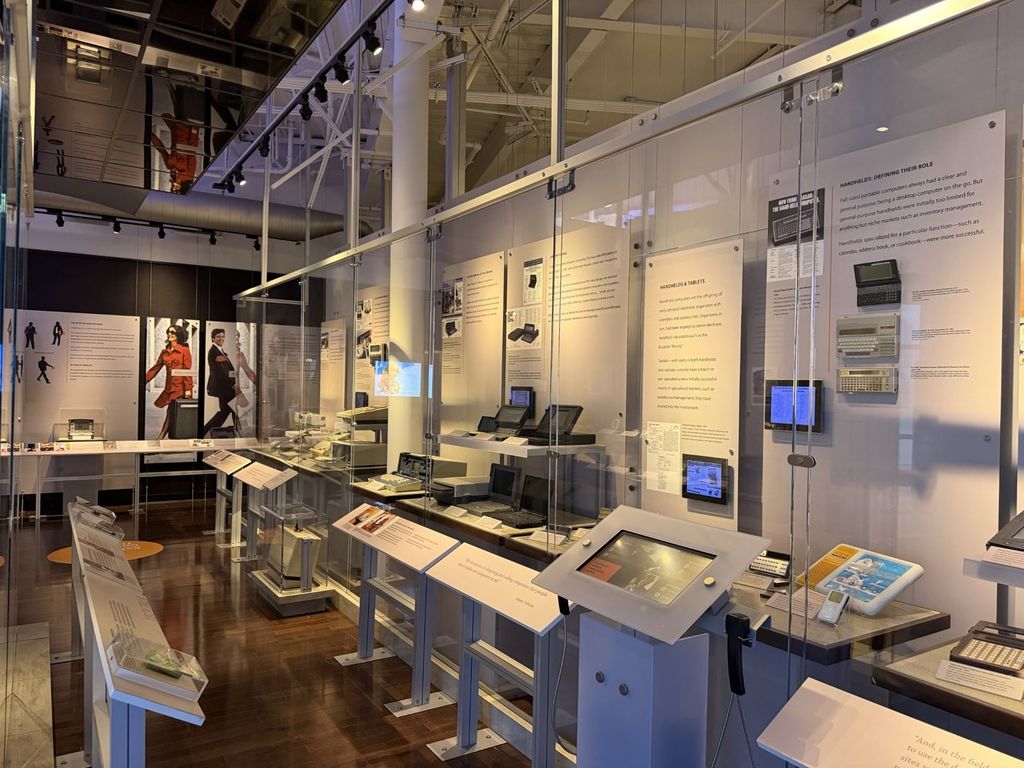
The handhelds and tablets gallery, from the Osborne portable to pen computers and organizers.
This is where the lobby banners come full circle. Jeff Hawkins, Donna Dubinsky, and Ed Colligan built the Palm Pilot and then the Treo smartphone by focusing on a few things done well, and the iPhone and Android followed. Every one of those waves brought new companies, new funding rounds, and new demand for housing near the major employers. The companies that built mobile devices weren’t built here by accident. They were built here because the talent, the capital, and the culture of building things were already here.
Tips for Planning Your Visit
The galleries flow roughly in chronological order, so start with the early computing galleries and work your way forward to the web and mobile devices. Wear comfortable shoes, because there’s a lot of ground to cover, and pace yourself. The lighting in some galleries is dramatic and dim, so readers with low vision may want to bring their glasses or use a phone flashlight to read the smaller labels. If you have questions about accessibility, wheelchairs, or group tours, call the museum ahead of time at (650) 810-1010. When you need a break, the Cloud Bistro just off the lobby has coffee, snacks, and plenty of tables in a sunny, glass-walled space, and there’s patio seating outside under the trees. On the day I visited it was full of students and engineers working on laptops, which felt about right for this building. If you’re making a day of it, downtown Mountain View is about ten minutes away, and I’ve written about why Castro Street is my favorite street in Silicon Valley. History lovers should also add History Park in San Jose and the historic mansions of Silicon Valley to the list.
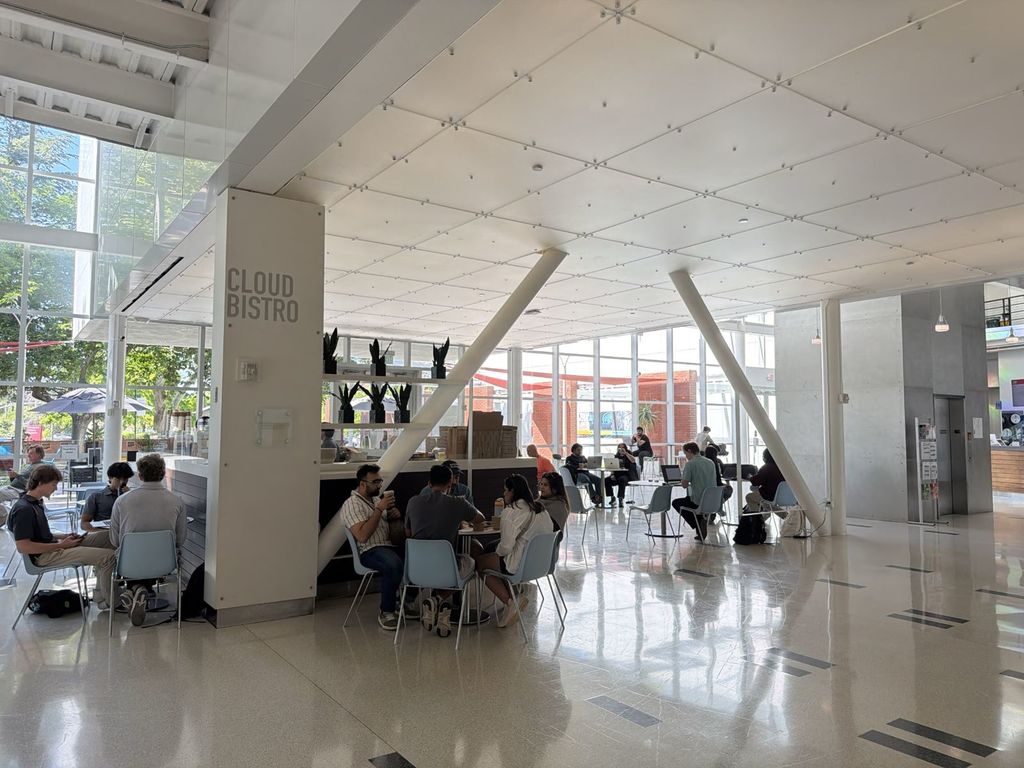
The Cloud Bistro, a bright spot for coffee and a break between galleries.
If you’re a longtime Santa Clara County resident, the experience can feel almost surreal. You’re looking at the machines that made your neighborhood what it is, and you’re standing near the center of one of the most significant economic transformations of the last century. And if you’re thinking about what comes next, whether that’s downsizing, moving to a retirement community, relocating closer to family, or simply understanding what your home is worth, the museum gives you useful context for what is probably the biggest asset you own. The Computer History Museum tells you how you got here. When you’re ready to talk about where you want to go next, I’m happy to help you think it through. You can reach me at 408-413-3087 or book a call with me here.
Frequently Asked Questions About the Computer History Museum
Where is the Computer History Museum located?
What are the Computer History Museum’s hours?
How much does it cost to visit the Computer History Museum?
How long does it take to see the Computer History Museum?
What is the main exhibit at the Computer History Museum?
Is the Computer History Museum good for kids and grandparents?
What building is the Computer History Museum in?
How did the tech industry affect Santa Clara County home prices?

Time to talk to a REALTOR®?
Book a Call with Seb
Selling, buying or just weighing your options? Pick a time that works for you and we'll talk it through.
Pick a Time →Rather talk now? Call or text 408.413.3087
Amazing Mountain View Homes for Sale
2
3
4
5
6
7
8
9
10
11
12
13
14
15
16
17
18
19
20
21
22
23
24
25