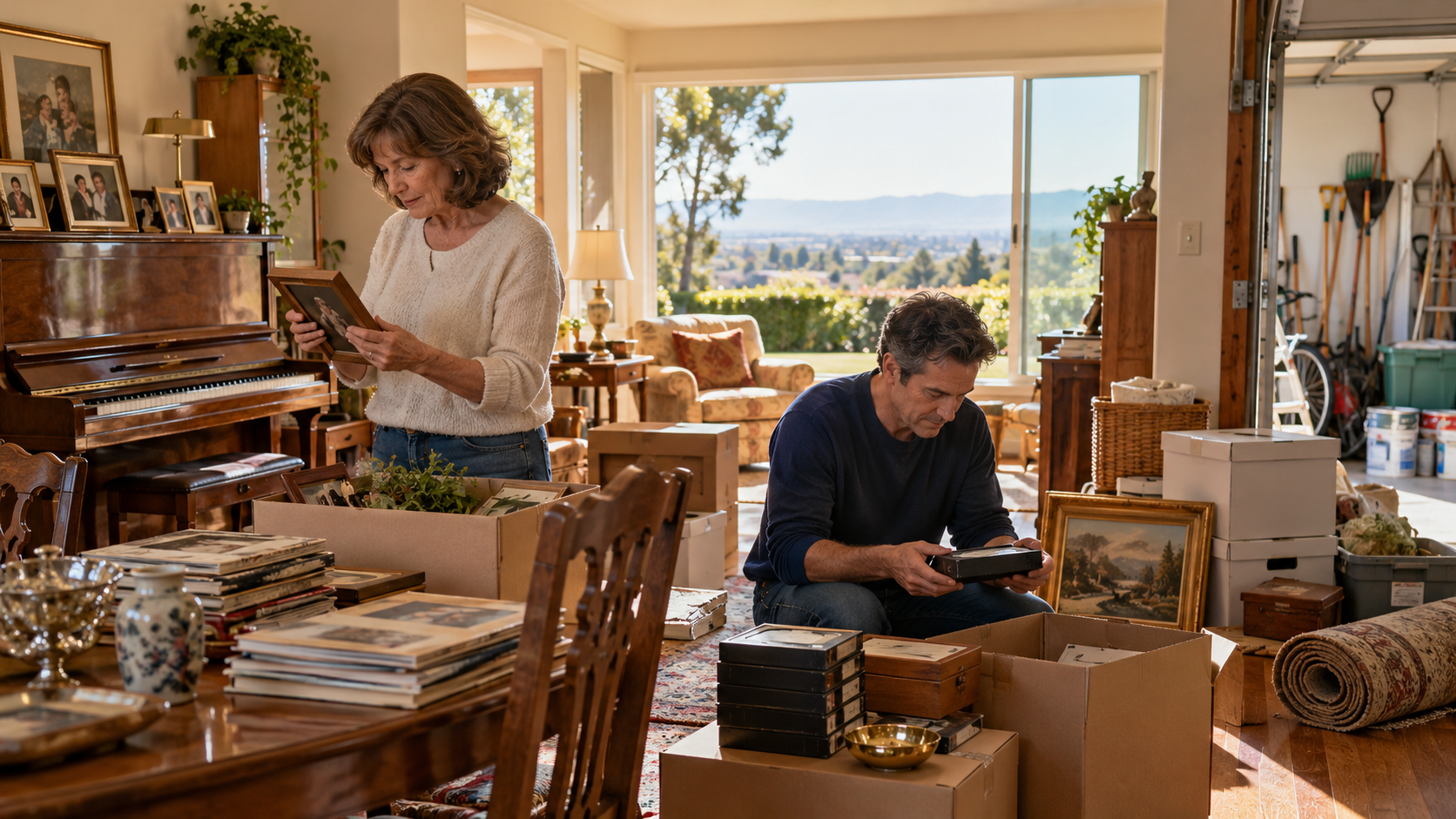
Every house I help clear has the same leftovers. The formal china. The dining set for twelve. The upright piano. Thirty years of National Geographic. A wall unit full of VHS tapes, a garage of half-empty paint cans, boxes of slides, and file drawers of old statements. Nobody in the family wants any of it, the estate sale company passes on half of it, and the family feels guilty throwing it away. If you’re trying to figure out what to do with parents’ stuff that nobody wants, this is a practical, item-by-item guide to where these things can go in Silicon Valley and Santa Cruz County, along with the numbers behind why so little of it sells anymore. It’s part of my guide to getting rid of a lifetime of stuff before selling a Silicon Valley home.
Key Takeaways
From my practice: Sometimes the things nobody wants have a home after all. On a country property I sold, the garage and grounds were full of decades of belongings, including an RV and a boat, and the old saddles went to a horse rescue. It’s worth a few phone calls before anything goes into a dumpster.

Free 2026 Checklist for Families
The Parent's Home Transition Plan
Moving Mom or Dad into assisted living or memory care usually happens faster than anyone planned, and the house ends up being the biggest decision on the table. This checklist walks Silicon Valley families through every step in order, from the first conversation and the legal paperwork to paying for care, the cleanout, the sale of the house and the taxes, so nothing important gets missed while you're focused on your parent.
You're all set. Thanks! The Parent's Home Transition Plan is on its way to your inbox. If you don't see it in a few minutes, check your promotions or spam folder.
Why Nobody Wants Mom and Dad’s Stuff Anymore
It isn’t your imagination, and it isn’t that your parents had bad taste. The market for the things their generation was told to collect has collapsed. Yankee Magazine followed a Portsmouth, New Hampshire secretary desk from around 1800 that sold at Christie’s in 2004 for about $71,000 with the buyer’s premium. When it came back to auction years later, it brought $14,400, a drop of almost 80 percent. The auctioneer who sold it estimated that high-end antiques now bring about 70 percent less than at their peak and ordinary antiques about 90 percent less. His example was a desk that once sold for $4,500 and now sells for $450.
Pianos are the starkest case. According to the Associated Press, U.S. acoustic piano sales fell from nearly 350,000 in 1923 to about 34,000 in 2022, while roughly 203,000 digital pianos sold that same year. One Minnesota nonprofit that takes in about 1,000 pianos a year reported that around 70 percent have to be recycled or landfilled, and removal fees of $280 to $350 were typical. Clothing and linens tell a similar story. The EPA estimates Americans generated 17 million tons of textile waste in 2018, and about 11.3 million tons of it went to landfills.
Knowing this up front saves families months of frustration. Once everyone accepts that the dining set is worth roughly what someone will charge to haul it away, the decisions get much easier and the conversation shifts to what matters: the photos, the keepsakes, and the handful of items that hold real value.
Before Anything Leaves the House
The most expensive mistakes happen in the first week, when a well-meaning sibling starts filling a dumpster. A few things should happen before anything is sold, donated, or hauled away.
- Check the will or trust. Some documents leave specific items to specific people, and the executor or successor trustee is the person with authority to release anything. Agree as a family that nothing leaves until that person says so.
- Search everything. Parents who lived through lean times often tucked cash and jewelry into books, freezers, coat pockets, shoe boxes, and the backs of drawers. Open every container and flip through books before they go to donation.
- Photograph and inventory. A room-by-room video and a list of anything of value helps with the estate accounting and insurance, and it keeps siblings who live out of town in the loop.
- Appraise the few things that might matter. Fine jewelry, sterling, coins, art, and documented antiques are worth an independent appraisal before anyone divides or sells them.
- Handle firearms separately. In California, guns can’t simply be handed off or sold privately. Most transfers go through a licensed dealer, and family members who receive one through an intra-familial transfer must report it to the California Department of Justice within 30 days. Ask the estate attorney before anyone moves them.
Item by Item
| Item | Realistic options |
|---|---|
| China, crystal, and silver-plate | Offer to family, then donation or an estate sale. Sterling silver can be sold for its metal value. |
| Traditional wood furniture | Estate sale, online marketplaces at low prices, or donation if in good condition. The Habitat for Humanity ReStore in San Jose takes quality pieces and offers residential pickup. Much of the rest ends up hauled away. |
| Mid-century modern furniture | Often sells well through estate sales, consignment, or dealers. |
| Pianos | Very hard to give away. Some rebuilders and nonprofits accept quality instruments. For the rest, expect to pay a few hundred dollars for removal. |
| Books and magazines | Friends of the Library groups and used bookstores take good books, but most won’t take National Geographic, encyclopedias, Reader’s Digest Condensed Books, or VHS tapes. Recycle magazines. |
| Clothing and linens | Donation for good condition, textile recycling for the rest. |
| Tools and garage equipment | Often sell well at estate sales. Tool libraries and trade programs may take donations. |
| Electronics and old TVs | E-waste recyclers. Wipe or remove hard drives from computers first. |
| Paint, chemicals, pesticides, and batteries | Santa Clara County Household Hazardous Waste program, free for residents, by appointment. In Santa Cruz County, the county HHW facilities are free with proof of residency. |
| Medications | Santa Clara County has more than 100 free take-back kiosks plus mail-back envelopes. Many pharmacies also accept them. |
| Medical equipment such as walkers and wheelchairs | Loan closets such as Avenidas in Palo Alto, senior centers, and some charities accept them. Call first. |
| Cars | Sell, give to family, or donate to a charity vehicle program. Handle the title and file the DMV Notice of Transfer and Release of Liability within 5 days of the transfer. |
| Jewelry and watches | Have fine pieces appraised before dividing. Costume jewelry usually sells in estate sale lots. |
| Coins, stamps, and collectibles | Coins and stamps are worth a specialist’s look. Most figurines, collector plates, and dolls sell for a fraction of what was paid. |
| Firearms | Never sell or give away informally. Talk to the estate attorney and use a licensed dealer. |
Dividing What the Family Does Want
The items people fight over are rarely the valuable ones. It’s the cookie jar, the recipe box, or Dad’s watch. Families get through this best when they agree on a process before anyone walks through the house. A simple rotation works well: siblings draw numbers and take turns choosing one item per round, with the order reversing each round so nobody always picks first. Siblings who can’t be there in person can choose from photos on a shared list or join by video call.
For anything with real monetary value, use appraised values and count those items against each person’s share of the estate, so taking the jewelry or the grand piano doesn’t feel like a windfall to everyone else. If the will or trust gives the executor or trustee discretion, that person should explain the method up front. Families with long-standing tension sometimes bring in a neutral third party, such as a senior move manager or a mediator, just to run the division day.
Papers and Documents
Old financial papers are both a burden and a risk. Before shredding, keep what the estate or the tax preparer may need: recent tax returns, records of home purchase and improvements for basis, investment cost records, insurance policies, and anything related to the trust or will. Home improvement records in particular can be worth real money at tax time. See how to rebuild your home’s cost basis. For the rest, a shredding service that does on-site or drop-off shredding is faster and safer than a home shredder. The IRS says to keep property records until the limitations period runs out for the year the property is sold, so home and investment basis records should stay with the estate until the house is sold and the final returns are filed. Watch the mail for a few months, too, since that’s often how families discover accounts, policies, and subscriptions they didn’t know about.
Photos, Slides, and Home Movies
These are the items families most regret losing. Before dividing or discarding, consider having photos, slides, and home movies digitized so every sibling can have a copy. Many local services scan in bulk. Then the physical originals can be divided, kept by one person, or let go without the fear of losing the memories.
A real example: For one family selling their parents’ home, the rule was simple: the family took the photos and keepsakes first, and everything else was handled for them. After that, I had the furniture hauled and donated, and a crew spent ten days on cleanout, repairs, paint and the decks. The house sold all cash in 14 days for $1,275,000.
Who to Hire: Estate Sale Companies, Move Managers, and Cleanout Crews
Most families end up using some combination of three kinds of help, and it’s worth knowing what each one does. Estate sale companies run a public sale in the house and usually work on commission, so they only take homes with enough sellable inventory to make it worth their time. They’re a good fit when there’s mid-century furniture, tools, jewelry, or collectibles, and a poor fit when the house is mostly traditional furniture and everyday household goods. Ask whether they clear out what doesn’t sell or leave it behind.
Senior move managers, many of whom belong to the National Association of Senior & Specialty Move Managers, help a parent who is still living decide what to bring to a smaller home or community, then sort, pack, and arrange donation for the rest. They’re especially helpful when a parent needs patience and a neutral voice in the room.
Cleanout and junk removal companies are the last step. They usually price by how much of the truck you fill, and the better ones donate and recycle what they can instead of sending everything to the landfill, so ask where things go. When I’m handling a sale for a family that lives out of the area, I coordinate all three so the family can focus on the keepsakes and the decisions only they can make.
Giving Things a Second Life
Many families feel better when things go to people who will use them. Refugee resettlement groups, domestic violence shelters, and organizations furnishing first apartments for young adults leaving foster care often need household basics. Schools and theater groups sometimes want fabric, craft supplies, or vintage clothing. Local online giveaway groups can move surprising amounts quickly. It takes more effort than a single haul-away, so it helps to decide early how much time the family has.
A few local places to start: the Habitat for Humanity ReStore on Las Plumas Avenue in San Jose takes furniture, appliances, and building materials in good condition. San Jose Public Library branches accept book donations that support their Friends of the Library sales, though call ahead because each branch sets its own limits. For walkers, wheelchairs, and shower chairs, Avenidas in Palo Alto runs a medical equipment loan closet that accepts gently used equipment if you contact them first.

Free 2-minute family assessment
Worried about Mom and Dad? See If It's Time to Have The Talk.
Answer a dozen quick questions about what you've noticed, the house itself, and who in the family is involved. You'll get an honest read on how urgent things really are and a plan for starting the conversation without a family fight.
Take the Quiz →Rather talk now? Call or text 408.413.3087
The Guilt Problem
I hear it often: “Mom would be upset if we threw this away.” What I’ve seen is that most parents, when asked while they’re living, want their children to take what they love and not be burdened by the rest. If the parent is still living, ask them directly. If not, remember that keeping objects isn’t the same as keeping memories, and that the house needs to be cleared so the family can move forward. For the full sequence and costs, see my guide to getting rid of a lifetime of stuff before selling a Silicon Valley home.
When the next step is a smaller home, my complete guide to downsizing in the Bay Area lays out the whole process from first conversation to moving day.
Frequently Asked Questions
What do you do with furniture nobody wants?
Offer it to family, then try an estate sale, online marketplaces, or donation if in good condition. Much traditional furniture has little resale value and ends up hauled away.
How do I get rid of an old piano?
Pianos are hard to give away. Some rebuilders, dealers, and nonprofits accept quality instruments. Otherwise, piano movers and junk removal companies remove them for a fee, often a few hundred dollars.
Where do I dispose of old paint and chemicals in Santa Clara County?
Through the Santa Clara County Household Hazardous Waste program, which is free for residents and accepts drop-offs by appointment. Santa Cruz County residents can use the county HHW facilities for free with proof of residency.
What papers should we keep when clearing a parent’s house?
Keep documents the estate or tax preparer may need, including tax returns, home purchase and improvement records, investment records, insurance policies, and estate planning documents. Shred the rest securely.
Should we digitize family photos before dividing them?
Yes. Digitizing photos, slides, and home movies lets every family member keep a copy and reduces conflict over originals.
Why won’t anyone buy my parents’ antique furniture?
Demand for traditional antiques has fallen sharply. One New Hampshire auctioneer estimates that ordinary antiques sell for about 90 percent less than at their peak, so much of it sells for very little or is donated.
What should we do before throwing anything away?
Check the will or trust for specific gifts, get the executor’s or trustee’s okay, search for hidden cash and jewelry, photograph everything, and have valuables appraised.
How should siblings divide a parent’s belongings?
Agree on a process first. A rotating draft where siblings take turns choosing, with appraised items counted against each person’s share, keeps things fair and reduces conflict.
Can we sell the house with belongings still inside?
Yes. Some buyers, especially cash buyers and investors, will take a house as-is with items left behind. You’ll usually net less than if the house is cleared and prepared, so it’s worth comparing both options with your agent.
Sources and Further Reading
- National Association of Senior & Specialty Move Managers (NASMM)
- Yankee Magazine, “The Death of Brown Furniture” (2019)
- Associated Press, “Hundreds of pianos a year are being trashed in Minnesota”
- U.S. EPA, Textiles: Material-Specific Data
- County of Santa Clara, Household Hazardous Waste Program
- County of Santa Clara, Safe Medication Disposal
- County of Santa Cruz, Household Hazardous Waste
- California DMV, Notice of Transfer and Release of Liability
- California Department of Justice, Firearms Reporting
- IRS, How Long Should I Keep Records?
- San Jose Public Library, Donate Materials
- Habitat for Humanity East Bay/Silicon Valley ReStores
- Avenidas, Medical Equipment Loan Closet
Free Family Strategy Session
Paying for Mom or Dad's care with the house? Find out how many months of care it will fund.
In a 30-minute call, we'll estimate your parent's net proceeds after selling costs and taxes, map that against the care costs you're looking at, and sort out timing: sell before the move, after it, or bridge the gap. You'll leave with real numbers and a clear order of operations. No listing agreement, no pressure.
Book My Family Strategy Session →Senior Friendly Homes in Silicon Valley South
2
3
4
5
6
7
8
9
10
11
12
13
14
15
16
17
18
19
20
21
22
23
24
25