Key takeaways
Inman advises against “99” pricing and says buyers search in price bands; a round number like $400,000 can pull in searches above and below that bracket. Listing at a bridge price — e.g., $1 M instead of $999,000 — ensures your home appears in more buyer searches, boosting competition.
Realtor.com notes that homes listed on the Multiple Listing Service reach the widest audience and generally command higher sale prices, while FSBO properties often net less. Rely on the MLS as the primary marketing engine rather than social media alone.
A HomeJab survey reported by Inman found that nearly three‑quarters of agents hire professional photographers and that high‑quality visual media can lead to faster sales and a better reputation. Crisp images and immersive tours capture buyer attention and help your listing stand out online.
Highlight the home’s top features, upgrades and neighborhood amenities, and avoid fluffy language. Complete data fields (room dimensions, HOA fees, special features) so your listing surfaces in more searches. Use neighborhood names and natural keywords in the remarks and photo captions to improve search visibility—without “keyword stuffing.”
Even well-staged homes don’t automatically sell for more; staging simply makes them easier to visualize. Focus your budget on deep cleaning, lighting and removing buyer turn‑offs. Use virtual staging when appropriate, and ensure any digitally altered photos are clearly disclosed.
Summary: Strategic pricing and MLS optimization go hand in hand. By listing at key price thresholds, harnessing the unrivaled reach of the MLS, using high‑quality photos and tours, and crafting a detailed, honest listing with thoughtful staging, you create maximum exposure and attract more qualified buyers. The result is more competition, fewer days on market and a stronger final sale price.
When you decide to put a property on the market, the two most important questions are “How much should I ask?” and “How can I make buyers come running?” I’ve spent decades helping homeowners find the right answers, and one thing is clear: there is no single better marketing channel than the Multiple Listing Service (MLS) when it comes to reaching qualified buyers. However, you only get the full benefit of the MLS if your pricing strategy and listing presentation work together to present such a compelling picture of value that stops the scroll and gets buyers to pay sharp attention. In this article I’ll explain how I approach bridge pricing, why strategic pricing matters, and the ways you can optimize your MLS entry for maximum visibility. I’ll share the research behind these methods and give you practical steps to apply them when you sell your home.
Why Strategic Pricing Matters
Price sends a signal. Set it too high and you discourage buyers; set it too low and buyers wonder what’s wrong. A concept called the Pricing Pyramid illustrates how different price levels affect buyer interest.
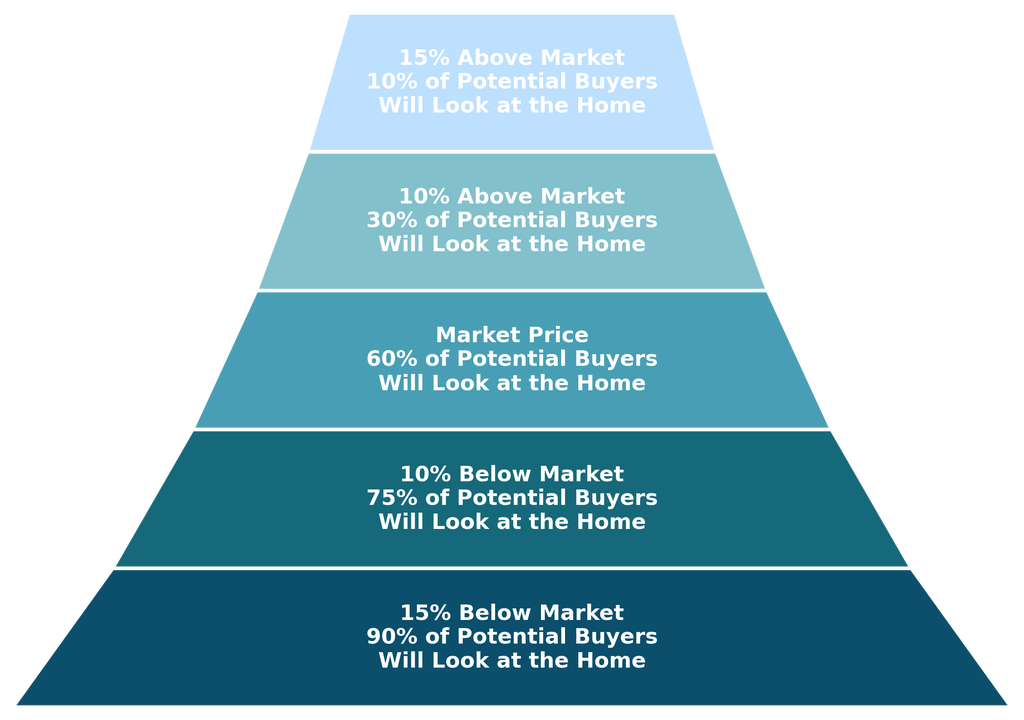
When a listing is priced well above comparable sales, only a small number of buyers will even look at it and the home may sit on the market for too long; eventually price reductions can make buyers question its condition. Pricing close to market value – the middle of the pyramid – attracts the largest pool of buyers and generates competitive interest. Pricing well below market value can draw attention, but many sellers fear this will make buyers assume there must be hidden problems.
In addition to the general price level, search behavior on real estate websites is bracketed – that is, buyers begin and end their searches at certain price points. Buyers typically filter properties by round numbers (often in increments of $50,000 or, more typically in the Bay Area, $100,000). If your price falls just below a bracket (or “bridge point”), you risk missing buyers who search starting at the point just above. I’m reminded of a condo listing I saw last year that illustrates this point very well:
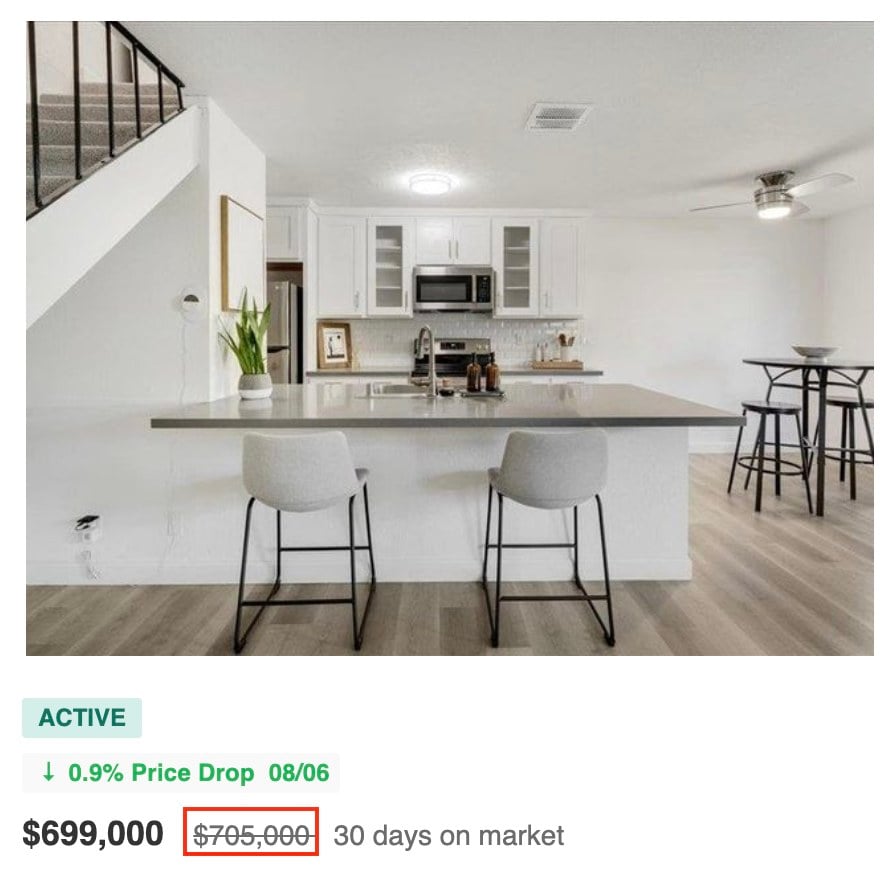
The seller of this property made a strategic blunder by pricing their property at $705,000 – just above a major bridge point, which is $700,000. Anyone searching for a condo up to $700,00 would not have found this condo – all because they inexplicably decided to list at $705,000 so they would, I’m sure, “leave room to negotiate” and still clear $700,000. So after 30 wasted days on market, they dropped the price to $699,000 – which is better, but still also not smart.
I say $699,000 isn’t smart either because nobody searches from $0-$699,000 – everyone would search from $0 to $700,000 – so yes, $699,000 would show up for all of those searches, but the seller has just given away $1,000 because the listing would show up just the same if it were listed at $700,000 in a $0 to $700,000 search.
And of course, some buyers – I would argue the better buyers – won’t start at $0 for their search. They will search in a range, and if buyers are starting their search at $700,000 (because everything they’ve seen under that price is something they “wouldn’t consider living in”), the listing priced at $699,000 wouldn’t show up in that search.
By pricing “on the bridge,” your listing will show up in searches for prices both above and below the price you set. To me, pricing on the bridge is the smartest and best way to price homes in Silicon Valley.
Does your place need a little work?
Sell As-Is. Sell for More.
No remodel, no lowball investor offer. Most Bay Area sellers net more selling as-is, and I'll show you how to get full market value without fixing a thing.
Show Me How →
Getting to True Market Value From Bridge Pricing
Using the condo listing above, let’s imagine that an analysis of comparable sales informed us that the unit is actually worth $725,000. There are recent, solid, model-match comps that make it plain that it should sell for $725,000 – so wouldn’t you be leaving $25,000 on the table if you price it at the $700,000 bridge point?
To that, I would say that if the home in the Bay Area is listed below market value – even a little below market value – the market will respond with multiple offers. Buyers have a better sense of market value than anyone else, because they’re out there voting with their dollars. If the property is clearly worth $725,000 and it’s priced at $700,000, you would get offers to prove it. Certainly, the offers may not come in at $725,000 – you may have to negotiate them to get to that price – but if buyers see $725,000 they’ll pay that much, even if it’s listed at only $700,000.
But here’s the thing: pricing it at the bridge point below your estimated sale price solves another problem, which is that sellers (and their agents) frequently over-estimate market value. It could be that the comparable sales data shows a solid $725,000 value – or so you think. It could be that your location in the complex is less desirable, or that the condition of your property is slightly inferior – or it could just be that the market has retreated since those recent sales closed (even if they were only a months or even weeks ago). If that’s the case, pricing it off the bridge at $725,000 will be a very costly mistake. It is much smarter – even when you think you have a solid grasp of the market value – to price below whatever you feel that is, to get maximum exposure and leave room to negotiate the price up.
The MLS: Your Most Powerful Marketing Platform
The MLS isn’t just a database; it’s a centralized marketing engine. In fact, the MLS is the cornerstone of real‑estate marketing. It allows agents to share detailed property information with a wide network of professionals and buyers, across town, across the state, and in fact, world wide. Properties listed on the MLS are also syndicated to popular public websites like Zillow, Realtor.com and Compass.com and dozens of other “major” real estate portal sites, in addition to untold thousands of individual REALTOR® websites (like mine!) – meaning your home will appear across thousands of platforms automatically. This syndication dramatically increases exposure: the listing reaches a vast pool of buyers, including those outside your immediate area.
And I’m going to be real with you for a second: the fact is, the MLS – and the thousands upon thousands of sites that syndicate its data – is the place where buyers look for property. Buyer’s don’t search for homes on Facebook or Instagram. They’re not scouring LinkedIn for a new “executive home” in Saratoga. They’re not waiting for a “Just Listed!” postcard to hit their mailbox. They’re not doom scrolling through TikTok to discover the perfect single level home in Silver Creek.
Real buyers who want to buy a home right now are searching for homes listed for sale on the MLS. They’re not looking anywhere else. They’re not perusing the classifieds section of the Carmel Pinecone looking for an amazing Tudor-style home in Carmel Village. True, they might, by pure luck, find a home off the MLS, in any of those places REALTOR®s sometimes post their listings – but that is certainly not a strategy that is going to get your home in front of the vast, overwhelming majority of the buyer pool who’s ready, willing, and able to buy your home.
In short, there is no better platform for marketing a home. But simply putting your property in the MLS isn’t enough if you want to get the best price and terms on the sale of your home. To make the most of this tool, you need to optimize your listing so it ranks well in searches and appeals to buyers immediately. Here are the strategies I use to ensure each listing stands out.
Want to Sell For the Highest Price Possible?

Optimizing Your MLS Listing: A Step‑by‑Step Guide
1. Professional Photos and Media
In a world where 90 percent of buyers start their search online, your photos are your first showing. High‑quality, professionally lit photography makes your property stand out. A real estate marketing guide recommends investing in professional photography and paying attention to lighting and angles to showcase the home in its best light. For larger or unique properties, consider video tours and 3D or virtual‑reality walkthroughs. Video tours provide an immersive experience and can capture the attention of online users, while 3D tours allow buyers to explore the property from home.
2. Compelling and Accurate Descriptions
Once photos hook a buyer, the description needs to hold their attention. Use clear, descriptive language that highlights the property’s features, upgrades, and unique selling points. Mention what makes the home special — a remodeled kitchen, energy‑efficient systems, or an outstanding view. Avoid fluff and make sure all facts are accurate. Detail matters: include information about the neighborhood, school district, transportation, and amenities. Accurate descriptions reduce confusion and build trust.
3. Bridge Pricing For Maximum Exposure
Pricing is part of your MLS entry – the most important part, by a long shot. Overpricing will result in longer days on market and does nothing to increase how much you’ll sell the home for (just the opposite, in fact). On the other hand, underpricing may leave money on the table. Align your price so that the home is more likely to be found where a buyer begins or ends their search. Price bracketing (bridge pricing) increases exposure, and when combined with market‑value pricing, it balances visibility with value. Avoid using “just under” pricing (like $499,999) because it may exclude your listing from higher‑range searches. Instead, choose a round number at the top of a bracket so the listing shows up in both the lower and upper search filters.
For example, let’s say that you think your home is worth about $1,000,000. Many people would think that they should set their list price at $999,000 – so that it would be found when buyers are searching for homes in the range of $0 to $1,000,000. However, many buyers would search in a higher range – and they would set a minimum price for homes – so a set of better-qualified buyers would be searching from $1,000,000 to $1,500,000 – and if the listing were priced at $999,000 – that better-qualified cohort of buyers would not see your listing. By “pricing on the bridge” at $1,000,000 your listing would be seen by both sets of buyers, significantly increasing the number of eyeballs (and potentially the number of offers) your home will get.
4. Keyword‑Rich Titles and SEO‑Friendly Fields
Many MLS systems and syndicated sites allow you to enter a listing title or headline. Use this space to include relevant keywords, such as neighborhood names or property types. A guide on MLS optimization notes that strategic keyword placement in titles, meta descriptions, headings, and body content helps search engines recognize the topic and serve your listing to potential buyers. Avoid keyword stuffing; instead, incorporate phrases naturally. For example, “Remodeled 4‑Bedroom in Sunnyvale’s Cherry Chase District” tells buyers exactly what they’re getting and includes a common search term.
Hate to wait?

5. High‑Impact Fields and Data Accuracy
MLS forms include numerous fields for data. Complete as many as possible — not just the basic facts. Fill out room dimensions, energy‑efficiency upgrades, HOA fees, and any special features (e.g., pool, solar panels). Comprehensive data not only builds trust but also improves search results because many buyers filter by specific criteria. Provide accurate square footage and lot size; mis‑reported numbers can trigger appraisal issues or legal problems later. Include the property’s tax ID and any restrictions upfront so there are no surprises.
6. Highlight Neighborhood and Lifestyle
Buyers aren’t just purchasing a house; they’re buying a lifestyle. Use the agent remarks section to highlight nearby amenities — parks, trail systems, public transit, shopping, dining, and community events. If your area offers excellent schools or convenient commuting options, mention those specifically. For homes with energy‑efficient upgrades (solar panels, upgraded insulation, energy‑efficient appliances), call these out. Many buyers prioritize sustainability and long‑term cost savings, and these features can be differentiators.
7. Use Virtual Staging and Professional Staging Wisely
While a peer‑reviewed staging study suggests that renting furniture and décor does not reliably raise sale prices, it can improve presentation and help buyers imagine living in the space. That said, staging should be treated as marketing, not as a reason to overprice the home. If you’re on a tight budget, virtual staging can be a cost‑effective alternative. Some MLS systems require you to disclose when images are digitally altered, so follow your local rules when using virtual staging.
8. Syndicate and Promote Outside the MLS
Syndication is one of the MLS’s biggest advantages, but you should also promote your listing through other channels. Share professional photos and videos on social platforms like Facebook, Instagram, LinkedIn, and YouTube. Write brief posts that link back to the full listing and invite your network to share. Consider a targeted ad campaign to reach specific buyer demographics. Email marketing to your client database can also drive traffic to the listing.
Sell your home in a weekend

9. Leverage Local SEO and Online Presence
Because buyers often search for homes in specific areas, local SEO is crucial. A comprehensive guide on MLS optimization suggests using location‑specific keywords and ensuring your business information (name, address, phone number) is consistent across all websites and directories. Local citations — mentions of your business on other websites — boost credibility and search rankings. Encourage satisfied clients to leave reviews on Google and other real estate platforms; positive reviews not only attract new buyers but also signal trust to search engines.
10. Build Off‑Page Authority
Off‑page optimization involves earning backlinks and mentions from trustworthy sites. When other websites link to your listings, search engines interpret this as a vote of confidence. You can build backlinks by writing guest articles for local blogs, participating in industry forums, or responding to media queries through services like HARO. These efforts establish authority and can lead to higher rankings and more exposure.
Change Happens

Addressing Common Seller Concerns
“Should I price high to leave room for negotiation?”
While it’s tempting to start high and negotiate down, overpricing often backfires. The pricing pyramid shows that high prices attract fewer buyers and often lead to extended time on the market. When a listing languishes, buyers wonder what’s wrong and are more likely to submit low offers. If negotiation room is important, use a bridge price at the top of a bracket. You’ll still have space to negotiate while reaching more buyers.
“Is pricing below market value risky?”
Pricing something below what you believe to be market value can create urgency and draw multiple offers. However, this strategy works best in hot markets and should be coupled with a strong marketing plan. But in all markets, hot and cold, you must understand that the law of supply and demand is ultimately what drives the price for everything, and that lower prices attract more attention (demand) which will drive the sale price higher.
“Does staging pay off?”
Staging can improve how a home looks and feels, but research suggests it does not consistently increase what buyers are willing to pay. Treat staging as marketing and avoid using it as justification to raise the price. Focus on eliminating buyer turn‑offs — odors, clutter, darkness, and obvious maintenance issues — and invest in professional cleaning. Virtual staging is a cost‑effective option when budgets are tight.
“Why do I need SEO for a real‑estate listing?”
The MLS syndicates your listing to many websites, but each platform has its own search algorithm. By using relevant keywords, optimizing photos and meta descriptions, and building backlinks, you help your listing surface higher in search results . SEO isn’t just for blogs; it’s a practical way to ensure more buyers see your property.
Conclusion: Putting It All Together
Selling a home isn’t just about setting a price and waiting — it’s about positioning the property to attract the right buyers and generate strong offers. Through bridge pricing, I align your list price with buyer search patterns and market data, maximizing exposure across price brackets. By listing on the MLS and optimizing the entry with professional media, detailed descriptions, keyword‑rich titles, complete data, and thoughtful promotion, I make sure your home stands out in a crowded marketplace. Local SEO, off‑page authority, and data‑driven adjustments further refine the strategy.
There truly is no better marketing than the MLS, but to maximize that power, you must be strategic with your listing. Bridge pricing gets more eyes on your listing; a well‑crafted MLS entry turns those views into showings and offers. If you’re thinking about selling and want a plan built on data, visibility, and real‑world experience, let’s talk. Together we can price your home strategically, optimize your MLS listing, and create the exposure needed to achieve the best possible outcome.
Frequently Asked Questions
Should I price my home just under a round number?
Probably not. Real estate searches are often grouped into round-number price bands. Inman advises that pricing at the top of a band (for example, $400 000 instead of $399 999) captures buyers searching both above and below that threshold [oai_citation:0‡inman.com](https://www.inman.com/2025/12/08/how-to-help-sellers-price-homes-strategically-in-a-shifting-market/#:~:text=margins%20and%20keep%20sellers%20from,trapped%20in%20downward%20pricing%20trends). “99” pricing may exclude your listing from a larger pool of buyers [oai_citation:1‡inman.com](https://www.inman.com/2025/12/08/how-to-help-sellers-price-homes-strategically-in-a-shifting-market/#:~:text=margins%20and%20keep%20sellers%20from,trapped%20in%20downward%20pricing%20trends).
Why list on the MLS instead of selling on my own or only on social media?
The Multiple Listing Service (MLS) syndicates your home to all major real‑estate websites, reaching the broadest audience of qualified buyers. Realtor.com notes that homes listed on the MLS get more eyeballs and generally sell for higher prices, while for‑sale‑by‑owner homes typically net less [oai_citation:2‡realtor.com](https://www.realtor.com/advice/buy/what-is-the-mls-multiple-listing-service/#:~:text=you%27re%20a%20regular%20Joe%20who,specific%20policies%20surrounding%20pocket%20listings).
Do professional photos and virtual tours really help?
Yes. Inman reports that nearly three‑quarters of agents hire professional photographers and that high‑quality photos, video tours and 3‑D tours lead to faster sales and bolster an agent’s reputation [oai_citation:3‡inman.com](https://www.inman.com/2021/10/19/virtual-staging-more-popular-than-conventional-staging/#:~:text=that%20is%20dominating%20real%20estate,%E2%80%9D). Because most buyers start their search online, polished visuals are essential.
Does staging guarantee a higher sale price?
Staging makes a home easier to visualise and can shorten time on market, but it doesn’t guarantee a higher sale price. The National Association of Realtors’ 2017 Profile of Home Staging found that 39 % of seller’s agents said staging greatly decreases days on market and 77 % of buyer’s agents said it helps buyers imagine themselves living there [oai_citation:4‡inman.com](https://www.inman.com/2017/07/21/does-staging-add-value-to-the-home-selling-process/#:~:text=In%20the%20National%20Association%20of,%E2%80%9D). Decluttering, neutralising colours and professional cleaning often produce a better return than full staging [oai_citation:5‡inman.com](https://www.inman.com/2017/07/21/does-staging-add-value-to-the-home-selling-process/#:~:text=In%C2%A0my%20experience%2C%20this%20is%20a,from%20the%201980s%2C%20for%20example).
Can I price high and just negotiate down later?
Overpricing limits exposure. Buyers filter by price, so a high list price can reduce the number of people who see your home. Pricing at a market‑supported level creates urgency and invites multiple offers, giving you leverage to negotiate. Pricing too high often leads to longer days on market and lower final offers.
How can I optimise my MLS listing for maximum visibility?
Complete every field—room sizes, upgrades, HOA fees and amenities—so your property appears in more search filters. Write a clear, honest description highlighting key features and neighbourhood benefits. Use natural language with location names in the remarks and captions (e.g., “Sun‑filled 3‑bedroom in [neighbourhood]”) and avoid keyword stuffing. Pair this with professional photos and, if budget allows, video or 3‑D tours to capture buyer interest [oai_citation:6‡inman.com](https://www.inman.com/2021/10/19/virtual-staging-more-popular-than-conventional-staging/#:~:text=that%20is%20dominating%20real%20estate,%E2%80%9D).
Should I renovate before listing?
Major renovations rarely return every dollar invested. Focus on high‑ROI prep: fix obvious defects, freshen paint, update lighting and address buyer turn‑offs like odours or grime. Buyers will pay more for a well‑maintained home with good bones than for design choices they may undo. Simple improvements and strategic pricing usually outperform large remodels.
Time to talk to a REALTOR?

Senior Friendly Homes in Silicon Valley South
2
3
4
5
6
7
8
9
10
11
12
13
14
15
16
17
18
19
20
21
22
23
24
25