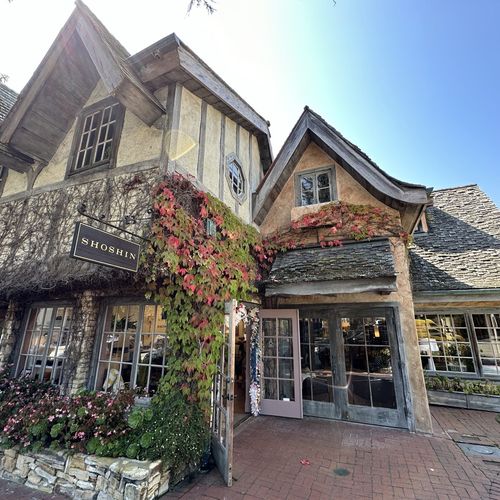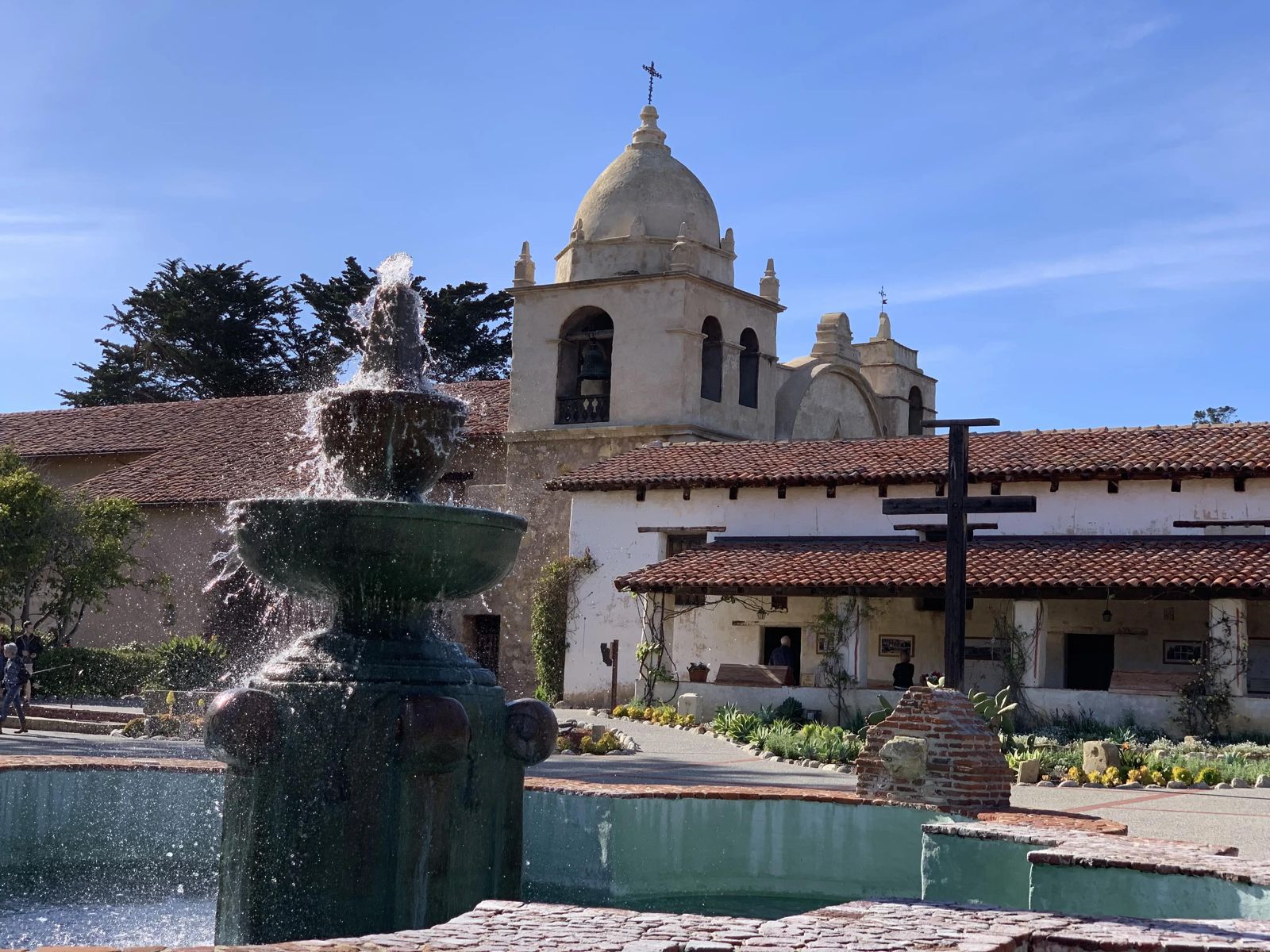
If you’ve driven down Highway 1 into Carmel and turned off at Rio Road, you’ve probably seen that dome peeking over the cypress trees and wondered if it’s worth stopping. It is, and it’s one of my favorite places on the whole Central Coast. I’m a Bay Area native, I’ve spent more than 23 years helping families buy and sell homes from Silicon Valley down through Monterey County, and I’ve been visiting the Carmel Mission for years. The photos in this guide come from my own visits over the years, in fog, in sunshine, and in the springtime when the bougainvillea is so bright it almost hurts to look at it.
The Carmel Mission, officially Mission San Carlos Borromeo de Carmelo, is where Saint Junípero Serra lived, worked, and is buried. It was the headquarters of the entire California mission chain, it holds the oldest statue of Mary in California, and it’s home to what’s considered the state’s first library. It’s also an active Catholic parish and a basilica, so you’re walking through a place that’s still very much alive. This guide covers the history, what to see, what it costs, how to plan your day, and what it’s like to live nearby.
Key Takeaways
Summary: The Carmel Mission Basilica in Carmel-by-the-Sea is one of the most beautifully restored of California’s 21 Spanish missions and the final resting place of Saint Junípero Serra. Founded in 1770 and moved to the Carmel River in 1771, it served as the headquarters of the mission system, and its 1797 sandstone church, museums, gardens, and cemetery tell the story of the Franciscan friars and the Rumsen Ohlone and Esselen people who built and lived at the mission. Plan on two to three hours, check the hours before you go because the basilica can close for weddings and services, and pair your visit with Carmel River State Beach, Point Lobos, or a stop at Mission San Juan Bautista on the drive home.
Table of Contents
- Carmel Mission at a Glance
- A Short History of the Carmel Mission
- Inside the Carmel Mission Basilica
- Our Lady of Bethlehem
- The Museums, Serra’s Bible, and California’s First Library
- Gardens, Courtyards, and the Mission Cemetery
- The Bells of the Carmel Mission
- Tips for Planning Your Visit
- Make It a Mission Day with San Juan Bautista
- Living Near the Carmel Mission
- Frequently Asked Questions
Carmel Mission at a Glance
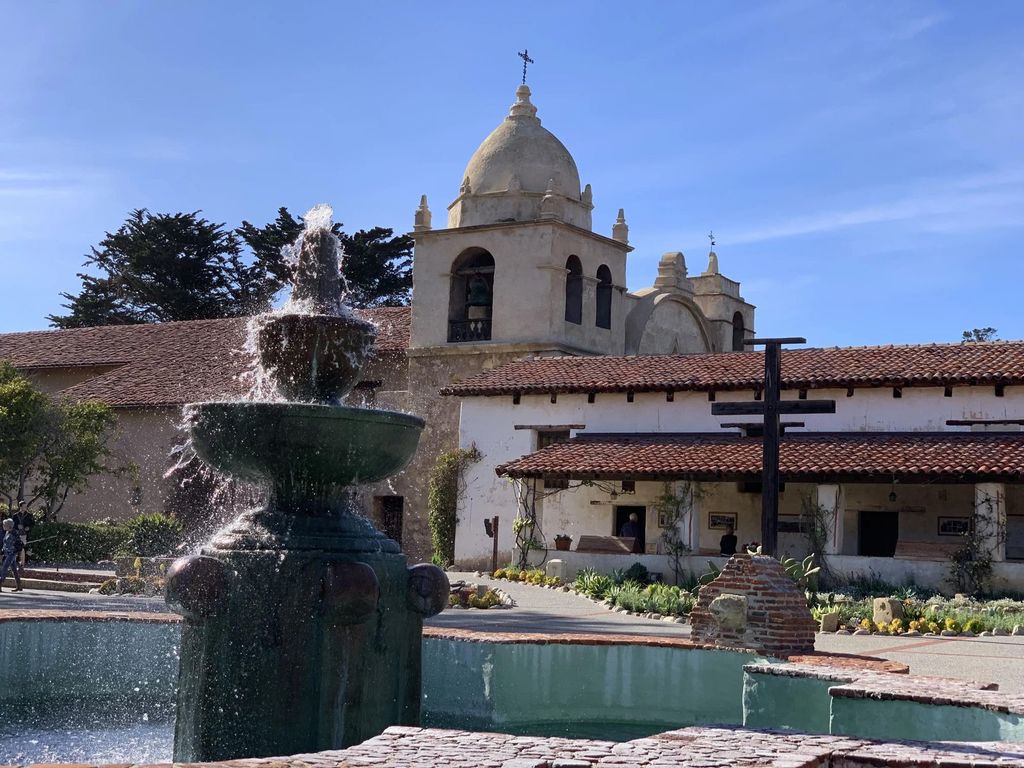
On a clear day the courtyard fountain frames the Moorish-style bell tower perfectly, and it’s the shot everybody takes for a reason.
- Official name: Mission San Carlos Borromeo de Carmelo, also called the Carmel Mission Basilica
- Address: 3080 Rio Road, Carmel, CA 93923
- Hours: Wednesday and Thursday 10 a.m. to 4 p.m., Friday and Saturday 10 a.m. to 5 p.m., Sunday 11:30 a.m. to 5 p.m., closed Monday and Tuesday (the grounds close 15 minutes before the Mission Store)
- Admission: $15 adults, $12 seniors 62+, $8 youth ages 7 to 17, free for kids 6 and under
- Phone: 831-624-1271
- Time to allow: Two to three hours if you want to see the basilica, museums, gardens, and cemetery without rushing
- Getting there: About 75 miles from San Jose (roughly an hour and a half without traffic) and about an hour from Santa Cruz
Hours and prices come straight from the Carmel Mission’s visitor information page, and they do change, so give it a quick look before you head down. Admission includes a self-guided tour of the basilica, the museums, and the grounds.
A Short History of the Carmel Mission
Father Junípero Serra founded Mission San Carlos Borromeo on June 3, 1770, right next to the Spanish presidio in Monterey. It was the second mission in Alta California after San Diego. Serra didn’t love the location, between the soldiers and the poor farmland, so the next year he moved it about five miles south to the mouth of the Carmel River, where there was fresh water, good soil, and some distance from the garrison. The mission was re-established there on August 1, 1771, and Serra made it his home and the headquarters for the whole mission system until he died.
This land wasn’t empty when the Spanish arrived. The mission sat near Rumsen Ohlone villages, and Esselen people lived in the mountains to the south. Thousands of Native Californians were baptized here, and they did the actual work of building the mission, farming its fields, and raising its livestock. Life under the mission system was hard and often brutal for them, and disease took a terrible toll. That history is part of the story, and you’ll feel it most in the cemetery, which I’ll get to below.
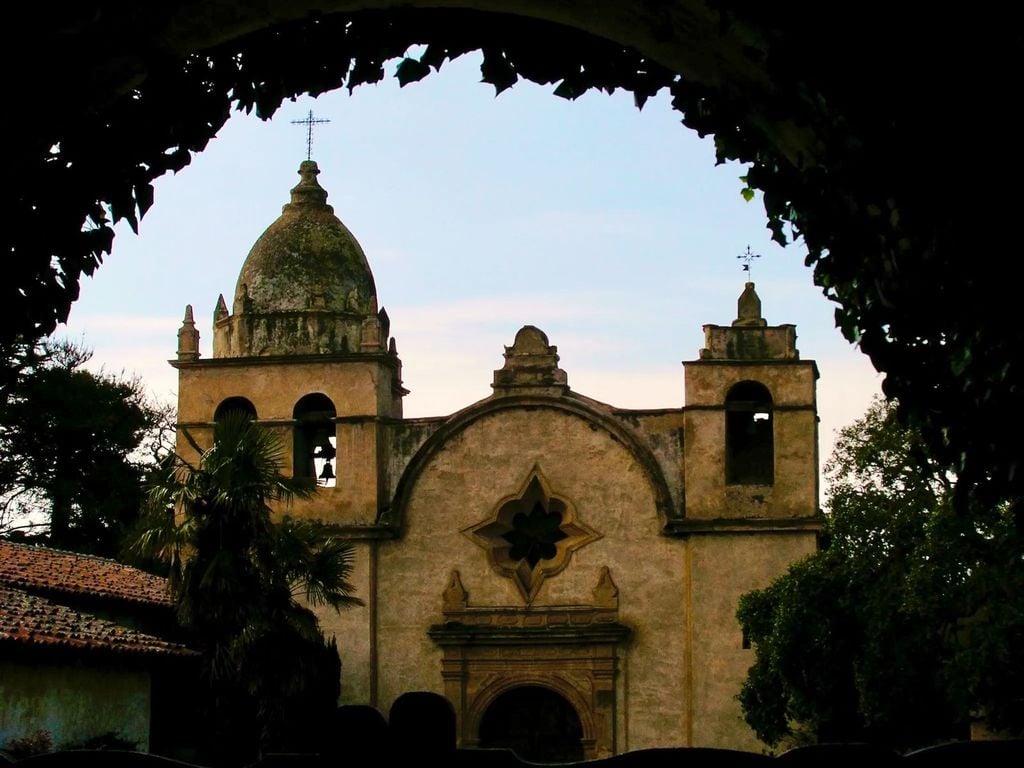
The basilica facade at dusk, with the star-shaped window over the entrance and the domed bell tower on the left.
Serra died at the mission on August 28, 1784, and was buried beneath the floor of the adobe church next to his friend and fellow friar Juan Crespí. His successor, Father Fermín Francisco de Lasuén, decided the mission deserved something more permanent. Work on the stone church began in 1793, led by master stonemason Manuel Ruiz, using sandstone quarried in the Santa Lucia Mountains, and it was dedicated in 1797. They built it right over Serra’s grave, which is why he’s still in the sanctuary today.
After Mexico secularized the missions in the 1830s, the Carmel Mission was abandoned and slowly fell apart. The roof caved in around 1852, and for decades cattle and weather had their way with it. Father Angel Casanova put a new steep roof on it in 1884, and then the real rescue started in 1931 when a cabinetmaker named Harry Downie was hired to help. Downie ended up spending about 50 years on the restoration, researching the original design, tracking down artifacts, and rebuilding the padres’ quarters and the church roof. He’s the reason the Carmel Mission looks the way it does, and he’s buried in the cemetery here.
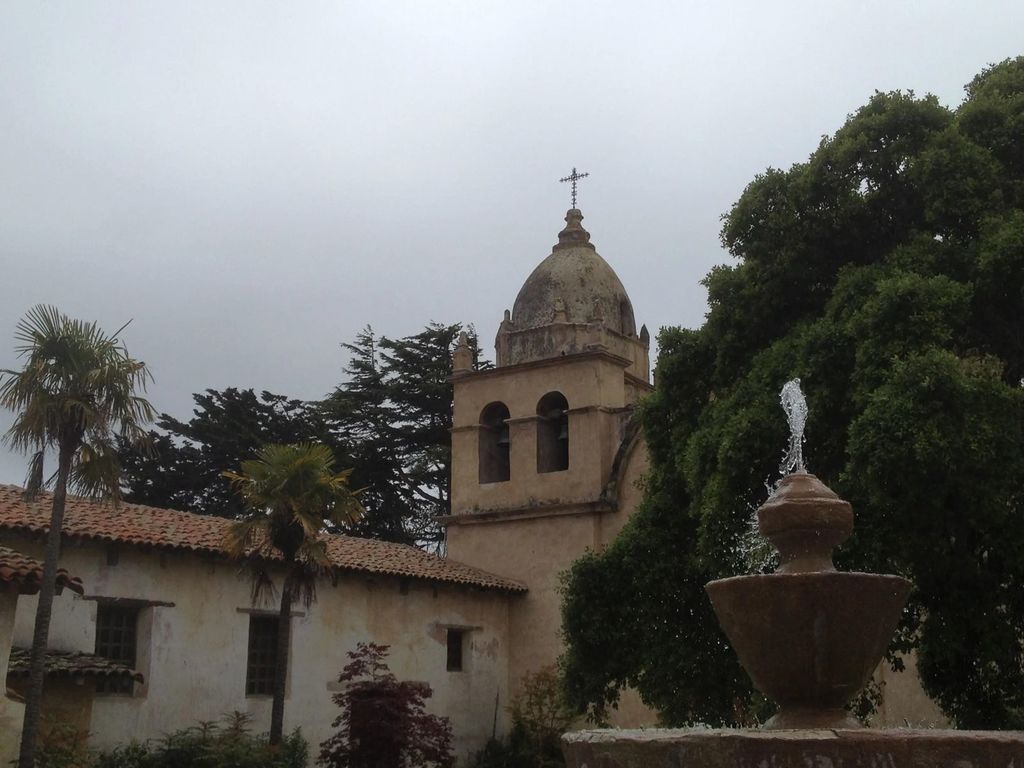
The same bell tower on a typical foggy Carmel morning, which might be my favorite way to see it.
The honors piled up after that. Pope John XXIII named it a minor basilica in 1960, the same year it was designated a National Historic Landmark. Pope John Paul II visited in 1987 and laid flowers on Serra’s grave, and Pope Francis canonized Serra in 2015. If you want to go deeper, the mission’s own brief history is a good read.
Inside the Carmel Mission Basilica
Walk through the front doors and the first thing you’ll notice is the ceiling. The interior is a long, narrow tunnel vault shaped like a parabolic arch, and according to the National Park Service it’s unique among the California mission churches. The walls are about five feet thick, so even on a warm day it’s cool and hushed inside. The bell tower outside, with its rounded dome, shows a Spanish-Moorish influence you won’t see at most of the other missions.
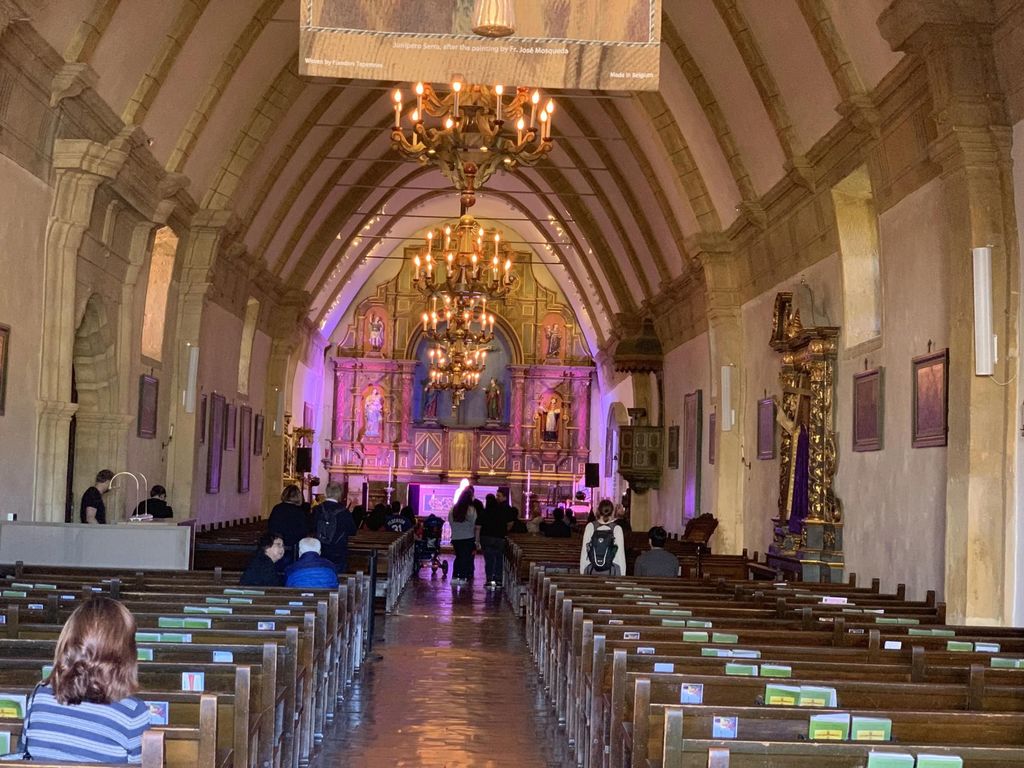
The basilica nave with its candle chandeliers and the painted reredos at the far end. The tapestry overhead is of Junípero Serra, woven in Belgium after a painting by Fr. José Mosqueda.
Up front in the sanctuary is Serra’s grave. He’s buried alongside Juan Crespí, Fermín Francisco de Lasuén, and Julian López, which makes this little patch of floor one of the most significant spots in early California history. Nearby is a gilded reliquary made in 1984 that holds fragments of Serra’s original redwood coffin. Serra’s remains have actually been exhumed five times over the years, most recently in 1987, which is the kind of trivia that makes for great conversation on the drive home.
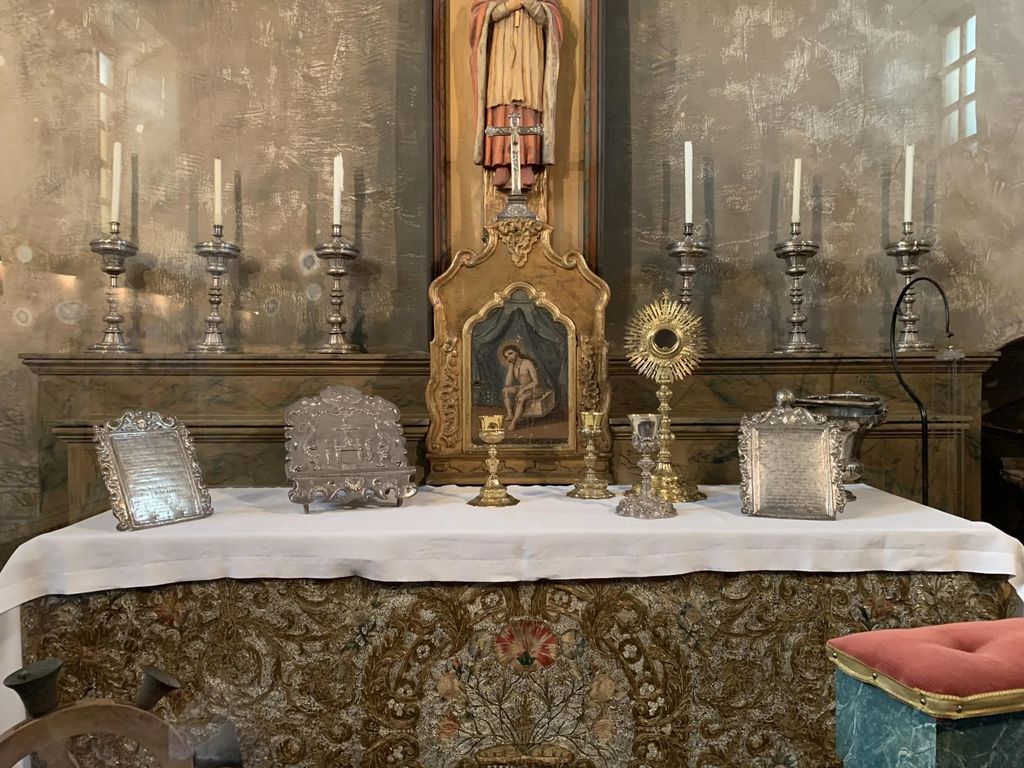
Silver altar cards, gilded chalices, and a sunburst monstrance from the mission’s collection. The craftsmanship up close is incredible.
Because this is an active parish, you’ll often see people praying, and the basilica can close for Masses, weddings, and funerals. Please keep your voice down and be respectful. If you’re around in December, keep an eye out for the Christmas concerts held in the basilica, including Chanticleer’s annual holiday performances. The acoustics in that long stone room are something else.
Our Lady of Bethlehem
Off to the side of the nave is the Our Lady of Bethlehem Chapel, and the statue inside is a big deal. It was carved in Spain in the 1400s, Serra brought it with him on the 1769 expedition north to Monterey, and it’s considered the oldest statue of Mary in California and the second oldest in the United States. Here’s my favorite detail: she stands 5 feet 2 inches tall, the same height as Serra himself. Harry Downie restored the statue, and the mission’s Our Lady of Bethlehem page tells the full story.
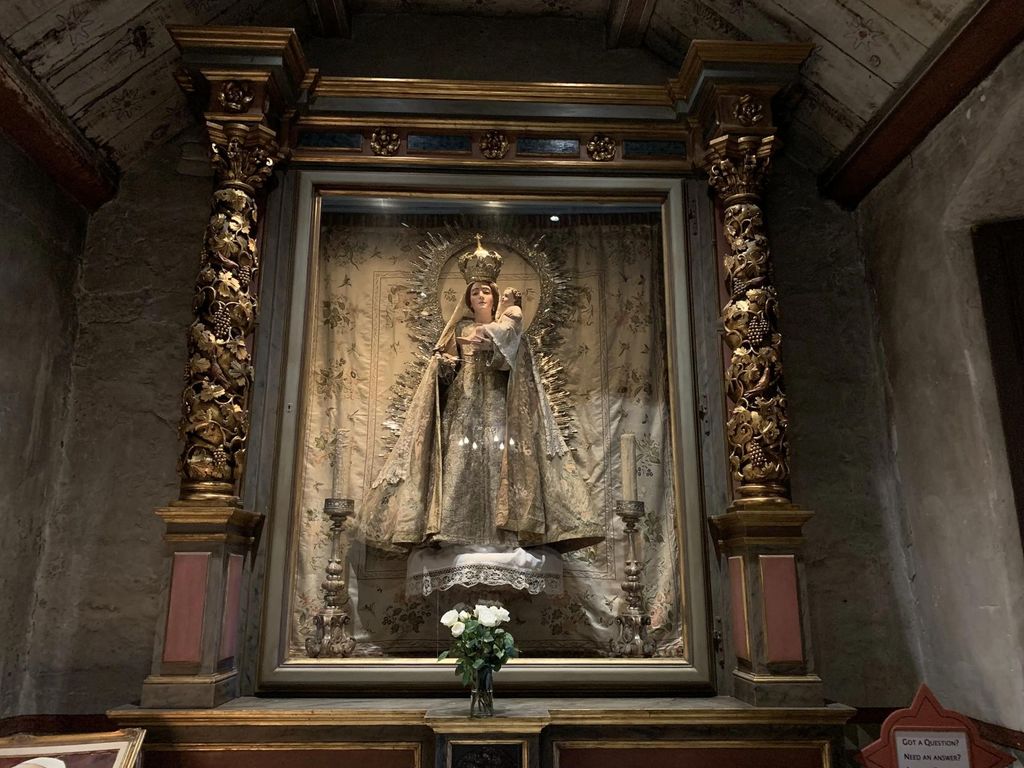
Our Lady of Bethlehem in her chapel, framed by gilded columns carved with grapevines and birds.
Take a minute to look at the twisted columns on either side. They’re carved with grapes, leaves, and little birds, and the whole altar glows when the light hits it. A lot of visitors walk right past this chapel on the way to the museums, and they miss one of the best things here.
The Museums, Serra’s Bible, and California’s First Library
The museum rooms around the quadrangle are where the mission really comes to life for me. The Convento Museum holds Serra’s own Bible, a 1568 edition printed in Lyon, France, that’s believed to be the oldest Bible in California. Ronald Reagan was sworn in as governor on it in 1967. You’ll also see Serra’s Caravaca cross, a small reliquary cross from his hometown in Mallorca that was found on his chest when his grave was opened in 1943.
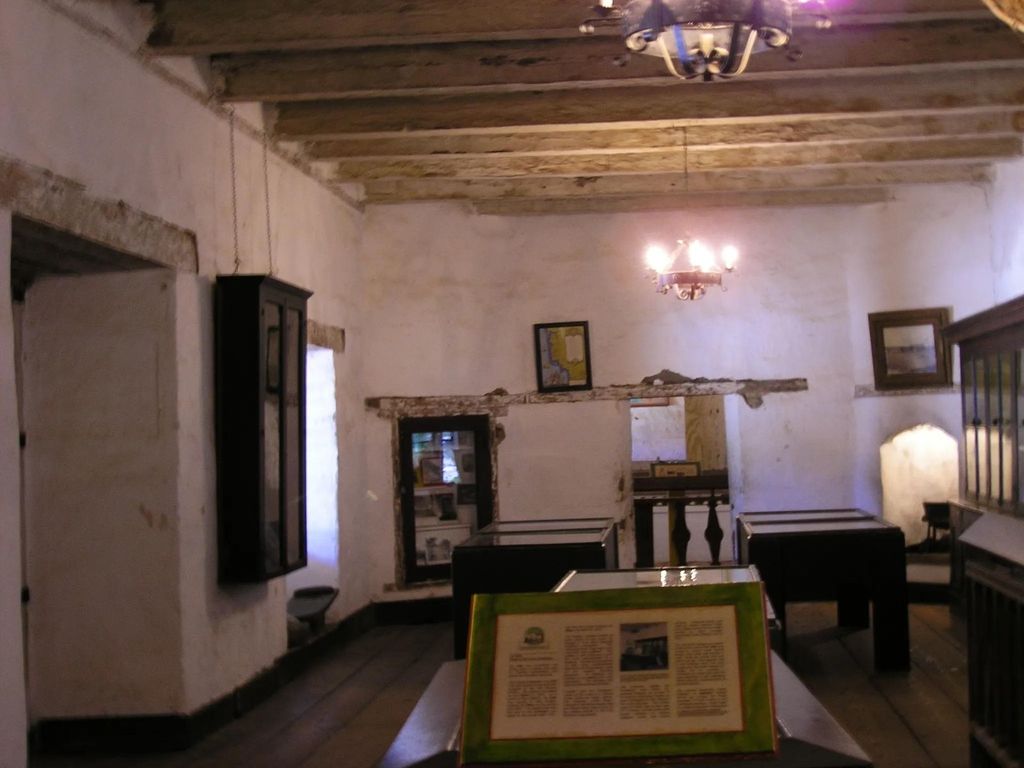
One of the whitewashed museum rooms, with hand-hewn ceiling beams and display cases full of documents, maps, and photographs.
This is also where you’ll find California’s first library. By 1800 the mission had collected around 400 books, which was a remarkable library on what was then the far edge of the Spanish empire. The collection was scattered after secularization, but 229 of the original titles were tracked down and brought back in 1949, and some still carry Serra’s handwritten notes. As someone who’s helped a lot of families sort through generations of belongings when they downsize, I always think about what it took to find and recover those books.
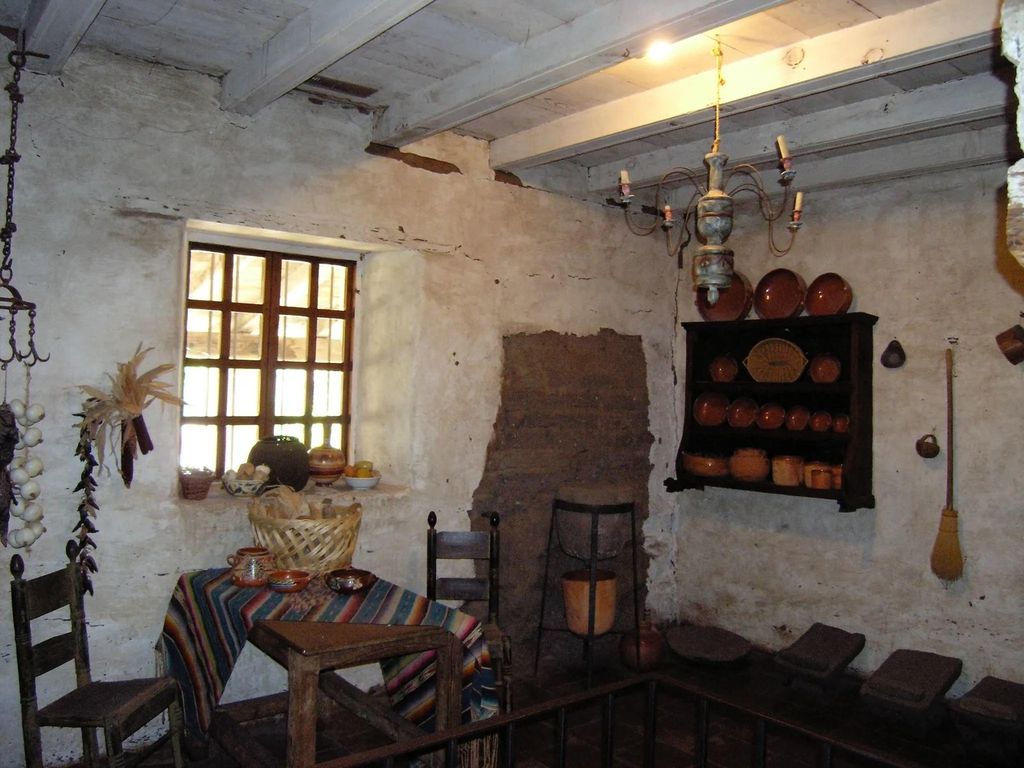
The recreated mission kitchen, with clay cookware, grinding stones, dried corn, and strings of chiles and garlic.
Don’t skip the kitchen exhibit, either. It’s a simple room, but it gives you a real sense of everyday life here, from the clay pots to the stone metates used for grinding corn. Then head to the Mora Chapel to see the Serra Memorial Cenotaph, a bronze and marble tomb sculpture that artist Jo Mora worked on from 1920 to 1924. It shows Serra lying in repose with a bear cub at his feet and Crespí, Lasuén, and López around him. It was too big for the sanctuary, so they built a chapel just for it.
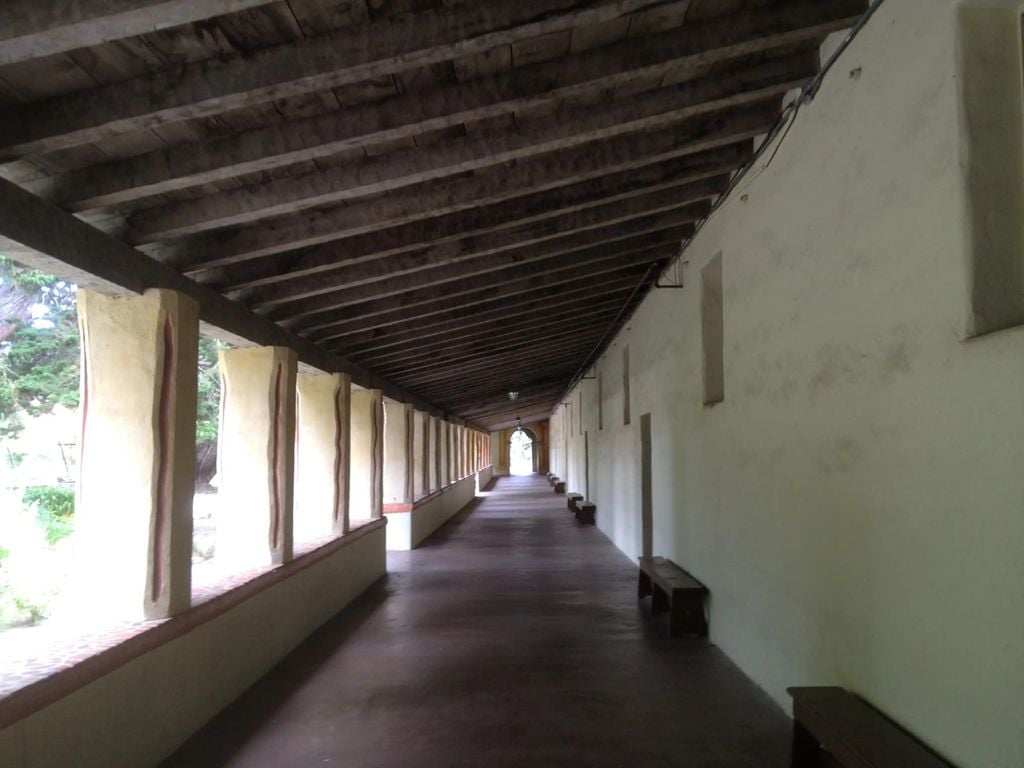
The long covered corridor along the quadrangle is the perfect spot to sit on a bench and take a breather between museum rooms.
Gardens, Courtyards, and the Mission Cemetery
The gardens are reason enough to visit. Carmel’s mild coastal climate means something is blooming almost all year, and the bougainvillea here is famous. There’s a magenta one by the bell tower that’s grown into a giant ball of color, and a purple one that climbs the wall beside an old wooden door like it’s trying to get inside. You’ll also see birds of paradise, roses, succulents, and pomegranates scattered around the paths.
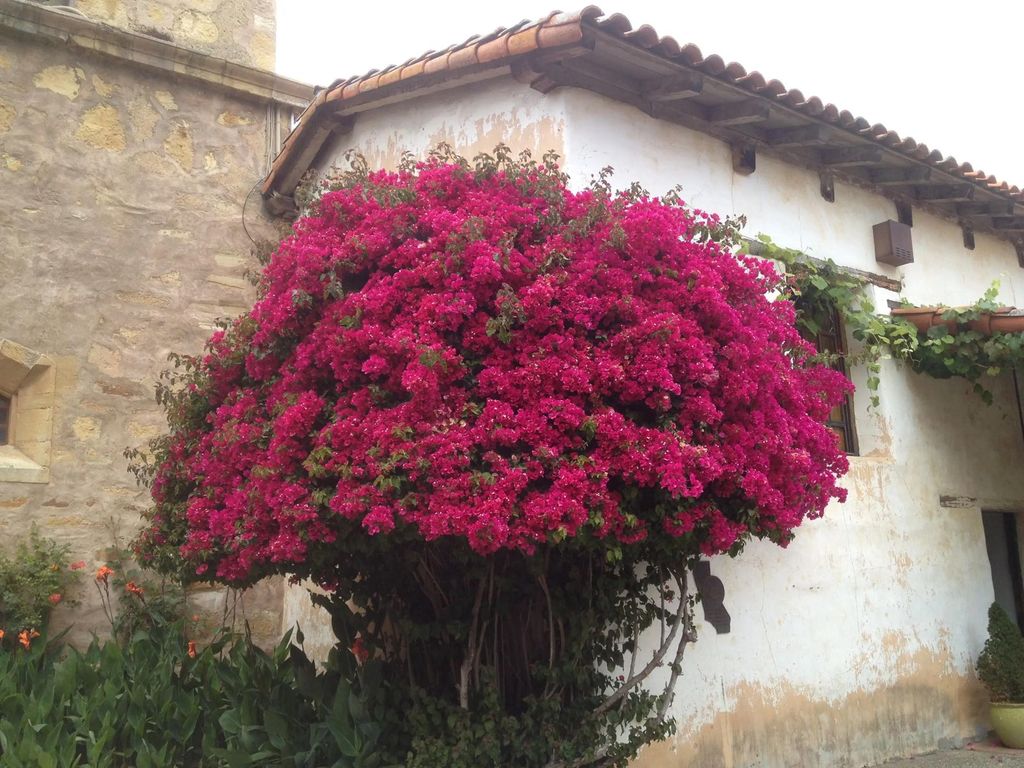
This magenta bougainvillea against the whitewashed adobe is one of the most photographed plants on the Monterey Peninsula.
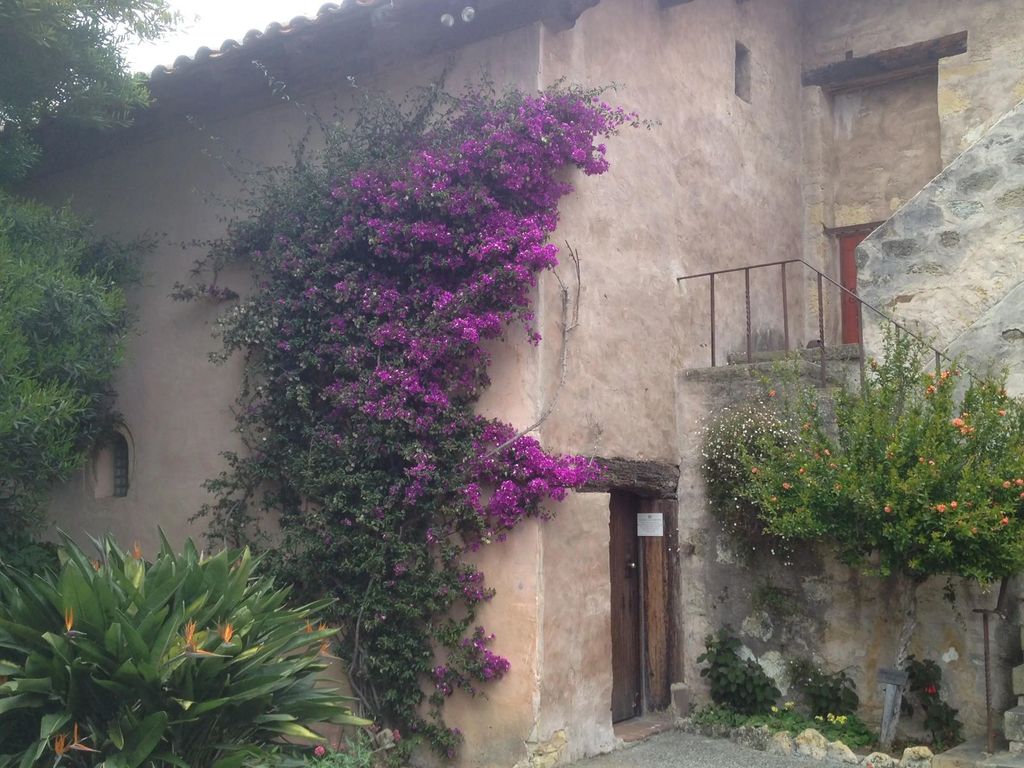
Purple bougainvillea, birds of paradise, and a stone staircase in one of the quieter corners of the courtyard.
As you wander, keep an eye out for the little shrines tucked into the walls. My favorite is the Holy Family shrine, a baroque plaster frame with a blue and white tile mural in the center and a double-barred cross on top. People leave flowers there all the time, and the way the light hits it in the late afternoon is beautiful.
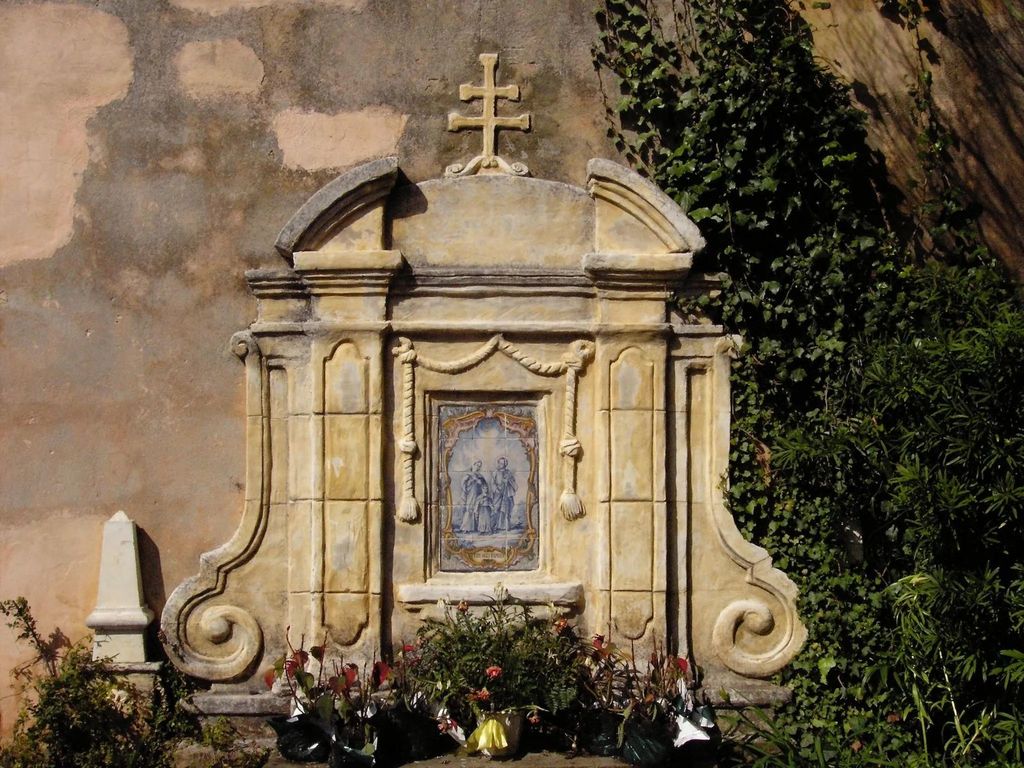
The Holy Family tile shrine, with fresh flowers left by visitors at its base.
The cemetery next to the basilica is the most moving part of the visit. An estimated 3,000 to 4,000 Native Americans are buried here, and many of the graves are marked with abalone shells, a Native tradition you’ll see throughout the grounds. One of the best known graves belongs to Old Gabriel, a mason who helped build the mission. His headstone says he lived to 151, though later research puts his age closer to 119, which is still pretty astonishing. The mission’s must-see features page has more on the cemetery and the other highlights.
The Bells of the Carmel Mission
The bells have their own story. The “Ave Maria” bell in the tower was cast in Mexico City in 1807 and installed here in 1820. It disappeared after secularization, was eventually found, and was hung back in the bell tower in 1925. It’s one of those details that sums up the whole mission, which was lost, scattered, and then patiently pieced back together.
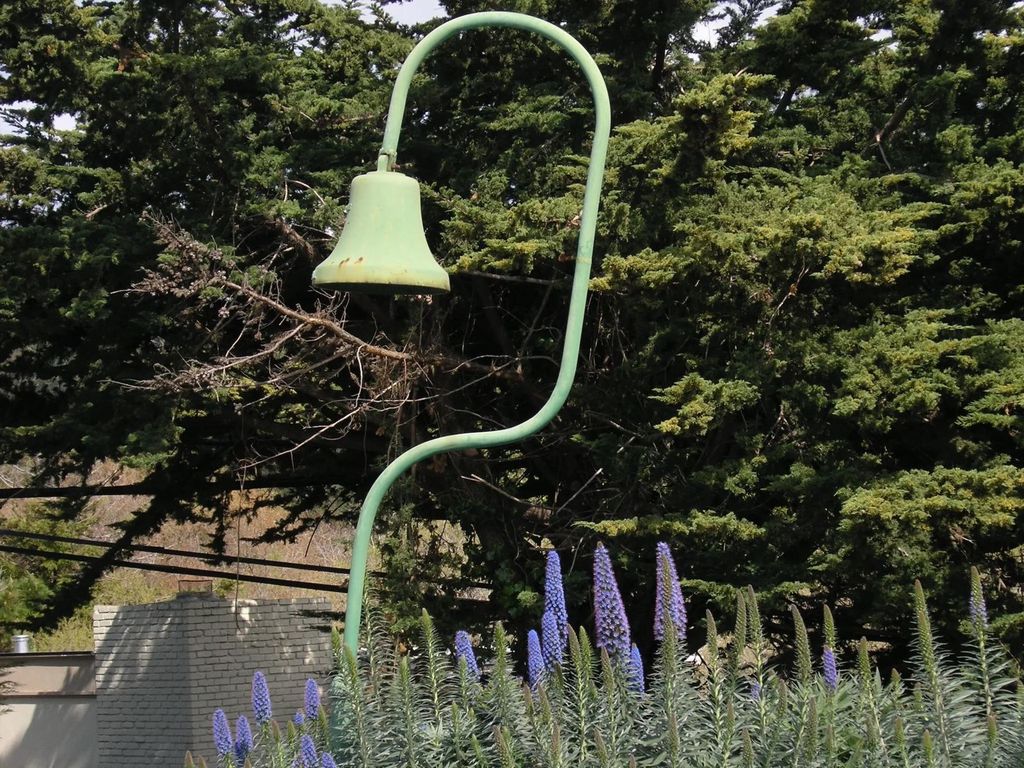
A green El Camino Real bell marker on its shepherd’s crook post, surrounded by blue pride of Madeira in full spring bloom.
You’ll also notice the shepherd’s crook bell markers along the roads here. These are El Camino Real bells, which began going up in 1906 to mark the old route connecting the missions. If you’ve ever driven Highway 101 through the South Bay and Salinas Valley, you’ve passed dozens of them, and now you’ll know what they are.
Tips for Planning Your Visit
A lot of the people I work with are in their 60s, 70s, and 80s, and many of them visit with grown kids or grandkids in tow. Here’s what makes the day easy for everyone in the group.
- Check the schedule first. The mission is closed Monday and Tuesday, and the basilica can be closed for weddings, funerals, and services even when the grounds are open. Saturdays in wedding season are the most likely to have the church closed for part of the day.
- Go on a weekday if you can. Wednesday and Thursday mornings are the quietest, and you’ll have the museum rooms mostly to yourself.
- Bring a layer. Carmel fog is real, and the thick walls keep the basilica and museums cool even in summer.
- Take your time. The grounds are mostly level, there are benches all along the corridors, and the mission has ADA-compliant restrooms. If anyone in your group has mobility concerns, call ahead at 831-624-1271 and they’ll fill you in on the best routes. The mission also posts its accessibility details online.
- Ask about the senior rate. Admission is $12 for seniors 62 and older instead of $15.
- Visiting with a group? Groups of 10 or more should email the mission ahead of time through its group tours page.
- Make a day of it. Carmel River State Beach is just down the road, Point Lobos is about ten minutes south on Highway 1, and downtown Carmel-by-the-Sea is a five-minute drive for lunch and a stroll on Ocean Avenue.
If you love this kind of outing, I’ve also written about History Park in San Jose, the Computer History Museum in Mountain View, and a whole list of things to do for seniors in the South Bay. They’re all great outings for a slow, curious day out with family.
Make It a Mission Day with San Juan Bautista
If you’re coming from Silicon Valley, Mission San Juan Bautista is an easy detour on the way home, just a few minutes off Highway 101 and about 45 minutes from Carmel. It was founded in 1797, the same year the Carmel stone church was dedicated, and it’s a completely different experience. Its church is the largest of the California mission churches and the only one with three aisles, and the colorful reredos behind the altar was painted by Thomas Doak, considered the first American settler in California.
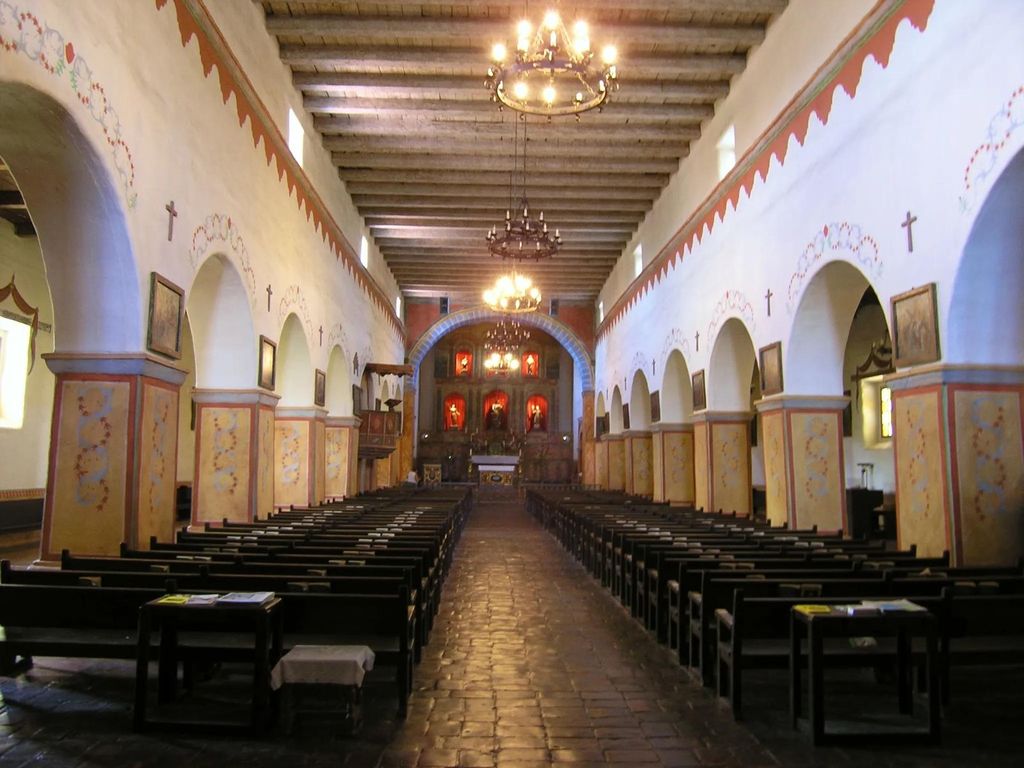
This one isn’t Carmel. It’s the three-aisle church at Mission San Juan Bautista, an easy stop on the drive back to the South Bay.
The plaza around it is part of San Juan Bautista State Historic Park, and if you’re a classic movie fan, this is the mission Alfred Hitchcock used in “Vertigo.” Seeing the two missions on the same day really shows you how different each one is. Carmel feels intimate and garden-like, while San Juan Bautista feels grand and open.
Living Near the Carmel Mission
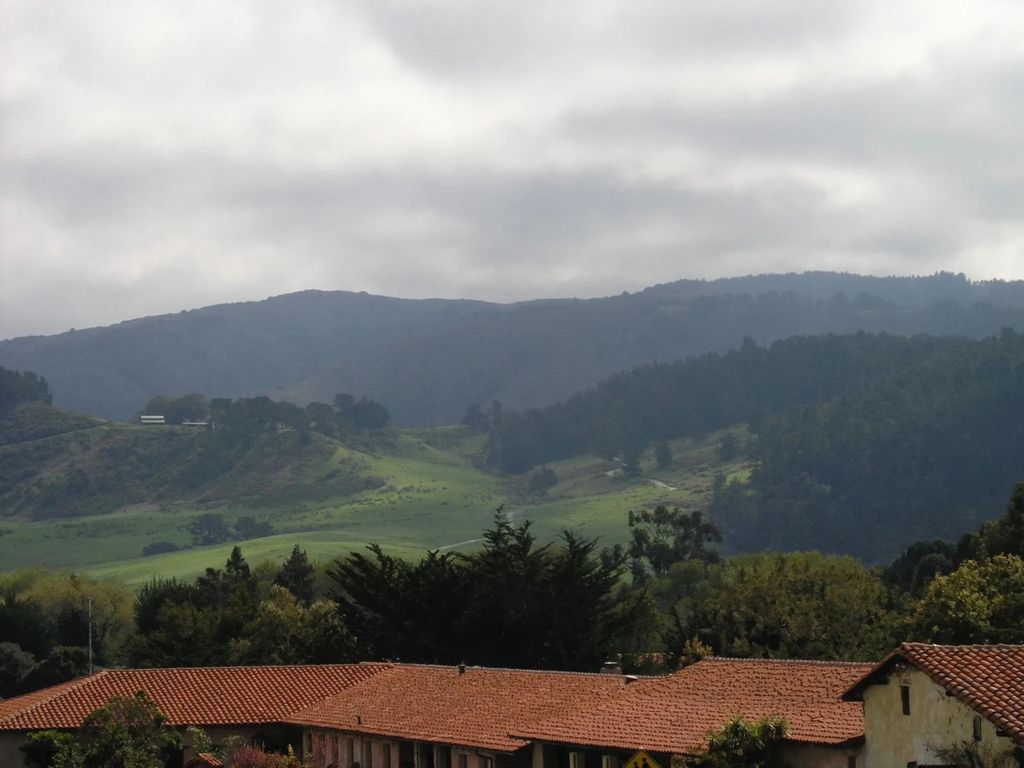
Looking past the mission’s red tile roofs toward the green hills of the Carmel River valley after a winter storm.
The neighborhoods around the mission are some of the most charming on the Monterey Peninsula. Mission Fields is right next door, Hatton Fields rises on the hill to the north, and Carmel Point is a short walk toward the beach. You’ve got Carmel River State Beach, the Crossroads shopping center, and the restaurants and galleries of Carmel-by-the-Sea all within a few minutes. Plenty of Bay Area families fall in love with this area on a day trip and eventually make it home, sometimes as a second home that later becomes a retirement home, and sometimes as a full move to the coast.
If you’re thinking about making a move like that, there’s a lot to weigh, from selling your Silicon Valley home and planning for capital gains to figuring out whether you want a single-level home, a condo, or one of the senior living communities in and around the Bay Area. You can see more about the local market on my Carmel-by-the-Sea and Monterey pages. I’m always happy to talk it through, and I’ll help you make your next move the best one yet.
Frequently Asked Questions About the Carmel Mission
Where is the Carmel Mission?
How much does it cost to visit the Carmel Mission?
What are the Carmel Mission’s hours?
Is Junípero Serra buried at the Carmel Mission?
How long should I spend at the Carmel Mission?
Is the Carmel Mission still an active church?
Is the Carmel Mission accessible for older adults and people with limited mobility?
What is the oldest thing at the Carmel Mission?
What else is there to do near the Carmel Mission?
Private Access
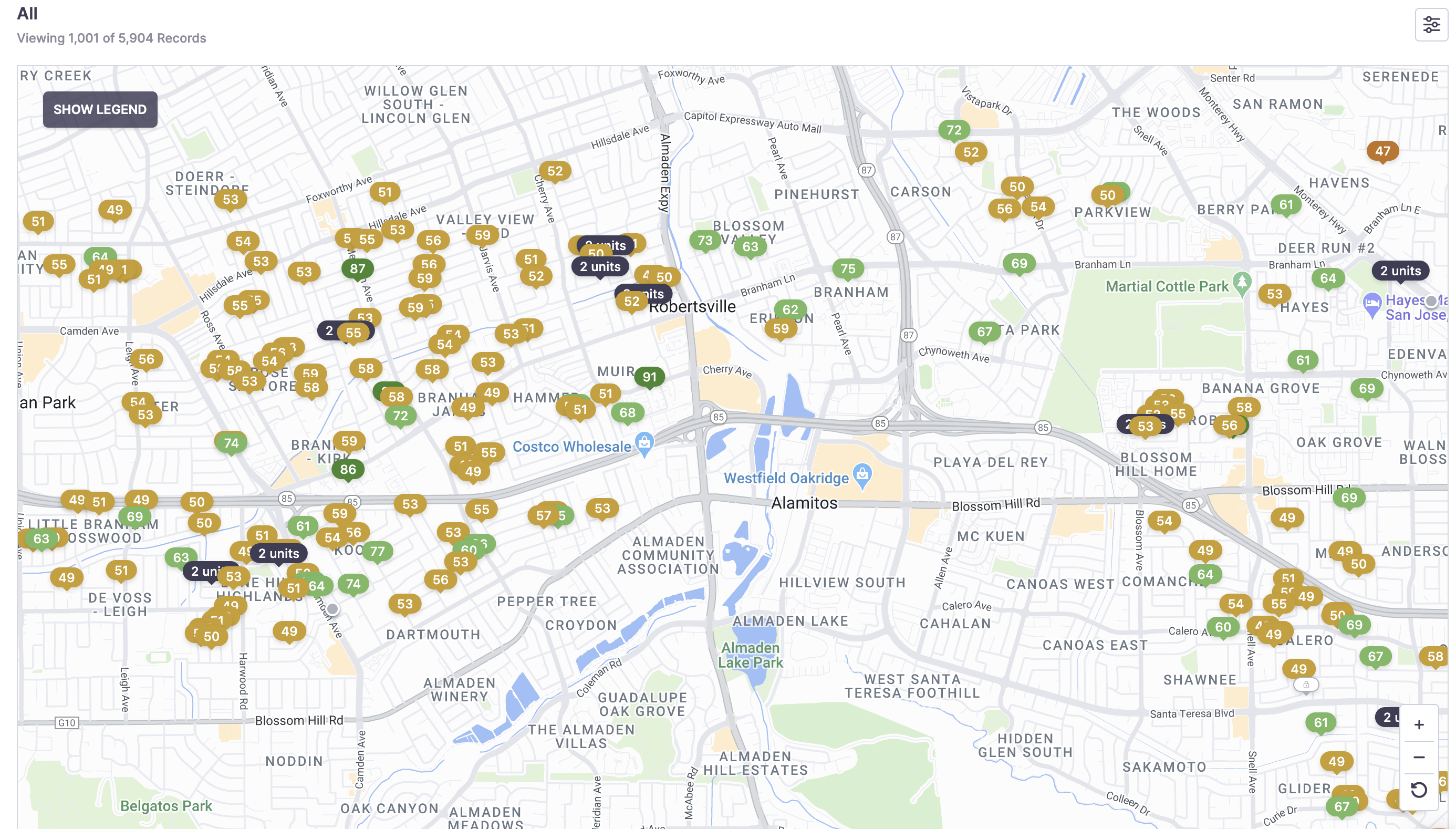
See the Bay Area Homes That Never Hit Zillow
A lot of the best homes in Silicon Valley and the Bay Area change hands quietly, before they're ever listed. Get free access to our off-market homes database and see what's available right now.
You're in. Thanks! Taking you to the off-market homes database now.
Delightful Homes For Sale in Monterey
2
3
4
5
6
7
8
9
10
11
12
13
14
15
16
17
18
19
20
21
22
23
24
25