
Three of the buyers I helped this year had a lot in common. Each one worked in tech, each had rented in Silicon Valley for years, and each bought a first home this year at an average price of about $2.5 million. None of them were new to the area. They had simply spent years asking the same question you’re probably asking right now: is it actually worth buying a house in the Bay Area, or am I better off renting and investing the difference?
I’ve been selling homes here for more than 23 years and have closed over 460 transactions, so I’ve watched this question play out through the dot-com bust, 2008, the pandemic run-up and the rate shock that followed. My honest answer is that it depends on how long you’ll stay and what you’d really do with the money otherwise. Below I’ll walk through the real numbers for a $2.5 million purchase in Santa Clara County, using current data instead of rules of thumb.
Key Takeaways
The Short Answer
If you expect to stay in the same home for at least seven to ten years, buying in the Bay Area has historically built far more wealth than renting. If you might leave in two or three years, renting is usually the smarter financial move, even for high earners. The first few years of ownership here are expensive, and the payoff comes from time, Prop 13 and forced savings rather than a quick gain.
What a $2.5 Million Home Actually Costs Per Month Right Now
The median single-family home in Santa Clara County sold for $1.9 million in August 2026, flat compared with a year earlier, according to the California Association of REALTORS®. Most of my tech buyers end up above the median because they want specific school districts and commutes, which is how you get to $2.5 million fast in Cupertino, Saratoga, Los Gatos or the nicer parts of San Jose.
Here is the monthly picture on a $2.5 million purchase with 20% down. I’m using the 7.40% average 30-year fixed rate Freddie Mac reported for the week of October 8, 2026, up from 6.30% a year earlier. I’m also using a property tax estimate of about 1.15% (Prop 13’s 1% base plus typical voter-approved assessments) and roughly $3,000 a year for insurance.
| Cost | Monthly |
|---|---|
| Principal and interest on a $2,000,000 loan at 7.40% | $13,848 |
| Property tax (about 1.15%) | $2,396 |
| Homeowner’s insurance (estimate) | $250 |
| Total housing payment | $16,494 |
At $2 million, your loan is well above the 2026 conforming limit of $1,249,125 for high-cost areas set by the FHFA, so you’re in jumbo loan territory. That matters because jumbo lenders set their own rules on reserves and pricing, and rates can differ from the Freddie Mac average in either direction. You can plug in your own numbers on my mortgage calculator, and my post on fixed versus adjustable rate mortgages explains when an ARM can lower that payment.
The Part of the Payment You Never Get Back
Comparing a mortgage payment to rent is the most common mistake I see, because part of that $16,494 is principal you’re paying to yourself. The fair comparison is rent versus the costs of owning that are truly gone. In year one on this example, that looks roughly like this.
| Unrecoverable cost, year one | Annual |
|---|---|
| Mortgage interest | about $147,000 |
| Property tax | about $28,750 |
| Maintenance (1% of value, a common planning figure) | about $25,000 |
| Insurance | about $3,000 |
| Lost return on a $500,000 down payment at 4% | about $20,000 |
| Total | about $224,000, or $18,600 a month |
Only about $18,800 of your first year of payments goes to principal, because interest dominates early in a 30-year loan. Tax benefits help less than most buyers expect, and only if you itemize. Mortgage interest is deductible only on the first $750,000 of acquisition debt under IRS Publication 936, so on a $2 million loan a little over a third of your interest counts.
The state and local tax deduction cap rose to $40,400 for 2026, per IRS Publication 6079, but it shrinks by 30% of income above roughly $500,000 and bottoms out at $10,000, as the Schedule A instructions explain. In practice, a household earning around $600,000 or more is back to the $10,000 floor. Since that’s about what it takes to buy at $2.5 million, plan on the smaller deduction.
So here’s the honest first-year math. If you could rent the same house for less than about $18,000 a month, renting is cheaper in year one, and in almost every case you can. That is exactly why so many smart people in tech keep renting. The question is what happens in years two through ten.
Why the Math Flips the Longer You Stay
Three things change over time, and all of them favor the owner. First, the principal and interest on a fixed-rate loan stay the same for 30 years while rent keeps climbing. Average asking rent in San Jose was up $293 a month over the past year, about 9%, according to Zillow’s rental market data.
Second, Prop 13 caps increases in your assessed value at 2% a year for as long as you own, as the California Board of Equalization and the Santa Clara County Tax Collector explain. Your neighbor who buys the same house in 2036 will likely pay far more in property tax than you do. Third, your principal paydown accelerates every year, so more of each payment becomes equity, and if rates fall you can refinance while a renter’s lease simply resets higher.
Then there’s appreciation. The FHFA house price index for the San Jose-Sunnyvale-Santa Clara metro rose about 52% over the ten years ending in the second quarter of 2026, roughly 4.3% a year, based on FHFA data published by the St. Louis Fed. It isn’t a straight line, and the same index was down 1.6% year over year in the FHFA’s Q2 2026 report. On a $2.5 million home, though, even 4% a year is about $100,000 of growth in a typical year, which goes a long way toward offsetting those unrecoverable costs.
What Your Equity Could Look Like After Seven Years
To make this concrete, I ran the same $2.5 million example forward seven years. After 84 payments, your loan balance would be about $1.83 million. The table shows your equity under two scenarios, before selling costs.
| Scenario after 7 years | Home value | Loan balance | Your equity |
|---|---|---|---|
| No appreciation at all | $2,500,000 | about $1,834,000 | about $666,000 |
| 4.3% a year, the last decade’s local pace | about $3,357,000 | about $1,834,000 | about $1,523,000 |
Past appreciation doesn’t guarantee future results, and you’ll pay commissions and transfer taxes when you sell. Still, this is the gap that turns a painful first year into a strong long-term outcome. It also explains why I tell clients that the hold period matters more than the purchase date.
The Tax Break Renters Don’t Get When You Sell
One benefit people forget is the home sale exclusion. If you own and live in the home for at least two of the five years before you sell, you can exclude up to $250,000 of gain from federal income tax, or up to $500,000 for a married couple filing jointly, under IRS Topic 701.
Compare that with a renter who invests the down payment in stocks. Their gains are taxable, and California taxes capital gains as ordinary income with no lower rate, according to the Franchise Tax Board. That difference alone can be worth tens of thousands of dollars by the time you sell.
Free 50+ Page Buyer Guide
The Silicon Valley Strategic Purchase Blueprint
Five percent over the mark costs about $89,500 on a median Santa Clara County home, and nobody feels it the day they win. Learn what actually drives value here, what a disclosure package isn't telling you, and how to write a strong offer without overpaying.
You're all set. Thanks! The Strategic Purchase Blueprint is on its way to your inbox. If you don't see it in a few minutes, check your promotions or spam folder.
What the Research Says About Owning Versus Renting
The wealth gap between owners and renters is enormous. The Federal Reserve’s Survey of Consumer Finances found that median net worth in 2022 was $396,200 for homeowners and $10,400 for renters. Some of that is simply that wealthier people tend to buy, but a big part is that a mortgage forces savings that most of us wouldn’t make on our own.
Economists Todd Sinai and Nicholas Souleles also showed that owning acts as a hedge against rent risk, especially for households who plan to stay put, in research published in the Quarterly Journal of Economics and available as an NBER working paper. In a market like ours, where rents can jump sharply, locking in your housing cost has real value even before you count appreciation. I covered the bigger picture in the number one financial benefit of homeownership.
The “Rent and Invest the Difference” Argument
I respect this argument, and I hear it from engineers all the time. In theory, if you rent and invest the down payment plus every dollar you would have spent on ownership, you could match or beat a homeowner. In practice, very few people invest the difference consistently for a decade, and a lot of my tech clients already have most of their net worth in one company’s stock.
That last point is important. If your RSUs are a big chunk of your wealth, a home is often the most practical way to diversify into a different asset class. FINRA notes that some experts suggest keeping no more than 10% of your investments in any single stock, including your employer’s, in its guide on company stock. I wrote a full breakdown of that decision in Should I Sell My RSUs to Buy a House?
Who Should Keep Renting
Renting is usually the better call in a few situations. If you might relocate or switch to a remote job somewhere cheaper within three years, the transaction costs alone will eat you alive. If your income depends heavily on a single company’s stock price and you don’t have a cushion beyond the down payment, buying can stretch you too thin.
It also makes sense to wait if you don’t yet know which area you want for schools or commute. I’d rather a client rent one more year in the right neighborhood than buy in the wrong one. My guide to choosing a school district is a good place to start that research.
Accurate Home Price Data Is Just a Click Away!
Live MLS Data
What Are Homes Actually Selling For Right Now?
Median price, days on market, and how many homes are selling over asking, pulled straight from current MLS data for your neighborhood.
See the Live Sales Data →Who Should Probably Buy
Buying usually makes sense if you plan to stay seven years or more, your income is stable, and you can put down 20% while keeping six months or more of expenses in reserve. It’s an even stronger case if you have kids heading into school, since you’ll want to stay put anyway. The three buyers I mentioned all fit this profile, and each had been ready on paper for a while before they finally made the move.
If you’re on the fence, my post on the 7 signs you’re ready to stop renting is a quick gut check. You can also read my earlier take on renting versus buying in San Jose and the key things renters should consider before making the switch.
Costs First-Time Buyers Forget
Closing costs here include transfer taxes that surprise people. Santa Clara County charges $1.10 per $1,000, and San Jose, Mountain View and Palo Alto each add a city tax of $3.30 per $1,000, per the Santa Clara County Clerk-Recorder. San Jose’s Measure E adds 0.75% of the full price on sales from $2.3 million to $5 million, as the County explains here. Who pays these is negotiable, so it’s worth knowing before you write an offer.
Insurance deserves attention too. Standard homeowner’s policies in California don’t cover earthquake damage, so you’ll want to price a separate policy.
You’ll also want room for inspections, which matter a lot on the 1950s and 1960s homes common in our area. My guide on mistakes buyers make during inspections covers what to watch for.
How to Decide in the Next 30 Days
Start by getting fully pre-approved with a lender who understands RSU income, which I cover in my post on mortgage pre-approval in Silicon Valley. Then figure out what you can really afford using my article on how much you need to make to buy a house in the Bay Area. Finally, tour a few homes in two or three neighborhoods so the decision becomes concrete rather than theoretical.
When you’re ready to compete, homes in the best districts often sell before their offer date, so read my guides on winning offers and preemptive offers. The full process is laid out in my Silicon Valley Home Buyer Guide, and you can see how I work with buyers on my buyer’s agent page or read what my clients say.
How I Ran These Numbers
All payment figures assume a 30-year fixed loan at Freddie Mac’s 7.40% weekly average, 20% down, property tax of 1.15% and $3,000 a year for insurance. Appreciation figures come from the FHFA all-transactions house price index for the San Jose-Sunnyvale-Santa Clara metro. Every source was checked on October 11, 2026, and I’ll update this article as rates and prices change.
This article is general information and not tax, legal or financial advice. Talk with your CPA and lender about your own situation. Last updated October 11, 2026.
Free Buyer Strategy Call
Before you tour a single home, let's build your game plan.
In Silicon Valley, the buyers who win usually aren't the ones with the biggest offer. They're the ones who knew exactly how they'd compete before the right house ever came up. In 30 minutes we'll talk through your timing, how your down payment and equity comp fit together, and which neighborhoods really match the way you live, then put together a plan to win the home you want without overpaying for it.
Book My Buyer Strategy Call →
Frequently Asked Questions
Is it worth buying a house in the Bay Area in 2026?
For buyers who will stay seven to ten years, yes, historically it has been. Rates near 7.4% make the first few years expensive, but fixed payments, Prop 13 and long-term appreciation have favored owners over time.
How long do I need to stay to make buying worth it?
A good planning number is at least seven years. Transaction costs and front-loaded interest mean short holds rarely beat renting.
Is renting a waste of money in Silicon Valley?
No. Rent buys flexibility, and for people who may move soon it is often the smarter choice. It just doesn’t build equity or protect you from rising rents.
Should I wait for prices or rates to drop?
Nobody can time both. San Jose-area prices dipped about 1.6% over the past year while rates rose, and if rates fall later you can refinance, while a lower price you missed is gone.
How much is the monthly payment on a $2.5 million house in the Bay Area?
With 20% down at 7.40%, principal and interest run about $13,850 a month. Adding property tax and insurance brings the total to roughly $16,500.
Do I get a tax break for buying a home in California?
Some, if you itemize. Mortgage interest is deductible on the first $750,000 of debt, and when you sell, up to $500,000 of gain is excluded for married couples who meet the two-year ownership and use tests.
Private Access
See the Bay Area Homes That Never Hit Zillow
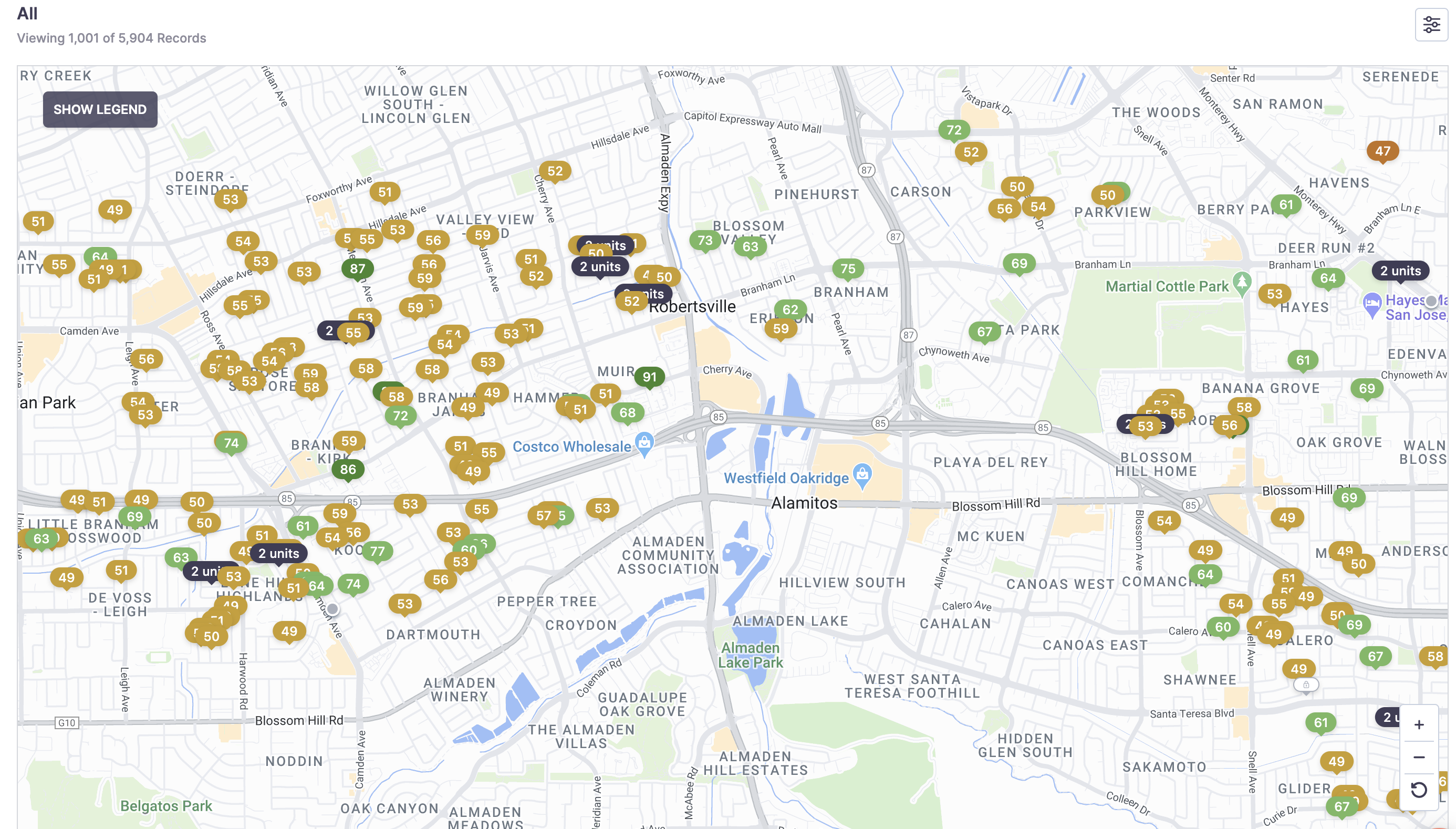
A lot of the best homes in Silicon Valley and the Bay Area change hands quietly, before they're ever listed. Get free access to our off-market homes database and see what's available right now.
You're in. Thanks! Taking you to the off-market homes database now.
Terrific Sunnyvale Homes for Sale
2
3
4
5
6
7
8
9
10
11
12
13
14
15
16
17
18
19
20
21
22
23
24
25