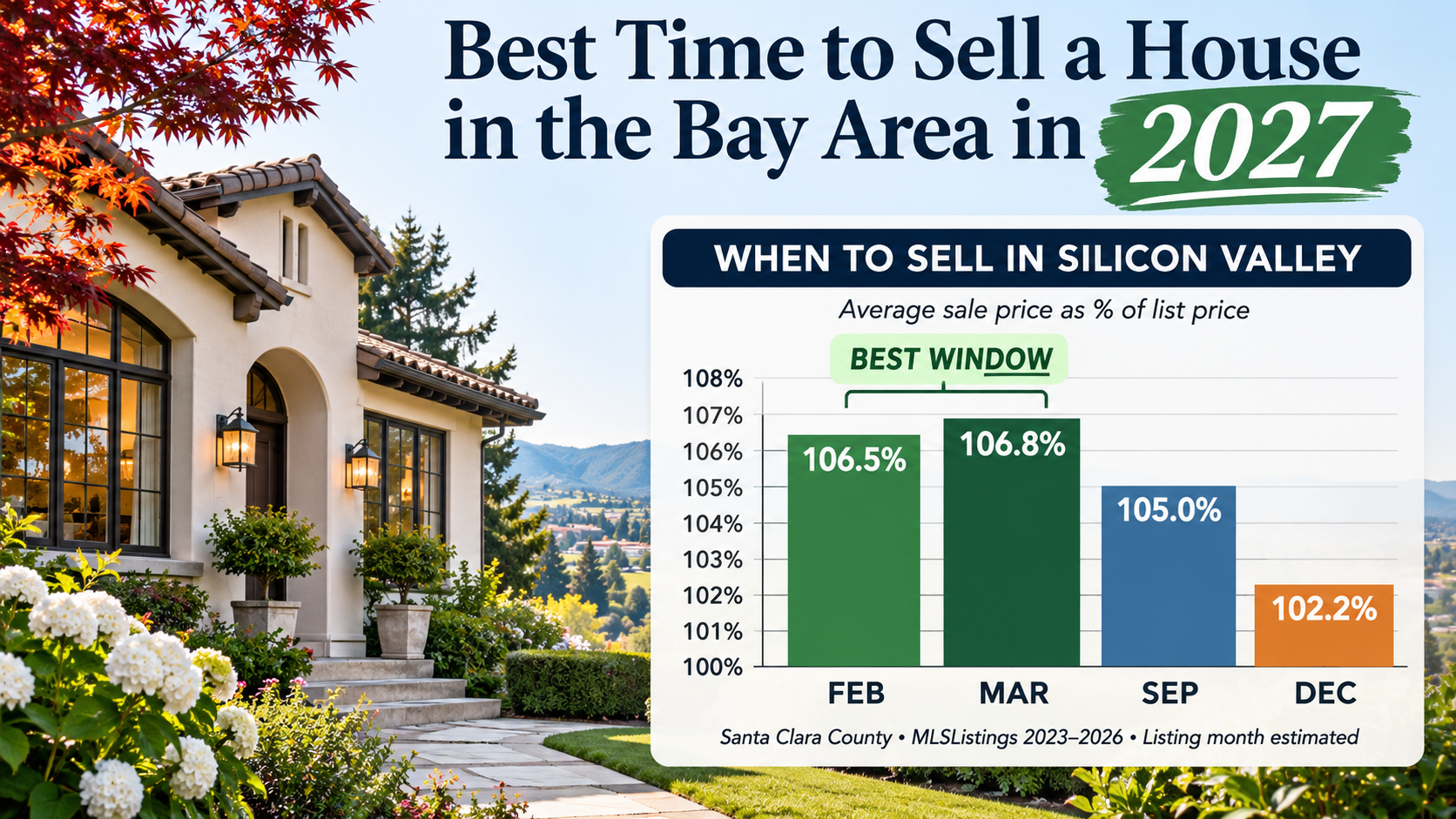
Every November my phone starts ringing with the same question. “Seb, we’re thinking about selling next year. When should we put the house on the market?” Often, it’s someone who’s owned their home for 25 or 30 years, raised the kids there, and is finally ready to think about what’s next. And usually they’ve heard the same thing from everybody: wait for spring. That advice isn’t wrong, but it’s incomplete in a way that can cost a Silicon Valley homeowner tens of thousands of dollars.
I’ve been selling homes here for more than 23 years and I’ve closed more than 470 of them, and if there’s one thing I’ve learned, it’s that the calendar doesn’t set your price: buyers and sellers do. The best time to sell is whenever lots of motivated buyers are chasing very few homes like yours, and in the Bay Area that moment arrives earlier than most people think. To show you exactly when, I went through every monthly MLSListings report for Santa Clara and San Mateo counties from January 2023 through September 2026. Below is what the numbers say, why they look the way they do, and what it all means if you’ve been in your home for a long time.
Key Takeaways
Summary: The best time to sell a house in the Bay Area in 2027 is from the first week of February to about March 15. That’s when buyers are back in force but most sellers are still waiting for “spring,” so competition for each home peaks. MLSListings data for Santa Clara and San Mateo counties from 2023 through 2026 shows February and March listings earned the highest sale-to-list ratios, while December listings did worst. For long-time homeowners, the real key is starting preparation in the fall so the house is ready when the window opens.
The Short Answer for 2027
If your life gives you a choice, have your home photographed, priced and live on the MLS between the first week of February and March 15, 2027. For years my rule of thumb has been to be on the market by March 15, and the data backs it up, with February doing every bit as well as early March. If you can’t be ready by then, the next best window in the South Bay runs from about a week after Labor Day (September 6, 2027) into mid-October. The stretch to avoid is mid-November through the end of December.
On a $1.9 million list price, which is close to the Santa Clara County median, the gap between a February listing (106.5% of list on average) and a December listing (102.2%) works out to roughly $82,000. That’s real money, especially for a family that’s counting on the house to fund the next chapter.
It All Comes Down to Supply and Demand
Here’s the thing most “best time to sell” articles skip. Spring isn’t magic. Buyers don’t pay more because the roses are blooming. They pay more when there are more of them than there are homes to buy, and they pay less when the opposite is true. Every seasonal pattern you’ll see below is really just supply and demand moving at different speeds.
When buyer interest outstrips the number of homes for sale, buyers compete. Homes sell in a week, offers stack up, and the winning buyer pays well over asking because they’ve already lost out on two or three other houses. When there are more homes than buyers, the whole thing flips. Homes sit, buyers take their time, and sellers start getting asked for credits and price reductions. Interest rates, the stock market, tech hiring and layoffs all push on that balance, but within any given year the seasons push on it in a very predictable way.
The key is that buyers and sellers come back to the market on different schedules. Buyers come back in January, right after the holidays, often with a bonus or a fresh batch of vested stock in their account. Sellers mostly wait. They’ve heard “list in the spring,” so they spend January and February painting and decluttering, and a big wave of them goes live in April and May. That timing gap is the whole story.
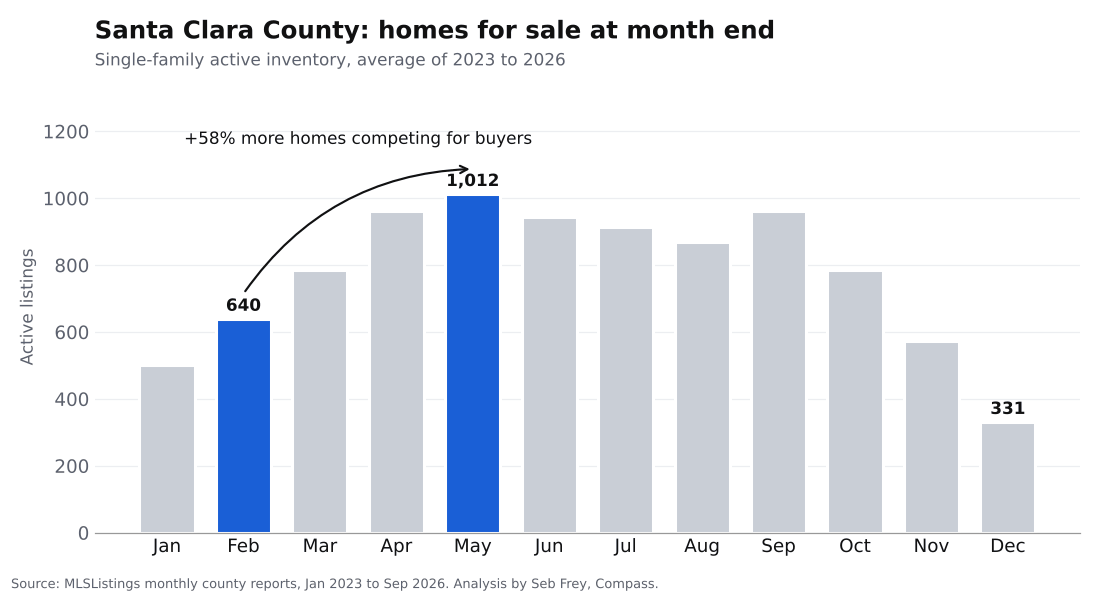
At the end of February, Santa Clara County has averaged about 640 single-family homes for sale over the last four years. By the end of May that number is about 1,010. The buyers didn’t go anywhere, but now they’re spread across almost 60% more homes, so each one has more options and less reason to overpay. San Mateo County follows the same curve, going from about 330 homes for sale in February to about 520 in May.
There’s a nice twist to this, too. Homes on the market bring out buyers. When there’s nothing to look at, a lot of people stop searching in earnest, and when fresh listings start showing up in February, they come off the sidelines. So the first good listings of the year get the benefit of a waking-up buyer pool without much competition. That’s the sweet spot.
Why Bay Area Buyers Show Up So Early
Nationally, the spring market peaks around late April or May. Here it peaks in February and March, and that’s not an accident. A few things are unique about who buys homes in Silicon Valley and the Peninsula.
- Tech money arrives early in the year. Year-end bonuses get paid, RSUs vest on quarterly schedules, and a lot of buyers see their down payment take shape between January and March.
- New jobs and relocations. Hiring and transfers tend to kick off with the new year, and someone starting a job in March wants a house before summer.
- The school calendar. Families with kids want to be moved in by August, which means being in contract by spring. Working backward, that puts them in open houses in February.
- Tax refunds. In the more affordable parts of the market, a refund can cover closing costs or round out a down payment.
- Better light. Longer days make homes show better, and I always tell sellers that natural light sells houses. Our mild winters mean we get that lift earlier than most of the country.
Put all of that together and you get a buyer pool that’s ready to go by Valentine’s Day, while most sellers are still deciding which color to paint the hallway. Those few weeks before the rest of the sellers catch up are where the money is.
The Best Month to Sell: What the Data Shows
MLSListings publishes a report every month with the median price, sale-to-list ratio, days on market, inventory and number of sales for each county it covers. Those figures are reported by the month a sale closes, so I shifted each one back a month to estimate when those homes were listed. The median home in Santa Clara County has been going under contract in 8 to 14 days, and escrow usually adds three to four weeks, so a March closing is mostly a February listing.
| Month listed | Sale price as % of list | Median price vs. year’s average | Median days on market |
|---|---|---|---|
| January | 105.5% | -5.8% | 8.5 |
| February | 106.5% | +2.1% | 8 |
| March | 106.8% | +5.1% | 8 |
| April | 105.5% | +7.0% | 9 |
| May | 104.8% | +4.8% | 9.5 |
| June | 104.0% | -0.9% | 11 |
| July | 103.8% | -0.5% | 11 |
| August | 104.0% | +2.3% | 10 |
| September | 105.0% | +1.8% | 9 |
| October | 104.3% | -0.9% | 11 |
| November | 103.7% | -4.6% | 12 |
| December | 102.2% | -10.3% | 14 |
Santa Clara County single-family homes. Sale-to-list and days on market are averages of monthly figures from January 2023 through September 2026; the price column uses full years 2023 through 2025. Source: MLSListings monthly county reports, analysis by Seb Frey. Listing month is estimated as one month before the closing month.
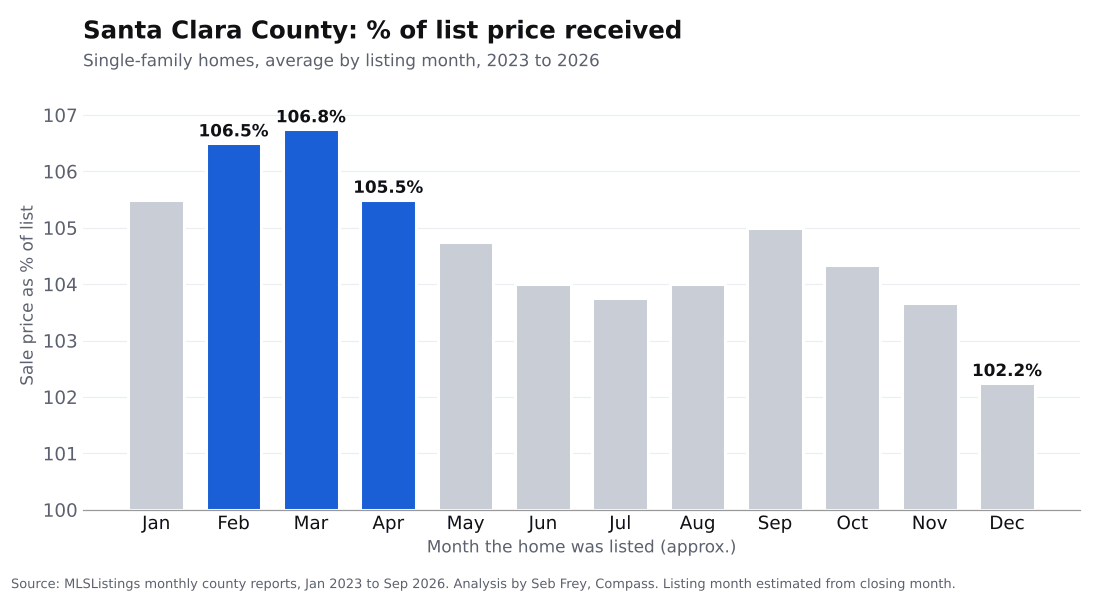
The sale-to-list ratio is the best single measure of how hard buyers are fighting over each house, and it tells the supply and demand story almost perfectly. It peaks for February and March listings, when buyers are back and inventory is thin. It slides through late spring and summer as more and more homes come on the market and families leave on vacation. It gets a second bump in September, when buyers who sat out the summer come back and want to close before the holidays. Then it bottoms out in December.
Notice that days on market move in the opposite direction. The months with the biggest overbids are also the months when homes sell fastest, at about 8 days. That’s not a coincidence. High prices and quick sales come from the same thing, which is lots of buyers competing for the same house at the same time.
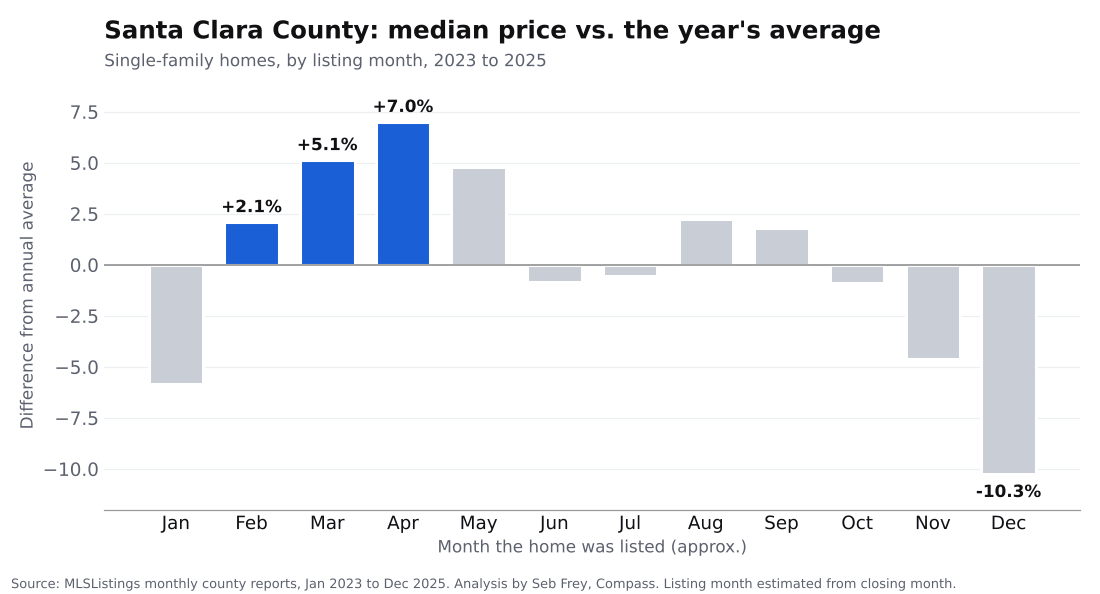
Median price tells a similar story, with one catch. April and May listings show the highest medians partly because bigger, more expensive homes tend to list in spring, so some of that bump is the mix of homes rather than buyers paying more for the same house. That’s why I put more weight on the sale-to-list ratio, which points to February and March.
Zillow found the same thing when it studied 2025 sales in the 35 largest U.S. metros. San Jose’s best listing window was the first two weeks of February, the earliest peak in the country, and those homes sold for about 3.1% more than average, or roughly $53,800 on a typical home. That was the biggest seasonal premium of any large metro (Zillow). You can see more of my local numbers on my Bay Area real estate sales charts.

Thinking about selling?
Just list with me, I'll do the rest.
Minimum hassle, maximum profit, and a sale on your timeline at a price and terms you'll love.
Let's Get Started →Rather talk now? Call or text 408.413.3087
San Mateo County: Same Early Spring, Less Room for Error
If you’re selling on the Peninsula, in places like San Mateo, Burlingame, Redwood City, San Carlos, Belmont or Menlo Park, the pattern is almost identical. San Mateo County homes listed in February sold for an average of 106.5% of list from 2023 through 2026, the best of any month, with March and April right behind at 106%.
| Month listed | Sale price as % of list | Median price vs. year’s average | Median days on market |
|---|---|---|---|
| January | 104.8% | +3.4% | 10 |
| February | 106.5% | +1.6% | 10 |
| March | 106.0% | +5.1% | 10 |
| April | 106.0% | +9.0% | 10 |
| May | 105.0% | +3.1% | 11 |
| June | 104.5% | -0.3% | 12.5 |
| July | 104.5% | -4.4% | 13 |
| August | 104.5% | +0.9% | 12 |
| September | 104.3% | +1.6% | 12 |
| October | 104.3% | -1.2% | 13 |
| November | 103.3% | -7.9% | 16 |
| December | 101.5% | -10.8% | 19 |
San Mateo County single-family homes, same sources and method as the Santa Clara County table above.
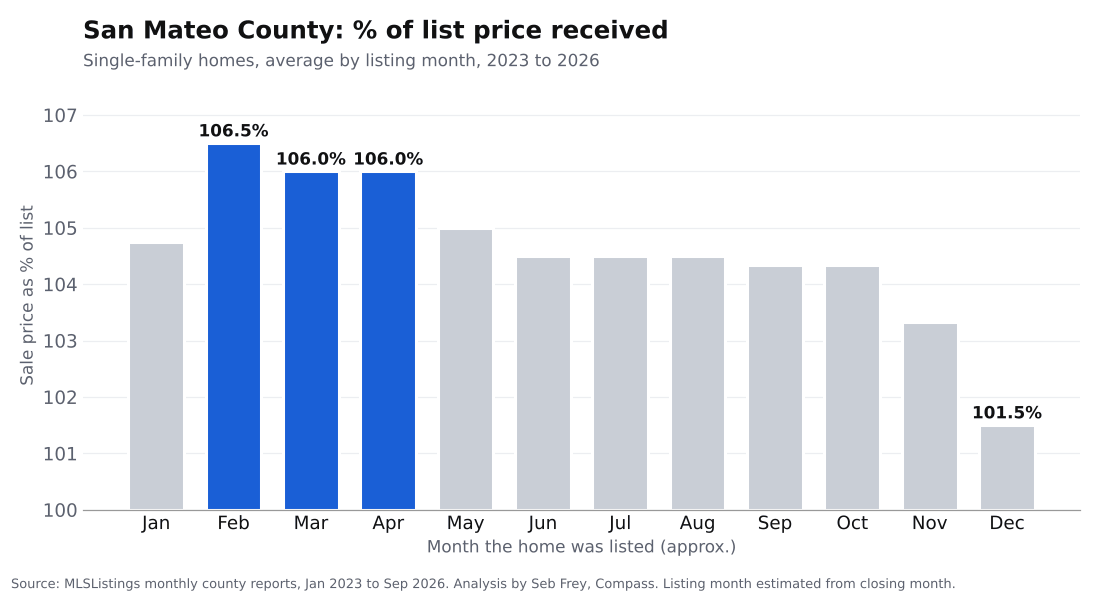
Two things stand out. First, there’s no real fall bounce on the Peninsula. From June through October, San Mateo County listings all averaged around 104.3 to 104.5% of list, so if you miss spring, there’s less reason to hold out for September than there is in the South Bay. Second, the holidays hurt more here. December listings averaged only 101.5% of list, closed about 11% below that year’s average median price and took a median of 19 days to sell, the weakest numbers of any month in either county. The Peninsula has fewer homes and fewer buyers to begin with, so when buyers step away for the holidays, the drop is steeper.
April listings show the highest median price in San Mateo County, about 9% over the yearly average, but just like in Santa Clara County, a lot of that is bigger homes coming to market in spring. The sale-to-list ratio is the better guide, and it points to February.
Supply Beats the Calendar
If you only take one idea from this article, take this one. The month you list matters, but how many homes you’re competing with matters more. Compare the last three springs in Santa Clara County.
- Spring 2024: At the end of March there were only 497 single-family homes for sale against 650 sales that month, less than one month of supply. Homes listed that February and March sold for 109 to 110% of list.
- Spring 2025: 986 homes for sale at the end of March, about 1.5 months of supply. The spring premium shrank to about 107 to 108%.
- Spring 2026: 1,044 homes for sale at the end of March, again about 1.5 months of supply, and spring listings sold for about 105 to 106% of list.
Same season, very different results, and the difference is supply. That’s why I watch months of supply, which is just the number of homes for sale divided by the number selling each month, more closely than I watch the calendar. Some market watchers call the flip side of this the absorption rate, meaning the share of available homes that sell in a month. Either way, it’s the clearest picture of who has the leverage.
Here’s why that matters for 2027. In September 2026, Santa Clara County had 1,224 single-family homes for sale, up 21% from a year earlier, or about 1.7 months of supply. Homes were taking an average of 27 days to sell, compared with 13 to 16 days in the spring of 2024. The Peninsula is a bit tighter, with 476 homes for sale in San Mateo County, down from 567 a year earlier. More competition from other sellers in the South Bay makes the early window more valuable, not less. If supply keeps building, the sellers who get on the market before the April rush will have the buyers to themselves for a few weeks, and the ones who wait will be one of many.
Mortgage rates push on all of this too. Freddie Mac’s 30-year average was 7.18% in early November 2026, up from 6.22% a year earlier (RISMedia). Higher rates trim what buyers can afford and thin out the buyer pool at the margins, which is one more reason to be on the market when demand is naturally at its strongest.
Your 2027 Selling Calendar, Season by Season
Early Spring (February to mid-March): The Sweet Spot
This is the window where demand is surging and supply hasn’t caught up yet. Buyers are back with bonuses and fresh plans, and most sellers are still getting ready. In 2027 I’d aim to go live in the first two weeks of February, and no later than March 15. Lunar New Year falls on February 6, 2027, and a lot of our buyers celebrate it, so I’d schedule the first open house for the weekend before or after. Presidents Day weekend (February 13 to 15) is usually a busy one.
Late Spring and Early Summer (April to June): Good, but Crowded
Buyers are still out in April and May, but this is when everyone else who “waited for spring” shows up. Inventory is at its peak, buyers can afford to be picky, and the overbids get smaller. Spring break for most local schools lands in late March and early April, when some buyers travel, and graduations and vacations start pulling families away by June. Homes still sell well, they just have to work harder for it.
Mid-Summer (July and August): The Lull
Plenty of Bay Area families are on vacation, and the buyers who are left have the most inventory of the year to choose from. Sale-to-list ratios dip to around 104% and homes take a few days longer to sell. It’s not a bad time to sell, but it’s rarely the best.
Fall (September to mid-October): The Second Chance
After Labor Day the South Bay wakes back up. Buyers who missed out in spring come back with renewed urgency because they want to close before the holidays, while plenty of sellers have already pulled their homes or decided to wait until next year. September listings in Santa Clara County averaged 105% of list, better than any summer month. On the Peninsula the fall bump is much smaller.
The Holidays (mid-November to December): The Weakest Stretch
Here’s where supply and demand get interesting. Inventory drops to its lowest point of the year in December, so you’d think sellers would have all the leverage. They don’t, because buyers disappear even faster. Between Thanksgiving (November 25, 2027) and New Year’s, most buyers are traveling, hosting family or simply not thinking about houses. The ones who are out are often serious, like people relocating for a January start date, and a well-priced home can still do fine. But on average, December listings had the smallest overbids and the longest time on market of the year in both counties.
What This Means If You’ve Owned Your Home for 20, 30 or 40 Years
Most of the people I work with aren’t flipping houses or chasing a market. They bought decades ago, raised a family, and now they’re thinking about downsizing, moving closer to the grandkids, or moving into a senior community. Their situation is different from a typical seller’s in a few important ways, and those differences change how to think about timing.
Your Flexibility Is Your Biggest Advantage
Long-time owners usually don’t have to sell on a certain date. There’s no job transfer and no new house waiting, and with Prop 13 the carrying costs are often modest. That flexibility is worth a lot of money, because it means you can choose the window when buyers are most plentiful instead of selling whenever the moving truck happens to be scheduled. If you can wait for February or March, I’d almost always recommend it.
Your Real Competition Is the Updated House Down the Street
A home that’s been lovingly lived in for 30 years often has original bathrooms, older kitchens and a garage full of history. In February that’s less of a problem, because buyers don’t have many choices. By May, your house is being compared side by side with freshly renovated homes and investor flips, and the gap shows. That’s another reason the early window tends to work especially well for longtime owners. Buyers in February are more willing to see the potential.
Getting Ready Takes Longer Than You Think
Sorting through decades of belongings, deciding what goes to the kids, and fixing what needs fixing almost always takes three to four months. That’s why a February listing really starts in November. The good news is that you don’t have to pay for the prep work out of pocket. Through Compass Concierge, paint, flooring, repairs and staging can be paid for at closing, and a good senior move manager can take a lot of the sorting and moving off your plate.

Does your home need some work first?
Let's get it market-ready, and pay for it at closing.
Paint, repairs, flooring and staging, all handled for you through Compass Concierge with nothing out of pocket up front and no contractors for you or your family to manage.
See How It Works →Rather talk now? Call or text 408.413.3087
Line Up the Next Move First
Many long-time owners are also buying a smaller home or moving into a senior community, and those have their own timelines, waitlists and move-in dates. Work backward from where you’re going. If your community has an opening in April, a February listing that closes in March lines up beautifully. If the move has already happened, the math changes, because every month the house sits empty adds property taxes, insurance, utilities and upkeep. I’ve written about paying for assisted living while the house sells and other ways to pay for assisted living in Silicon Valley, and there are real pros and cons to moving out before you sell.
Think About Taxes Before You Pick a Date
If you’ve owned your home for decades, your gain is probably well above the $250,000 ($500,000 for married couples) capital gains exclusion for a primary residence, so the tax year your sale lands in can matter. Selling in early 2027 rather than late 2026 pushes the tax bill out a full year. If you’re 55 or older and buying another home in California, Prop 19 may let you carry your low property tax base with you. Talk with your CPA before you set a date. My posts on selling now versus letting the kids inherit and capital gains on an inherited house cover the basics.
Use the Holidays to Decide, Not to List
Thanksgiving and Christmas are often the only times the whole family is in one place. That makes them a great time to talk about the plan, agree on who’s helping, and walk through the house together. It’s also why the holidays are a poor time to list. Use them to make decisions, then use January to get ready, and go live in February.
Be Honest About Being Ready
None of this matters if you’re not emotionally ready to let go. Leaving a home full of memories is hard, even when it’s clearly the right move. I’d rather you take an extra season to feel good about the decision than rush into the “perfect” month and regret it. If a parent’s health or a family situation is setting the timeline, that comes first, and a well-prepared, well-priced home will still sell in any month here. My post on the best time to downsize looks at timing from the life side instead of the market side.
Timing Matters Less Than Strategy
A lot of homeowners spend months thinking about when to sell and almost no time thinking about how. Some assume there’s just a “market price” for their house and they’ll get it no matter what they do. It doesn’t work that way. In my experience, getting the most money for a home always comes down to four things:
- The state of the market, meaning the balance of supply and demand when you list.
- Preparation and condition, meaning how your home looks and shows compared to the competition.
- Marketing and pricing strategy, meaning how many of the right buyers walk through the door in the first week.
- Negotiation, meaning how well you turn that interest into the best price and terms.
Timing only touches the first one. The other three are entirely in your control. The real secret of the spring market is that lots of buyers see the same house at the same time and have to compete for it. A good pricing and marketing plan can recreate that in any month, by pricing to draw a crowd, launching with a burst of exposure and setting a clear offer date. That’s how homes sell over asking in October and even December. The calendar gives you a tailwind, but strategy is what wins the race.
Does It Matter What Price Range You’re In?
It does. Entry-level homes and condos feel the seasons the least, because first-time buyers are out year-round and there’s never enough supply at that price. Mid-range family homes feel the seasons the most, since so many of those buyers are planning around the school year. Luxury homes, which I’d define as roughly twice the county median, or about $4 million and up in Santa Clara County today, follow the spring pattern too, and the stakes are higher. There are only so many buyers for a $5 million home in Los Altos or Saratoga, so missing the stretch when they’re actively shopping costs more. If you own a luxury home and have flexibility, plan around February and March, with September as a backup, and spend the extra time on preparation and marketing.
What About the Rest of California?
If you’re comparing notes with friends elsewhere in the state, their best window is probably later than ours. Here’s what Zillow found when it looked at 2025 sales in California’s largest metros:
| Metro | Best time to list | Premium |
|---|---|---|
| San Jose | First two weeks of February | 3.1% (about $53,800) |
| Los Angeles | Last two weeks of April | 2.5% (about $25,300) |
| San Diego | Last two weeks of March | 2.1% (about $21,300) |
| San Francisco | Last two weeks of May | 1.9% (about $23,000) |
| Sacramento | First two weeks of April | 1.7% (about $9,900) |
| Riverside | Last two weeks of April | 1.5% (about $8,800) |
Source: Zillow Best Time to List, March 2026.
Zillow’s San Francisco metro includes San Mateo County along with San Francisco and the East Bay, and it shows a late-May peak. The MLS numbers for San Mateo County alone point to February, which is why I trust the county-level data over the metro average for Peninsula sellers.
The Best Week and Day to List
Within the early spring window, sooner is usually better, because every week that passes brings more competing listings. I like to go live on a Thursday. It gives buyers and their agents a day or two to see the listing, book showings and plan to come to the weekend open houses, which is when most of the energy around a Bay Area listing builds. Offer dates are typically set for the following week, once everyone has had a chance to see the house and get their financing in order.
Planning a Spring 2027 Sale? Start Now
The sellers who get the February premium are the ones who started in the fall. Here’s the timeline I’d follow to be on the market in the first half of February 2027:
- November: Get a pricing consultation, talk through the plan as a family, and figure out where you’re moving next.
- December: Sort, donate and declutter, and line up a senior move manager if you need one.
- Early January: A pre-sale home inspection, then repairs, paint and any updates worth doing. Our rainy season tends to reveal roof leaks and drainage problems right about now, so it’s better to find them before a buyer does.
- Late January: Staging, photography, video and the marketing plan.
- First half of February: Go live on a Thursday, hold open houses that weekend and the next, and set an offer date.
If you’re thinking about selling in 2027, the best thing you can do this month is talk it through. I’ll look at your home, your timing and your goals, and I’ll tell you honestly whether February, September or right now makes the most sense for you.

Time to talk to a REALTOR®?
Book a Call with Seb
Selling, buying or just weighing your options? Pick a time that works for you and we'll talk it through.
Pick a Time →Rather talk now? Call or text 408.413.3087
Frequently Asked Questions
What is the best month to sell a house in the Bay Area in 2027?
February, with early March a close second. In Santa Clara County, homes listed in February and March sold for an average of 106.5% and 106.8% of list from 2023 through 2026, the best of any months. Buyers are back in force after the holidays, but most sellers wait until April or May, so competition for each home peaks early. Aim to be on the market by March 15.
Why do Bay Area homes sell for more in early spring?
Supply and demand. Buyers return in January and February with bonuses, vested stock and plans to move before the next school year, but inventory is still near its low for the year. In Santa Clara County there are about 640 homes for sale at the end of February versus about 1,010 at the end of May, so early listings face far less competition.
What is the worst month to list a house in the Bay Area?
December. Inventory is at its lowest, but buyers disappear even faster for the holidays. Santa Clara County December listings closed about 10% below that year’s average median price and sold for only about 102% of list, and San Mateo County December listings averaged 101.5%.
Is fall a good time to sell a house in the Bay Area?
In the South Bay, yes. September listings in Santa Clara County averaged about 105% of list, better than summer, because buyers come back after Labor Day and want to close before the holidays. On the Peninsula the fall bump is much smaller, so San Mateo County sellers should focus on spring if they can.
When is the best time to sell a house in San Mateo County?
February, with March and April close behind. San Mateo County homes listed in February sold for an average of 106.5% of list from 2023 through 2026, while December listings averaged only 101.5% and took the longest to sell.
Does the number of homes for sale matter more than the month?
Yes. In spring 2024 Santa Clara County had less than one month of supply and homes sold for 109 to 110% of list. In spring 2025 and 2026, with about 1.5 months of supply, the spring premium was closer to 105 to 108%. Heading into 2027, supply is about 1.7 months and rising, which makes listing early even more important.
I have owned my home for 30 years. How far ahead should I start preparing?
Start three to four months ahead. Sorting, repairs, paint and staging take time, so a February 2027 listing really begins in November or December 2026. Programs like Compass Concierge can cover prep costs until closing, and a senior move manager can handle much of the sorting and moving.
Should I wait for mortgage rates to drop before selling?
Usually not. Nobody can reliably predict rates, and if they fall, more sellers tend to list at the same time, which adds competition. Pick the best window that fits your life and price your home for the market you are actually in.
Does the day of the week matter when listing a home?
It helps at the margins. Going live on a Thursday gives buyers and agents a day or two to see the listing and plan for the weekend open houses, which is when most of the activity around a Bay Area listing happens.