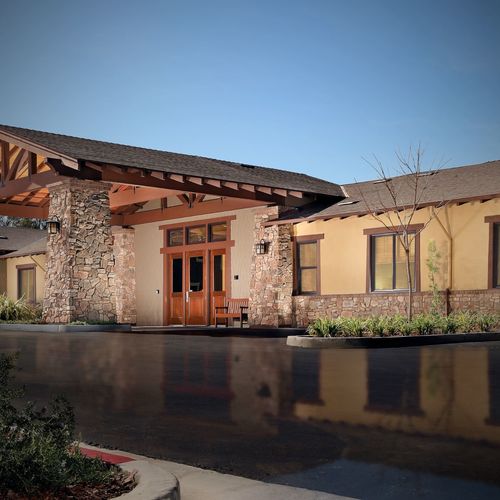
If your mom or dad has lived in Cupertino, Saratoga or West San Jose for decades, I’d bet the idea of moving them across the valley feels like a nonstarter. That’s a big part of why MorningStar at West San Jose keeps coming up when families call me. It’s a newer assisted living and memory care building on South De Anza Boulevard, just a few minutes from the Cupertino line, and it lets a parent get more support without leaving the part of town they already know.
In the tour video above I walk through the building, and in this piece I want to go a step further than the brochure does. We’ll look at how the community is laid out, what it costs relative to the rest of San Jose, and (because this is where I spend most of my working life) how the family home usually fits into paying for a move like this. I’m a REALTOR® who works mostly with homeowners over 60, so I tend to look at senior living through two lenses at once: is this a good place to live, and does the money work?
If moving Mom or Dad into MorningStar means selling the family home, here’s how I help as a San Jose senior real estate specialist.
MorningStar West San Jose by the numbers
MorningStar Senior Living operates a few dozen communities across the western states, and the company announced this San Jose project with developer Swenson back in 2019. The building went up as a four-story, roughly 87,000 square foot community, which puts it in a sweet spot size-wise; it’s big enough to support a real dining program and activity calendar, but it isn’t so sprawling that a resident with a walker dreads the trip to lunch. Because it’s recent construction (the doors opened around 2023), you’re getting current building codes and a design meant for today’s residents rather than a remodeled 1980s facility with long, dim hallways.
The capacity numbers tell you a lot about how the community runs day to day, so it’s worth knowing them before you tour. Here’s how the space breaks down, per MorningStar’s own materials and state licensing records as of September 2026:
- 69 assisted living suites in studio, one-bedroom and two-bedroom layouts
- 34 memory care suites in a separate, secured area called the Reflections Neighborhood
- A state-licensed capacity of 149 residents, which reflects that some suites can be shared by couples or companions
That licensing detail is worth a moment. In California, assisted living and memory care communities are licensed as Residential Care Facilities for the Elderly (RCFEs), and anyone can look up a community’s license status, capacity and inspection history on the California Department of Social Services Care Facility Search. I tell every family to pull that report before they sign anything, for MorningStar or any other community, because it’s the closest thing you’ll get to an independent report card.
Help For A Sudden Move to Assisted Living

Two neighborhoods under one roof
The building is organized around two distinct living areas, and understanding the difference between them helps a lot when you’re planning more than one step ahead. Families who see memory care on the horizon often choose a building like this precisely so a parent won’t have to change addresses later, and knowing how each side works makes that choice easier.
Assisted living
The assisted living suites come with private bathrooms and kitchenettes, plus the safety features you’d expect in newer construction, like grab bars, emergency call systems and accessible layouts. Couples who want to stay together should look closely at the one- and two-bedroom floor plans, while a single resident on a tighter budget will usually land in a studio or a smaller one-bedroom. Care here is geared toward help with the activities of daily living: bathing, dressing, medication management and getting around safely, with the goal of keeping residents as independent as they can be.
MorningStar lists common spaces that go beyond the usual lounge and dining room, including a theatre that doubles as a chapel, a bistro and bar, an art studio, a salon, a fitness center, a secure courtyard and a sky terrace, along with underground parking (which your visiting family will appreciate on a busy stretch of De Anza). Chef-prepared restaurant-style dining, housekeeping and linen service, a full activity calendar and transportation to appointments round out the package. Listing sites also describe the community as pet friendly on the assisted living side, which is a make-or-break detail for a lot of people, so confirm the specific rules for size and number of pets if that applies to your family.
Memory care in the Reflections Neighborhood
The 34 memory care suites sit in their own secured wing designed for people living with Alzheimer’s disease or other forms of dementia. The layout uses clearer wayfinding and smaller common areas, so residents are less likely to feel overwhelmed or lost, and the programming is built around what people with memory loss can still enjoy and do well. If your family is early in this process, the Alzheimer’s Association has good material on what to look for in a memory care setting and questions to ask on a tour.
The piece I find most useful for planning is the pricing model. In memory care, MorningStar uses an all-inclusive monthly rate that covers both the suite and whatever care the resident needs, rather than stacking on charges as needs increase. For a family that’s already watched a parent’s dementia progress, a predictable number can be a real relief, even if that number starts higher.
I also filmed a second video at MorningStar that gives you another look at the building, and it’s worth a few minutes if you’re comparing it against other communities on your list. Watching both before an in-person visit will help you walk in with sharper questions, since you’ll already have a sense of the layout and can spend your tour time on staffing, care and the feel of the place.
What it costs, and how it stacks up
Last I checked (as of September 2026), MorningStar’s website listed assisted living starting at about $7,425 a month and memory care starting at about $11,425 a month. Earlier published figures were a few hundred dollars lower, which tells you rates have moved, so treat these as a starting point and get a current quote directly from the community. Your actual number will depend on the suite you choose and, in assisted living, on the care level assigned after the community’s assessment.
Assisted living here works on a two-part structure: base rent for the apartment, plus a care fee tied to how much help the resident needs day to day. Memory care is the all-inclusive model I described above. That split works well for families who can see a transition coming, because you’re effectively pricing out both chapters in the same building before you commit.
For perspective, third-party sites like Seniorly have put the average for assisted living in the San Jose area in the low $7,000s per month, so MorningStar’s entry pricing sits right around the local average while the larger suites and higher care levels run above it. That’s roughly where I’d expect a newer, full-service building in a high-income part of Silicon Valley to land. When we compare communities, I always push families to ask the same set of questions: what’s included in the monthly fee, how care levels are assessed and how often, what triggers a move to a higher level, and how much rates have gone up each year for the past few years.
A location built for visiting
MorningStar sits at 1380 South De Anza Boulevard in the 95129 ZIP code, the corner of West San Jose that borders Cupertino and Saratoga. Highway 85 is close by, and Interstate 280 and San Tomas Expressway aren’t far, which matters more than people think. When an adult child in Sunnyvale, Los Gatos or central San Jose can swing by after work without losing an hour to surface streets, visits happen more often, and that’s a big factor in how well a parent settles in.
The surrounding area has plenty to do on an outing. Grocery stores (including H Mart up the road), coffee shops and casual restaurants line De Anza, and Santana Row and Westfield Valley Fair are a short drive away for a lunch out with the grandkids. On the medical side, MorningStar points to nearby providers including O’Connor Hospital and Santa Clara Valley Medical Center, which helps with specialist visits and follow-ups. The neighborhoods behind De Anza are established single-family streets, so the setting feels like suburban West San Jose rather than a commercial strip, and a parent who spent 40 years in Cupertino will recognize the surroundings.
Free Guide: Selling a Home You’ve Owned for Decades

Paying for it with the house you already own
Here’s where I can add something the listing sites can’t. For most of the families I work with, the parent’s home is the largest asset they have, and it’s usually what funds a move to a place like MorningStar. The good news is that MorningStar is a monthly rental model with no large entrance fee, which is a very different equation from an entrance-fee continuing care retirement community. You aren’t trying to free up several hundred thousand dollars on day one; you’re trying to build a reliable income stream (or a pool of cash) that covers a monthly bill of $7,000 to $12,000 or more for as long as it’s needed.
Timing is the first question. Some families move Mom or Dad in first, using savings or a short-term bridge loan, and then sell the house empty, which is easier on everyone and usually shows better. Others need the sale proceeds before the move. Programs like Compass Concierge can front the cost of prep work (paint, flooring, landscaping, staging) and get repaid at closing, and for some homes an as-is sale makes more sense than fixing anything at all. Sorting through 30 or 40 years of belongings deserves its own plan and its own timeline, because it’s usually the part that stalls everything.
On taxes, a longtime owner who’s lived in the home at least two of the last five years may be able to exclude up to $250,000 of capital gain (or $500,000 for a married couple) under IRS Section 121; the IRS explains the rules here, and your CPA should run the numbers for your situation. Since MorningStar is a rental, California’s Prop 19 property tax transfer doesn’t come into play unless someone in the family is buying another home. If you’d like to see what your parent’s house would net and how long that money would last at MorningStar’s rates, my page for seniors and their families is a good place to start.
Who MorningStar is a good match for
I don’t think any single community is right for everyone, but MorningStar makes a strong case for a specific kind of family. It fits an older adult who needs daily help but still wants a private apartment, a social calendar and possibly a pet along for the ride, and whose family lives on the west side of the valley. It’s also a serious contender if memory care is in the picture now or likely down the road, since the Reflections Neighborhood lets a resident make that transition without changing addresses. For some families, the price will be a stretch, and that’s the reality of private-pay senior living in the Bay Area; for a longtime homeowner sitting on significant equity, the question is more about value and peace of mind than the raw monthly number.
MorningStar describes its mission in terms of honoring, serving and investing in residents, rooted in Judeo-Christian values, with an emphasis on hospitality. Mission statements only go so far, though, because the day-to-day experience comes down to the local leadership team and how long the caregivers stay. Visit at different times of day, eat a meal there, and ask what staff turnover has looked like over the last year.
Frequently Asked Questions
What levels of care does MorningStar at West San Jose offer?
The community offers assisted living in 69 suites and memory care in 34 suites within its secured Reflections Neighborhood. MorningStar’s website also mentions independent living, so ask the community how that’s offered at this location before you tour.
How much does MorningStar at West San Jose cost?
As of September 2026, MorningStar’s website listed assisted living starting around $7,425 per month and memory care starting around $11,425 per month. Assisted living adds a care fee based on the resident’s needs, while memory care is all-inclusive. Always confirm current rates directly with the community.
Is there an entrance fee at MorningStar?
There isn’t one. MorningStar operates on a monthly rental model rather than the large up-front entrance fee you’d see at a continuing care retirement community, so families usually plan around covering the ongoing monthly cost.
Should we sell Mom’s house before or after she moves into MorningStar?
It depends on cash flow. Moving first and selling an empty home is easier on the resident and usually shows better, but it requires savings or a bridge loan to cover the gap. Selling first frees up the money before the move but adds pressure to the timeline. A longtime owner may also qualify for the Section 121 capital gains exclusion of up to $250,000 single or $500,000 married, so talk with a CPA about the tax side.
How can I check MorningStar’s state license and inspection history?
Assisted living and memory care in California are licensed as Residential Care Facilities for the Elderly. You can search the facility by name on the California Department of Social Services Care Facility Search to see its license status, capacity and any inspection reports or citations.
If MorningStar is on your family’s shortlist and you’re trying to figure out how the house, the timing and the monthly cost all fit together, I’d be glad to help you think it through. Give me a call at 408-596-1623 or book a time to talk with me, and we’ll map out a plan that works for your parent and for you.
This article is for general education only. Please confirm pricing, availability and care details directly with the community, and note that I’m not an attorney or CPA, so check legal and tax questions with a qualified professional.
Time to talk to a REALTOR?

Senior Friendly Homes in Silicon Valley South
2
3
4
5
6
7
8
9
10
11
12
13
14
15
16
17
18
19
20
21
22
23
24
25