If your mom or dad has been living with Alzheimer’s or another form of dementia, and the family has started whispering about “what happens next,” I’d like to walk you through one Tri-Valley option that comes up often with the families I work with. Sunol Creek Memory Care sits at 5980 Sunol Blvd in Pleasanton, and unlike a lot of places you’ll tour, memory care isn’t a wing tacked onto a bigger assisted living building. It’s the whole mission of the place, and that one design decision shapes almost everything else about how it runs.
I’m going to cover what the community is, how the care and daily life are set up, what it cost when I last checked, and then the part most memory care write-ups skip entirely: how families usually pay for this, which very often means selling the house Mom and Dad have lived in for decades. That piece is my home turf, so I’ll spend some real time on it.
A Small, Purpose-Built Memory Care Community
Sunol Creek opened in 2014 and is part of Agemark Senior Living, a family-owned operator that has been serving older adults for more than 35 years, according to the community’s website. The building is organized into two care neighborhoods of about 20 residents each, so you’re looking at roughly 40 residents total. For someone whose brain is struggling to process noise, crowds and unfamiliar faces, that scale matters a great deal, because a smaller setting means fewer people to keep track of, calmer common spaces, and caregivers who see the same residents day after day and learn their habits.
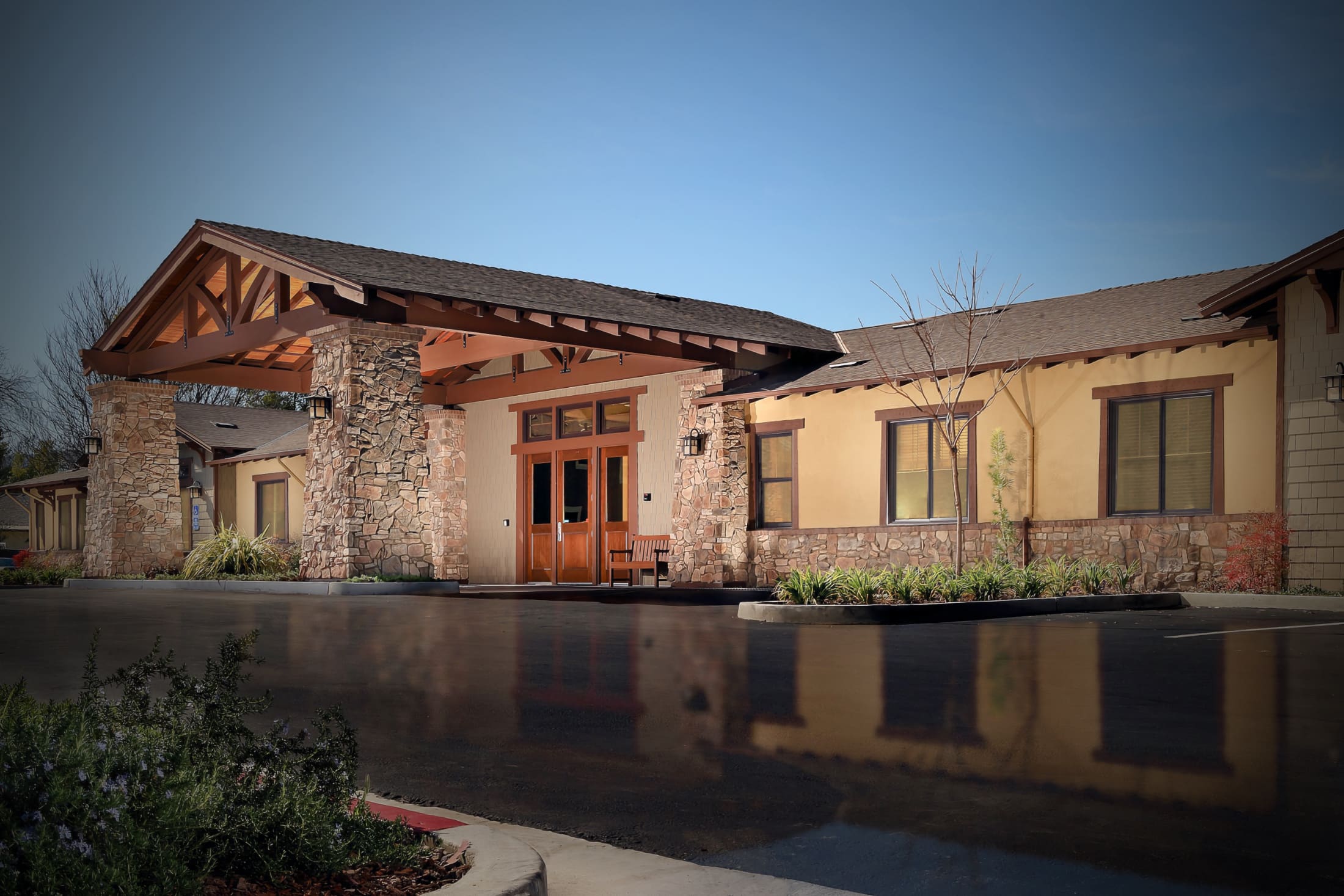
The featured photo at the top of this post shows the front entrance, a single-story Craftsman-style building with stone columns, a timber-beamed porte-cochère and warm stucco walls. Single-story living is a real plus in memory care, since there are no stairs to manage and fewer confusing transitions between floors. Inside, the community offers both private and shared suites along with common living areas, and there are secure outdoor spaces where residents can walk and get fresh air without a family member worrying about them wandering off.
Help For A Sudden Move to Assisted Living

How the Care Is Built Around the Person
Every resident at Sunol Creek gets an individualized care plan, and it’s developed with the family’s input and revisited as needs change. That second part is the one I’d press on during a tour, because dementia rarely holds still, and a plan that fit in March may not fit in September. The plans cover the hands-on basics (bathing, dressing, medication management, coordination with outside doctors) along with emotional well-being, social connection and cognitive support.
The underlying philosophy is that a diagnosis doesn’t erase who someone is. A retired machinist, a former schoolteacher and a lifelong gardener each arrive with their own routines, preferences and stories, and good memory care uses that history instead of forcing everyone into the same schedule. When you tour, bring a one-page “life story” about your parent (their career, favorite music, what calms them down, what time they like to wake up) and ask the staff how they’d actually use it. The quality of that answer tells you a lot.
Daily engagement with a purpose
Sunol Creek treats activities as part of the care rather than as a way to fill the afternoon. Their lifestyle programming includes functional fitness, music, art, creative projects, group games and social events, plus one-on-one time for residents who don’t do well in a group. Residents are invited and encouraged to join in, but nobody is pushed, which respects their independence and heads off a lot of frustration. In my experience, families often underestimate how much a sense of purpose (folding towels, tending a plant, singing a song they’ve known for 60 years) can steady someone who spends much of the day feeling lost.
Safety without feeling locked in
Memory care has to be secure, and Sunol Creek has controlled entrances and 24-hour staffing by caregivers trained in dementia care. The goal is to let residents move around freely inside a protected environment, so wandering, sundowning and sudden behavior changes are anticipated and handled calmly. Meals are planned to be both nourishing and appealing, since appetite often fades with dementia and mealtime routines do a lot to anchor the day.
Respite Stays: A Test Drive for Everyone
When space allows, Sunol Creek offers short-term respite stays. If you’re the spouse or adult child doing the caregiving, a respite stay can give you a few weeks to recover from surgery, take a trip you’ve been putting off, or simply sleep through the night for once. It also doubles as a trial run, since you get to see how your loved one adjusts before anyone signs up for a permanent move, and that can take a lot of the guilt and second-guessing out of the decision.
The community also puts real weight on supporting families, with ongoing communication, education about the disease, and staff who expect questions. The Alzheimer’s Association’s alz.org is another good place to find caregiver support groups and a 24/7 helpline, and I’d encourage every family in this situation to use it.
Recognition, Licensing and Doing Your Homework
Sunol Creek reports that U.S. News & World Report named it a Best Memory Care community, including a 2026 Best Memory Care recognition. That’s a useful signal, but I always tell families to go one step further. Memory care in California is licensed as a Residential Care Facility for the Elderly (RCFE), and Sunol Creek’s RCFE license number is 019200484. You can plug that number into the California Department of Social Services Community Care Licensing facility search and read the inspection reports and any citations yourself. It takes ten minutes, and it’s the same homework I’d do for my own parents.
Free Guide: Selling a Home You’ve Owned for Decades

What It Costs and How Families Pay for It
As of September 2026, Sunol Creek’s website listed a base room rate of about $5,495 per month, with care costs starting around $770 per month on top of that, and it noted that memory care in the region commonly runs $6,000 to $10,000 or more monthly depending on needs. Treat those figures as a starting point and confirm current rates directly by calling the community at 925-846-8283, because care levels get reassessed and prices change. This is a monthly rental model with no large entrance fee, which is a very different financial picture from a continuing care retirement community that asks for a big check up front.
Even without an entrance fee, $80,000 to $120,000 a year adds up quickly, and for most Bay Area families the parent’s house is the largest asset they have. Here are the questions I help families work through when the home will fund memory care.
Who has authority to sell?
If the house is in a living trust, the successor trustee can usually handle the sale once the parent can no longer manage their affairs. If it isn’t, you’ll want to know whether there’s a durable power of attorney that covers real estate, and you’ll want an estate planning attorney involved early. Sorting this out before a crisis saves weeks, and sometimes a court process.
The capital gains rule has a helpful twist
Under IRS Section 121, a homeowner can generally exclude up to $250,000 of gain ($500,000 for a married couple filing jointly) if the home was their primary residence for two of the last five years. There’s a special provision for owners who become physically or mentally unable to care for themselves: if they lived in the home for at least one year of the five and then moved into a licensed care facility, the time in that facility can count toward the residence requirement. For a parent who has been in memory care for a couple of years before the house sells, that can protect a significant exclusion. The IRS explains the basics in Topic 701, and your CPA should confirm how it applies to your family.
When one spouse stays behind
Often one parent moves into memory care while the other is still healthy and living at home. In that case, the at-home spouse might keep the house, or might sell and buy something smaller and easier to manage. If they’re 55 or older and buying a replacement home in California, Prop 19 may let them carry their existing property tax base to the new place, which can make a downsize far more affordable than it looks on paper.
Timing, prep and the belongings
Most memory care moves happen before the house sells, because the need is urgent. That’s fine, and it means you have a vacant house you can prepare without disrupting anyone. Some families sell as-is to keep things simple; others use Compass Concierge to cover repairs, paint and staging with no upfront cost and pay it back at closing, which often nets more. Sorting through 30 or 40 years of belongings is usually the hardest part emotionally, and I’d suggest bringing a few familiar items (a favorite chair, photos, a quilt) to your parent’s suite at Sunol Creek first, then handling the rest in stages. If you’d like to see how I approach these sales with families, my page for seniors and their families lays out the process.
Frequently Asked Questions
Is Sunol Creek a memory care community or assisted living?
Sunol Creek is a dedicated memory care community for people living with Alzheimer’s and other dementias. It’s licensed in California as a Residential Care Facility for the Elderly (RCFE #019200484), and memory support is its core focus rather than a separate wing of a larger assisted living building.
How big is Sunol Creek Memory Care?
According to the community, it has two care neighborhoods of about 20 residents each, so roughly 40 residents in total. The smaller scale helps reduce overstimulation and lets caregivers get to know each resident well.
How much does Sunol Creek Memory Care cost?
As of September 2026, the community’s website listed a base room rate of about $5,495 per month plus care costs starting around $770 per month. It’s a monthly rental with no entrance fee. Always confirm current pricing directly with the community at 925-846-8283.
Does Sunol Creek offer respite or short-term stays?
Yes, when space is available. Respite stays give family caregivers a break and let the resident try the community before committing to a permanent move.
Can we sell Mom’s house to pay for memory care, and will she owe capital gains tax?
Many families do exactly that. Under IRS Section 121, up to $250,000 of gain ($500,000 for married couples) can be excluded if the home was the primary residence for two of the last five years, and there’s a special rule that counts time spent in a licensed care facility for owners who lived in the home at least one year and then became unable to care for themselves. Confirm the details with a CPA, and make sure a trustee or agent under a durable power of attorney has authority to sell.
How can I check Sunol Creek’s inspection history?
Search the facility name or license number 019200484 on the California Department of Social Services Community Care Licensing facility search at ccld.dss.ca.gov. You can read inspection reports and any citations there.
Is Sunol Creek the Right Fit?
No single community is right for everyone, but Sunol Creek makes a strong case for families in Pleasanton and the wider Tri-Valley who want a smaller, purpose-built setting, care plans that bend as the disease progresses, and a team that keeps the family in the loop. I’d put it on the tour list, bring your parent’s life story and your toughest questions, and read the state inspection reports before you decide. If a respite stay is available, it’s one of the best ways to find out whether it feels like home.
If your family is weighing memory care and wondering what to do with the house, I’m glad to talk it through, with no pressure and no rush. Give me a call at 408-596-1623 or book a time to talk with me, and we’ll sort out the timing, the numbers and the next step together.
This article is for general education only. Please confirm pricing, availability and care details directly with the community, and keep in mind that I’m not an attorney or CPA, so check legal and tax questions with your own advisors.
Time to talk to a REALTOR?

Senior Friendly Homes in Silicon Valley South
2
3
4
5
6
7
8
9
10
11
12
13
14
15
16
17
18
19
20
21
22
23
24
25