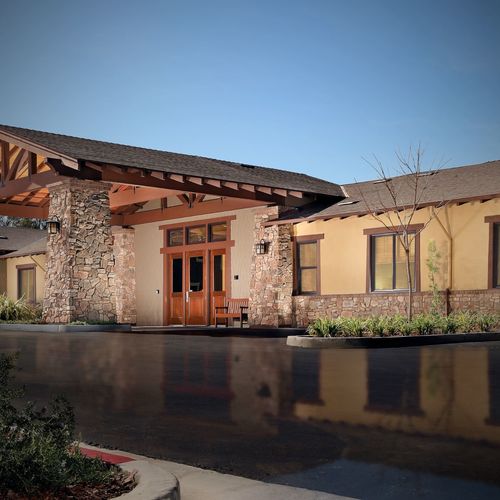
If you’ve owned your Saratoga, Los Gatos or West San Jose home for 25 or 30 years and you’re starting to think about a place that could carry you through every stage of aging, Saratoga Retirement Community is probably already on your radar. I’ve written before about what the move itself feels like, so this profile goes deeper into the mechanics: how the campus and care levels are organized, what questions to ask about the contract, what the entrance fee means in practical terms, and how selling your house fits into the plan. In the tour video above I walk the grounds, and I’ll refer back to a few things you can see there.
The Campus and Who Runs It
Saratoga Retirement Community (most people call it SRC) sits on a 37-acre campus at 14500 Fruitvale Avenue, near the foothills of the Santa Cruz Mountains. The historic white mission-style main building you see in the featured photo, with its twin bell towers and red tile roof, has been a local landmark for generations. The community is a not-for-profit with deep roots in the Independent Order of Odd Fellows, and it’s owned by Odd Fellows Home of California, a nonprofit that dates back to 1896.
There’s some recent news families should know about. In June 2026, Transforming Age, a nonprofit senior living organization, announced that it had taken on third-party management of SRC through its business services affiliate, while ownership stays with Odd Fellows Home of California. The same announcement mentioned a groundbreaking on a $101.7 million campus expansion to modernize facilities and add new residences, with the community currently described as having 337 residences. If you’re touring in the next year or two, ask how construction will affect the part of campus you’d live in and which new residence types are planned.
Help For A Sudden Move to Assisted Living

Four Levels of Care on One Campus
SRC is a continuing care retirement community, which California also calls a life plan community. The idea is that you move in while you’re independent, and if your health changes later, the next level of care is on the same campus rather than across town. For couples, that can be the whole ballgame, since one spouse can stay in independent living while the other gets more support a short walk away.
- Independent living in standalone cottages or apartments in the mission-style manor, with maintenance, dining and campus amenities included.
- Assisted living, with 24-hour help from licensed vocational nurses and certified nursing assistants for bathing, dressing, medication management, personal laundry, safety checks and escorts to meals and activities, plus on-site physical, occupational and speech therapy.
- Memory support in a secure setting for residents living with dementia.
- Skilled nursing and rehabilitation in a health center licensed as a skilled nursing facility (license number 220000416) with 94 licensed beds.
The community reports that it received 2026 U.S. News & World Report Best Short-Term Rehabilitation and Best Long-Term Care recognitions. Assisted living and memory care in California are licensed as Residential Care Facilities for the Elderly, and you can read inspection reports for those levels through the state’s Community Care Licensing facility search. I’d spend ten minutes there before you sign anything.
What Daily Life Looks Like
The amenity list is long, and it’s part of what makes the monthly fee easier to swallow when you compare it with the upkeep of a big house. Here’s what SRC offers on campus:
- Indoor pool and spa, plus a fitness and aquatic center
- Two dining rooms with restaurant-style meals and a private wine-tasting room
- Art studio, woodworking shop, model-train room, billiards and ping-pong
- Hair salon, library and a resident business center
- Bocce court, koi pond, English rose garden, walking paths and fitness trails
Beyond the facilities, there’s a full calendar of social outings, educational programs, arts and on-site events. Saratoga Village, local hospitals and the rest of Silicon Valley are a short drive away, so you’re not trading access for tranquility. For someone who’s spent years cleaning gutters and managing gardeners, handing all of that off while gaining a woodshop and a pool is a pretty good trade.
Understanding the Contract
This is where I’d slow down and bring your adult children, your CPA and possibly an elder law attorney into the conversation. A CCRC contract isn’t a lease; it’s a long-term agreement about housing and future care, and the terms vary a lot from one community (and even one contract option) to the next. SRC has published its own articles on how entrance fee contracts and contract types work, which is a good sign, but you’ll want the actual residence agreement in hand. Here are the questions I’d ask:
- Which contract types are offered right now, and how much of the entrance fee is refundable to me or my estate, and when?
- If I move to assisted living, memory support or skilled nursing, does my monthly fee stay the same, rise to a discounted rate, or go to full market rate?
- How have monthly fees increased over the past five years, and how will the expansion be financed?
- What health and financial qualifications do I need to meet to be accepted?
That second question matters because care costs can dwarf everything else. As reported at the time of writing (last I checked, as of September 2026), SRC’s skilled nursing daily rates for the public started around $608 per day for a semi-private room and $811 for a private room, while current independent living residents moving into skilled nursing started around $483 and $655 per day, with level-of-care charges possibly added. That resident discount is one of the concrete financial advantages of joining a campus like this, but please confirm current rates directly with SRC at 408-359-3008.
California regulates continuing care contracts through the Department of Social Services, and its Continuing Care Contracts Branch explains resident rights, including the right to cancel within a set period after signing. It’s worth reading before your first sales meeting so you know what protections you already have.
Free Guide: Selling a Home You’ve Owned for Decades

What the Entrance Fee Means for Selling Your Home
An entrance fee community asks for a large sum up front, on top of the monthly fee, and for most of my clients that money comes from the house. That changes the planning in a few important ways compared with a rental community, where you only need enough to cover the monthly cost.
Move first or sell first?
Most SRC applicants need the home equity before or right around move-in. Some have enough savings to pay the entrance fee and sell afterward at their own pace, which is the most comfortable path because you’re not staging and showing a house you’re still living in. Others use a short-term bridge loan secured by the house, and some communities offer deferred or phased payment of the entrance fee, so ask SRC what it allows. If you do need to sell first, we can often negotiate a rent-back so you stay in the house for a few weeks after closing while you move.
Preparing a house you’ve lived in for decades
Longtime Saratoga and Los Gatos homes often need some freshening up to sell for top dollar. Compass Concierge can front the cost of paint, flooring, landscaping and staging with no upfront payment, and it’s repaid from the sale proceeds. If you’d rather skip the projects, an as-is sale is a perfectly reasonable choice, and I’ll show you the numbers both ways. The bigger job is usually the belongings, since you’ll be moving from a family home into a cottage or apartment, so start by measuring your new floor plan and deciding what comes with you, then let family pick through the rest before you bring in an estate sale company.
Taxes: what helps and what doesn’t
If you’ve lived in your home as your primary residence for two of the last five years, IRS Section 121 lets you exclude up to $250,000 of gain if you’re single or $500,000 if you’re married filing jointly. In Silicon Valley, a house bought in the 1980s or 1990s can easily have more gain than that, so run the numbers with your CPA before listing. Prop 19, on the other hand, generally won’t help here, because it lets homeowners 55 and older transfer their property tax base to a replacement home they buy, and moving into a CCRC residence under a contract isn’t buying a home. Some families also ask their CPA whether part of the entrance fee or monthly fee counts as a prepaid medical expense, which is worth a conversation. If you’d like help mapping out the sale around your move-in date, my selling page explains how I work with longtime homeowners.
Who SRC Fits Best
SRC tends to suit people who value stability and don’t want to move twice, couples whose care needs are diverging, and homeowners who are ready to give up yard work and repairs while keeping an active, social life. It’s a bigger financial commitment up front than a rental community, so it makes the most sense when you have meaningful home equity and want the security of knowing where future care will happen. If you’re still healthy and independent, touring now gives you the most options, since independent living admission usually depends on meeting health qualifications at move-in.
Frequently Asked Questions
What levels of care does Saratoga Retirement Community offer?
SRC offers independent living in cottages and apartments, assisted living, memory support, and skilled nursing with rehabilitation, all on one 37-acre campus in Saratoga. The skilled nursing health center is licensed with 94 beds.
Who owns and manages Saratoga Retirement Community?
SRC is owned by Odd Fellows Home of California, a nonprofit founded in 1896. In June 2026, Transforming Age announced it had taken on third-party management of the community through its business services affiliate.
Is the entrance fee at Saratoga Retirement Community refundable?
That depends on the contract option you choose, and terms can change. Ask SRC for its current contract types, what percentage of the entrance fee is refundable, and when a refund is paid, then have your attorney or CPA review the residence agreement.
Do I need to sell my house before moving into SRC?
You don’t always have to. Some residents pay the entrance fee from savings and sell afterward, others use a bridge loan or a rent-back after closing, and some communities allow deferred entrance fee payments. Ask SRC what it offers and plan the sale timeline around your move-in date.
Can I use Prop 19 when I move to a CCRC like SRC?
In most cases it won’t apply. Prop 19 lets California homeowners 55 and older transfer their property tax base to a replacement home they purchase. Moving into a continuing care residence under a contract isn’t buying a home, so it usually doesn’t apply. The Section 121 capital gains exclusion on selling your current home still may.
How much does skilled nursing cost at SRC?
At the time of writing, public skilled nursing rates were reported to start around $608 per day semi-private and $811 private, with lower rates for current independent living residents of about $483 and $655. Confirm current rates with SRC at 408-359-3008.
If SRC is on your short list and you’re wondering how the house sale and the entrance fee fit together, I’d be glad to sit down and sketch out a timeline with you. Call me at 408-596-1623 or book a call with me, and we’ll figure out the order of operations that works for your family.
This article is for general education only. Please confirm pricing, availability, contract terms and care details directly with Saratoga Retirement Community, and remember that I’m not an attorney or CPA, so review legal and tax questions with your own advisors.
Time to talk to a REALTOR?

Senior Friendly Homes in Silicon Valley South
2
3
4
5
6
7
8
9
10
11
12
13
14
15
16
17
18
19
20
21
22
23
24
25