Key Takeaways
Summary: The best state for a Californian to move to depends on what you’re trying to fix. For lower total taxes and cheaper housing, Nevada and Arizona usually come out ahead, Texas trades income tax for high property tax, and Oregon and Washington feel the most like home but have their own income, capital gains and estate taxes. Long-time Bay Area homeowners should also factor in California tax on the sale, Prop 19, and how close they want to be to family before choosing.
It seems that a perennial theme around living in California is that people are often thinking about leaving the state. You’ve probably heard the joke: “Will the last person to leave California please turn out the lights?”
As a native-born Californian, I can’t say I identify with the pull of other states. I’ve been all around this country, and all around the world – and there are plenty of great places to live, but none of them hold a candle, for me, to what California has to offer. And I know most Californians feel the same way. I know, because I talk to dozens of them every week, following up with people who have at one time or another expressed an interest in selling their homes.
But there’s no question that many long-time California homeowners (especially older adults in the Bay Area) will, for a variety of reasons, eventually decide to make a move out of a state. In my experience, for most, it’s the possibility of cashing in on the equity they’ve built up on their homes in California and moving to a place they’ll be able to pay cash for a home and dramatically lower their monthly expenses for a more comfortable retirement. For others, they’re moving to be closer to where their kids and grandkids have moved to – but this can get complicated when they have multiple kids and grandkids to choose from (I wrote more about that in moving closer to family in retirement). And some folks have had it with California’s politics, packed highways, and high cost of…well, everything.
The single biggest impediment for people who want to cash in on their home equity is: where would I go? Most people do not sell for that simple reason – they don’t know where else they’d rather live. Interestingly enough, many folks looking to cash in on their home equity – that #1 reason for selling, in my experience – will remain in California, with some-day plans to move to Sacramento or somewhere in the Sierra foothills for example. This is often due to family and friends still living in northern California, and the desire to have a lower cost of living while not being half a continent away from them is a powerful reason to move “domestically.” There’s a tax reason too: if you’re 55 or older, Prop 19 lets you carry your low Prop 13 tax base to a replacement home anywhere in California, up to three times. No other state will honor that number.
However, many Bay Area homeowners will in fact decide to leave the state, heading out for greener pastures beyond the Golden State’s borders. Many of them are quite up-in-the-air about where they would go. Two of the biggest criteria seem to be places where houses are cheap, and there’s lower taxes, especially income tax. So what are the top states that these California homeowners are considering? Let’s take a look.
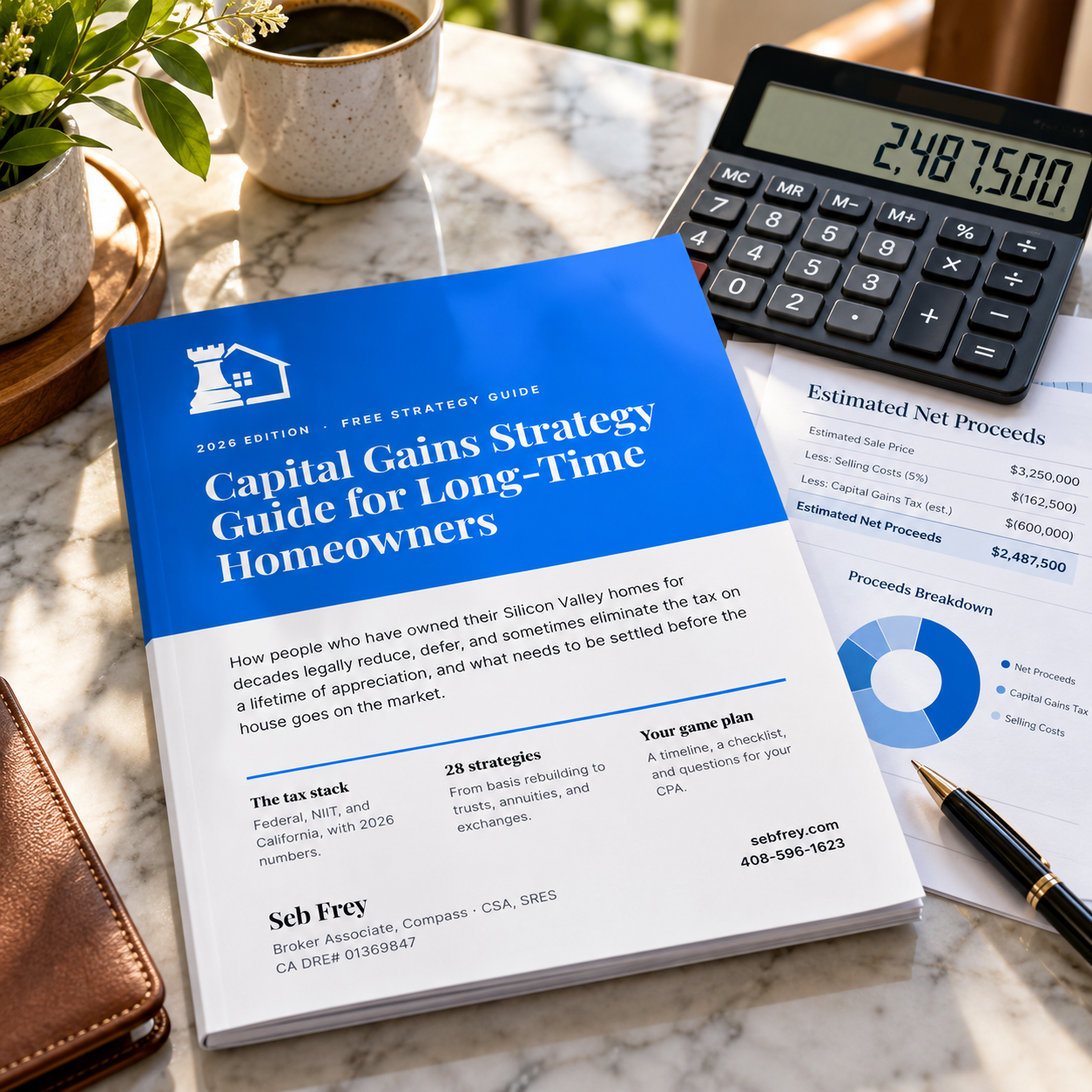
Free 2026 Strategy Guide
28 legal ways long-time owners cut their capital gains tax. Know your options before you list.
After decades in Silicon Valley, your gain can blow past the $250,000 and $500,000 exclusions. The guide walks through each strategy, a real bracket-by-bracket example, and what to settle before you list.
You're all set. Thanks! Your Capital Gains Strategy Guide is on its way to your inbox. If you don't see it in a few minutes, check your promotions or spam folder.
Most-Mentioned States to Move to from California
From a financial perspective, some states that make sense for Californians to move to are listed below. The property tax rates are the effective rates on owner-occupied homes published by the Tax Foundation. Keep in mind that California’s 0.70% is low because Prop 13 keeps long-time owners’ assessments far below market value. If you bought a home here today you’d pay roughly 1.1% to 1.25% of the purchase price, so the comparison depends on whether you’re thinking like a long-time owner or a new buyer.
- Texas – Texas has no state income tax, which can result in significant savings for high-income earners. It also has a low cost of living, especially when compared to California. However, it’s important to note that Texas has much higher property tax than California, an effective rate of about 1.40%, which is among the highest in the nation. Homeowners 65 and older do get an extra homestead exemption and a ceiling that freezes their school district taxes, which the Texas Comptroller explains here. Homeowners insurance in Texas also tends to run well above what Bay Area owners are used to paying.
- Nevada – Nevada has no state income tax, which combined with its low cost of living, can result in significant savings for residents. Its proximity to California and the Bay Area – especially Reno or North Lake Tahoe – makes it a favorite of Californians looking to sell and move out of state. Nevada also has low property tax, about 0.50%, and no estate or inheritance tax.
- Arizona – Arizona has a lower cost of living than California, with a warmer climate and lower housing costs. It has a flat 2.5% income tax, and property tax in Arizona averages around 0.48% per year. And while rising temperatures in Arizona will be challenging for Bay Area folks who have enjoyed the mild climate, the mountainous areas of Arizona will be fairly enticing.
- Oregon – Oregon has a state income tax with rates up to 9.9%, which is close to California’s for many retirees, but it has no sales tax and a lower cost of living compared to California, and is not too far away for folks wanting to maintain connections to friends and family still here. Its effective property tax rate is about 0.81%, a bit higher than California’s. Oregon also has an estate tax that applies to estates over $1 million, which catches a lot of former Bay Area homeowners. You can read about one family’s experience in my case study, Moving to Oregon After 45 Years.
- Washington – Washington has no state income tax on wages, a thriving tech industry, a lower cost of living compared to California, and beautiful natural landscapes. However, property in the Seattle area is not much cheaper than most of the Bay Area, and the tax picture is changing. Washington taxes long-term capital gains above roughly $270,000 at 7%, rising to 9.9% on gains over about $1.27 million, and its estate tax now starts at $3 million with a top rate of 35%, the highest in the country. Lawmakers also passed a 9.9% tax on household income over $1 million that takes effect in 2028 and is already being challenged in court. The Washington property tax rate averages about 0.75%. If Seattle is on your list, see my guide to moving to Seattle from the Bay Area.
Coast-to-Coast Agent Network
Moving out of California? I'll introduce you to an agent I trust there.
Through the Compass network I've vetted agents in most major markets across the country. Tell me where you're headed and I'll personally connect you with someone I'd send my own family to, then help you plan the sale of your Bay Area home so the timing works on both ends. There's no cost to you for the introduction.

Ready to talk now? Book a 30-minute call
Got it, thank you. I'll email you personally within one business day with an introduction to an agent I trust there.
Where Californians Actually Moved in 2024
What people tell me and what they actually do line up pretty well. According to Census Bureau migration estimates compiled by USAFacts, about 661,200 people left California for another state in 2024, while about 406,900 moved in from elsewhere in the U.S., a net loss of roughly 254,300 residents. The top destinations were Texas (about 77,200 people), Nevada (about 53,300) and Arizona (about 52,400).
NAR 2024 Study on Inflows and Outflows by State
The National Association of REALTORS® (NAR) published a report in October 2024 showing that job relocation trends significantly influence local real estate markets. The analysis is based on Census Bureau job-to-job flow data from the third quarter of 2023, so it covers working professionals rather than retirees. States like Virginia, Texas, and South Carolina are experiencing increased housing demand due to high job inflows, leading to rising home prices. Conversely, states with job outflows, such as Louisiana, are seeing decreased housing demand and potential price declines. These migration patterns underscore the strong connection between employment shifts and housing market dynamics.
Regarding California, the report points to high housing costs in areas like San Francisco and Los Angeles, the high cost of living, and high state income taxes as the main reasons workers leave. It notes:
While California remains a major job market, the state saw nearly 87,000 professionals leave for opportunities elsewhere, surpassing its job inflows of about 69,000. … Specifically, 14% of professionals found jobs in Texas, and 9% in Arizona. Washington (8%) and Nevada (7%) are a couple of other popular destinations for Californian professionals.

Most Affordable States for Californians to Move To
Those five are the states that I hear most-often cited as states where people from California and the Silicon Valley are considering moving to. However, back in February 2023 the San Jose Mercury News published an article that offers a deep analysis of which states truly make the most sense financially for Californians to move to, by comparing pay against cost of living in each state.

Here’s what the article found in terms of which states specifically make the most sense financially for Californians to move to. Colorado came out on top, blending top-shelf pay with a slightly above-average cost of living, which the author’s math valued at $119 for every $100 in California. The next best deals were Minnesota and New Hampshire at $117, then Illinois at $116, Utah and Maryland at $115, Wyoming, Kansas and Nebraska at $113 and West Virginia at $112. At the other end, Hawaii ranked last as a $73 value for every $100 in California, one of 12 states where the math said California was the better financial bet.
Two things to keep in mind with that list. It’s built around wages, so it fits a working household better than a retiree living on savings and Social Security. And a few of those states tax retirement income differently than California does. California doesn’t tax Social Security, but Colorado, Minnesota and Utah are among the eight states that still tax some Social Security benefits (Colorado lets residents 65 and older deduct them fully).

Free 10-Strategy Guide
The Moving Guide for Long-Time Bay Area Homeowners
How to plan your move in the right order, set a realistic timeline, and get your home ready to sell while protecting your equity and your peace of mind.
You're all set. Thanks! The Moving Guide is on its way to your inbox. If you don't see it in a few minutes, check your promotions or spam folder.
The Tax Questions to Answer Before You Leave California
The state you move to is only half the tax picture. Here’s what I make sure every client leaving the state talks through with their CPA before we list the house:
- California still taxes the gain on your California home. Moving to Nevada or Texas before you sell doesn’t help, because the gain on California real estate is California-source income no matter where you live when it closes. California escrow will also withhold 3⅓% of the sale price for the state unless an exemption applies, such as the principal residence exemption (see FTB Publication 1016).
- The federal exclusion still applies. You can exclude up to $250,000 of gain ($500,000 for a married couple) on a home you’ve owned and lived in for two of the last five years, per IRS Topic 701. For people who’ve owned in Silicon Valley for 30 years, the gain is often well past that, so read my guide to capital gains when you’ve owned for 30+ years and my article on taxes when you sell and leave California.
- Your property tax resets in the new state. Prop 13 and Prop 19 don’t cross state lines, so your new tax bill will be based on what you pay for the new house.
- Estate and inheritance taxes vary a lot. California has no estate tax, but Oregon and Washington do, and that can matter more to your kids than your income tax does to you.
- Selling vs. renting. Some people keep the Bay Area house as a rental when they move. That can work, but it changes the tax math, so it’s worth reading Should I Sell or Rent My Bay Area Home When I Retire? first.
Making the decision to leave California is one that needs to be made very carefully. I’ve spoken with many people who left the state only to end up missing it, and wishing they could come back. But coming back to California can be challenging, because buying back into this market can be cost-prohibitive, especially if you haven’t been accumulating wealth significantly while you’ve been out of state.
If, however, after sober reflection you’ve decided that moving out of state makes the most sense for you, then I encourage you to get a copy of my special report – the top relocation destinations for Bay Area homeowners. This report explores where people specifically from the Bay Area are moving to, and why. I have another article where I evaluate the top 10 of 25 relocation destinations as determined by Forbes Magazine, plus area guides for Greater Nashville, North Carolina’s Research Triangle and Coral Gables, Florida. When you’re ready to plan the logistics, start with the cost of moving out of the Bay Area and my 90-day senior move plan.
Free Cash-Out Strategy Call
You've spent decades building equity. Let's make sure you take as much of it with you as possible.
Selling a long-held California home and moving somewhere new comes down to a few big questions. We'll look at what your home should sell for, what you'll actually net after taxes and costs, and how to time the sale with your next purchase so you're never stuck in between. You'll leave with real numbers and a plan, whether or not you hire me.
Book My Cash-Out Strategy Call →
Concerned about Climate Risk?
While we have horrific wildfires out here, much of the rest of the country is susceptible to natural disasters as well – and many areas have much greater climate risk than most of California does. Explore my article on the best and worst climate risk areas for those relocating from California.
Frequently Asked Questions
What states do most Californians move to?
Texas, Nevada and Arizona. Census Bureau estimates compiled by USAFacts show about 77,200 Californians moved to Texas in 2024, about 53,300 to Nevada and about 52,400 to Arizona. Washington and Oregon are the other two I hear about most from Bay Area homeowners.
Is Texas really cheaper than California?
Homes usually are, and there’s no state income tax, but Texas has an effective property tax rate of about 1.40%, roughly double California’s average. Homeowners insurance also tends to cost more. Retirees living mostly on Social Security and savings often save less in Texas than they expect, because they weren’t paying much California income tax to begin with.
Does Washington have a state income tax?
Not on wages today. Washington does tax long-term capital gains above roughly $270,000, has the highest state estate tax rate in the country at 35%, and has passed a 9.9% tax on household income over $1 million that is scheduled to start in 2028 and is being challenged in court.
Which states have no state income tax?
Of the states Californians move to most, Texas and Nevada have no income tax, and Washington doesn’t tax wages. Florida, Tennessee, South Dakota, Wyoming, Alaska and New Hampshire are also on most no-income-tax lists. Always check property tax, sales tax and estate tax before deciding a state is cheaper overall.
If I move out of California before selling my house, do I avoid California tax?
No. The gain on California real estate is taxed by California no matter where you live when you sell. You can still use the federal exclusion of up to $250,000 ($500,000 for married couples) if you qualify, so talk to your CPA about timing before you move.
Can I take my Prop 13 tax base to another state?
No. Prop 19 lets homeowners 55 and older transfer their tax base to a replacement home anywhere in California, but it doesn’t apply outside the state. Your property tax in the new state will be based on what you pay for your new home.
Is Arizona a good place to retire if I’m leaving California?
For many people, yes. Arizona has a flat 2.5% income tax, an effective property tax rate of about 0.48%, no estate tax, and lower home prices. The summer heat is the big drawback, which is why a lot of Bay Area retirees look at higher-elevation towns.
What’s the biggest mistake people make when leaving California?
Choosing a state for one headline number, usually no income tax or cheap houses, without looking at property tax, insurance, estate tax, healthcare, climate risk and distance from family. I’ve talked with plenty of people who regretted the move and found it very hard to buy back into California later.
How do I narrow down where to move?
Pick two or three states, then narrow each one to specific towns, since the right fit is almost never a whole state. Compare each town on total housing cost, taxes, healthcare, weather and how far you’ll be from your kids and grandkids, then plan the sale of your Bay Area home around the move.
Coast-to-Coast Agent Network
Moving out of California? I'll introduce you to an agent I trust there.
Through the Compass network I've vetted agents in most major markets across the country. Tell me where you're headed and I'll personally connect you with someone I'd send my own family to, then help you plan the sale of your Bay Area home so the timing works on both ends. There's no cost to you for the introduction.
Ready to talk now? Book a 30-minute call
Got it, thank you. I'll email you personally within one business day with an introduction to an agent I trust there.