
“If we sell the house and buy a condo, we’ll have plenty left over.” I hear some version of that from almost every couple who starts thinking about downsizing, and they’re usually right that they’ll free up money. What surprises them is how much less it is than the simple difference between the two prices. Commission, capital gains tax, the purchase costs, the move itself, and HOA dues all take a bite. This article runs the full math on a realistic Silicon Valley downsize so you can see where the money actually goes. It’s part of my ultimate downsizing guide for Bay Area seniors. Downsizing in Silicon Valley rarely frees up as much cash as people expect on day one, and I’ll show you why with real numbers.
Key Takeaways
Summary: Downsizing from a Silicon Valley house to a condo usually frees up much less cash than the price difference suggests, once capital gains tax, commission, and HOA dues are counted. Running your real numbers first, including a Prop 19 transfer, is the best way to avoid a disappointing move.
From my practice: Freeing up cash is half the question, and turning it into income is the other half. One seller I worked with sold a house he’d bought for $490,000 for $1,275,000, and he wanted steady retirement income from part of it. We set up a structured installment sale that would have paid him $3,500 a month for more than eight years from about $300,000 of the proceeds, but the buyers declined to sign on at the last minute and we closed as a standard sale. Plan the income side before you list, so it can be written into the offer terms.
A Worked Example: What You Net Selling a $2.4M House
A couple in their early 70s bought their Willow Glen home in 1990 and have about $600,000 in basis including improvements. Their assessed value is about $320,000. They sell for $2,400,000 and buy a two-bedroom, single-level condo in Los Gatos for $1,300,000.
Selling the house
| Amount | |
|---|---|
| Sale price | $2,400,000 |
| Commission and seller closing costs (illustrative, about 5.5 percent) | ($132,000) |
| Pre-sale preparation, cleanout, and staging | ($35,000) |
| Estimated capital gains tax on roughly $1,150,000 of taxable gain after the $500,000 exclusion | (About $325,000) |
| Net after sale costs and tax | About $1,908,000 |
The tax estimate uses roughly the combined federal and California rates from my capital gains tax guide. Yours depends on your basis, other income, and whether a spouse’s death has stepped up the basis.
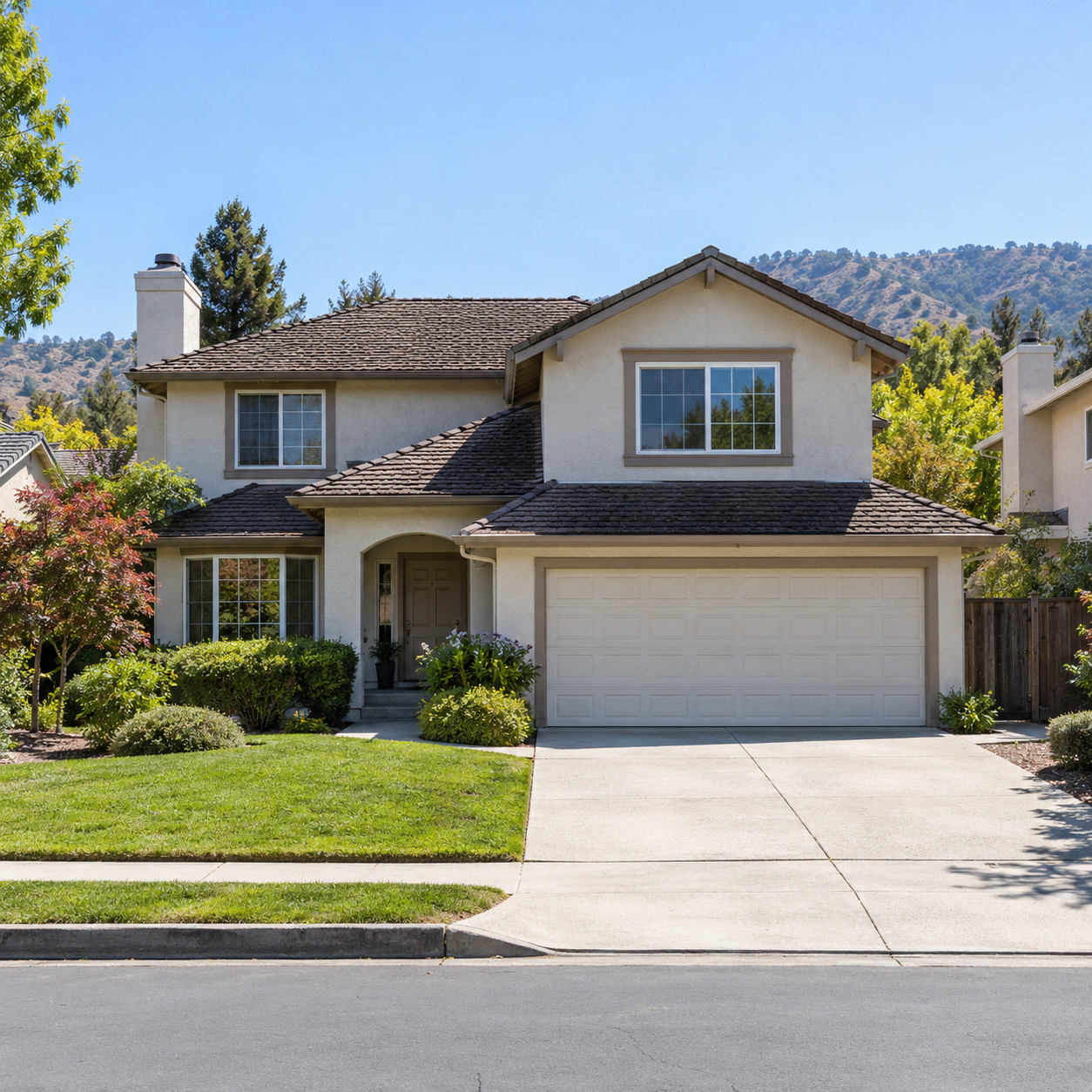
Free 3-minute decision check
Stay, downsize, or move away? Find out which one costs you the least.
For longtime Bay Area owners, the wrong call can cost six figures in taxes, remodeling, or years of higher living costs. Answer a dozen quick questions and see all three paths side by side, with a rough dollar figure for what each one would cost you or free up.
See My Best Path →Rather talk now? Call or text 408.413.3087
Buying the condo
| Amount | |
|---|---|
| Purchase price | ($1,300,000) |
| Buyer closing costs | (About $8,000) |
| Movers, new furniture, and small updates | (About $20,000) |
| Cash freed up | About $580,000 |
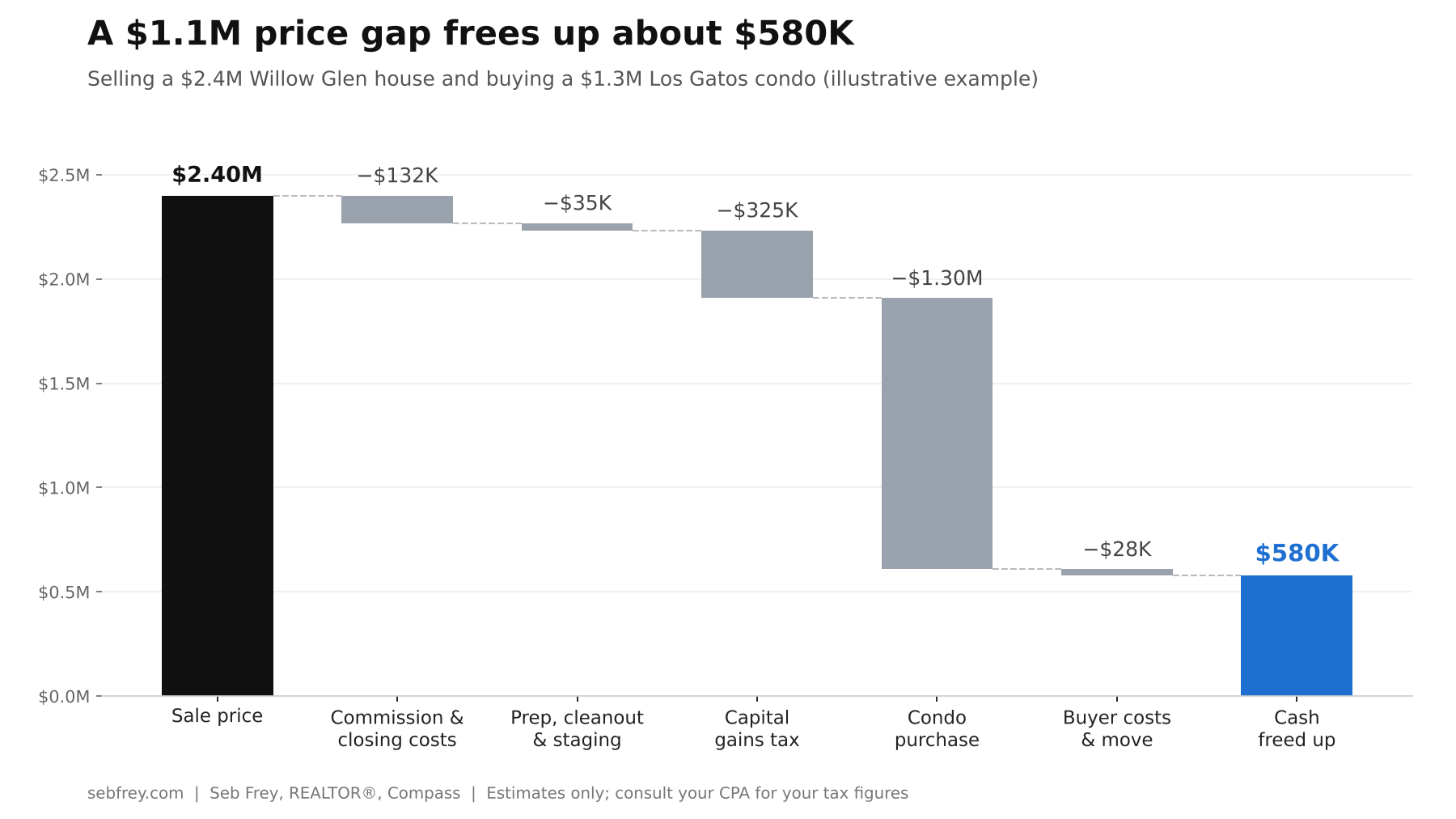
The price difference is $1,100,000. The cash freed is roughly half of that. For some couples that’s still exactly what they need to fund retirement and future care. For others, it changes the plan, and they choose a less expensive area, a smaller unit, or renting. The point is to know before you start.
Monthly Costs Before and After
| Annual cost | Willow Glen house | Los Gatos condo |
|---|---|---|
| Property tax (with the Prop 19 base-year transfer) | About $3,800 | About $3,800 |
| Property tax without the transfer | About $15,600 | |
| HOA dues | None | About $7,200 |
| Insurance | About $3,500 | About $1,200 (the HOA insures the building) |
| Maintenance, gardening, and repairs | About $12,000 | About $2,000 |
| Utilities | About $6,000 | About $3,000 |
| Total with the Prop 19 transfer | About $25,300 | About $17,200 |
With the Prop 19 base-year transfer, their annual costs fall by about $8,000. Without it, the condo would cost more to carry than the house. That’s why the base-year transfer is one of the most important tools for older Silicon Valley homeowners, and I explain it in the Prop 19 base-year transfer for homeowners 55 and older.
Free Guide: Selling a Home You’ve Owned for Decades

A real example: Here are real numbers from one downsize. My seller, in her eighties, sold an older four-bedroom creekside house for $1,400,000 and bought a newer three-bedroom single-level home nearby for $725,000, all cash. At closing, $721,033.75 of her proceeds went straight into the purchase, and she moved once, with no bridge loan, no rental and no storage. She went from an older house on a creek to a newer single-level home she can manage on her own.
How to Keep More of Your Money When You Downsize
- A step-up in basis. A widow or widower whose home received a community property step-up may owe little or no tax. See the community property double step-up.
- Documented improvements. They reduce the taxable gain. See how to calculate your adjusted basis.
- Selling well. Targeted preparation and strong marketing on a $2.4 million house can easily move the net by more than the entire cost of the move.
- Choosing the next home carefully. HOA dues and special assessments can eat into the savings.
- Timing income. Delaying IRA withdrawals in the year of the sale can keep more of the gain in lower brackets.
Before You Decide
Downsizing is rarely just a financial decision. Stairs, isolation, the burden of maintaining a large house, and being closer to family often matter more than the dollars. But the dollars should be clear. When I meet with a couple considering a move, I build a version of these tables with their actual basis, assessed value, likely sale price, and target homes, and we bring in their CPA for the tax line. For the broader planning picture, see my ultimate downsizing guide for Bay Area seniors and the Best Move method. And if you’re weighing whether to move at all, my comparison of a reverse mortgage vs. selling your Silicon Valley home runs the same $2.4 million example through four different paths.

Thinking about selling?
Just list with me, I'll do the rest.
Minimum hassle, maximum profit, and a sale on your timeline at a price and terms you'll love.
Let's Get Started →Rather talk now? Call or text 408.413.3087
Frequently Asked Questions
How much money will I free up by downsizing in Silicon Valley?
Usually much less than the price difference. In one example, selling a $2,400,000 home and buying a $1,300,000 condo freed about $580,000 after commission, preparation, capital gains tax, and purchase and moving costs.
Will my property taxes go up when I downsize?
If you’re 55 or older, Prop 19’s base-year transfer can let you keep your current assessed value on a replacement home of equal or lesser value anywhere in California.
Do monthly costs go down when you move to a condo?
Usually, but HOA dues offset part of the savings. In one example, annual costs fell by about $8,000 with the Prop 19 transfer, while without it the condo cost more to carry.
What is the biggest cost of downsizing?
For couples who bought decades ago, capital gains tax is often the largest cost, followed by commission and closing costs.
How much capital gains tax will I pay when I downsize in California?
It depends on your basis and other income. A married couple can exclude up to $500,000 of gain on a primary residence ($250,000 if single). The rest is taxed federally at up to 20 percent, plus the 3.8 percent net investment income tax for higher earners, and California taxes it as ordinary income. In the example above, roughly $1,150,000 of taxable gain produced about $325,000 in combined tax.
How can I increase what I net from downsizing?
Document improvements, use any step-up in basis, prepare and market the house well, use the Prop 19 base-year transfer, and choose a replacement home with reasonable HOA costs.
Sources and Further Reading
Downsizing Done Right
Senior Friendly Homes in Silicon Valley South
2
3
4
5
6
7
8
9
10
11
12
13
14
15
16
17
18
19
20
21
22
23
24
25