
Key Takeaways
Summary: Widowed homeowners in California usually have strong tax protections when they sell, including the $500,000 surviving spouse exclusion for two years and a full step-up in basis on community property. How the deed was worded and when the house sells can swing the taxable gain by close to a million dollars at Silicon Valley prices, so the smart move is to document the date-of-death value, clear title, file the county paperwork, and then make an unhurried decision inside the two-year window.
If you’ve recently lost your husband or wife, I’m so sorry. This post is the technical side of selling the house afterward: the tax rules, how to clear title, the county paperwork and the deadlines attached to each. If you’re still deciding whether to sell at all, stay, or move closer to family, start with my guide to deciding whether to sell the house after your spouse dies, then come back here when you want the numbers. The short version is that the biggest tax rules give you up to two years, so there’s room for a calm decision, but a couple of filings have much shorter clocks.
I’ve been licensed since 2003 and have closed more than 460 transactions in Santa Clara and Santa Cruz counties, and a lot of that work happens in the year after a spouse passes. I hold the SRES®, Certified Senior Advisor (CSA) and CAPS designations because so many of my clients are going through exactly this. So I’d like to lay out what you need to know about taxes, title and timing, in plain language, with real numbers at Silicon Valley prices. I’m not a CPA or an attorney, and the tax rules here are worth confirming with yours, but this should help you walk into those conversations knowing the right questions.
Your Mortgage After a Spouse Dies
Your mortgage lender generally can’t call the loan just because your spouse died, since the federal Garn-St Germain Act protects transfers to a surviving spouse or relative at death (12 U.S.C. §1701j-3). Keep making the payments, send the servicer a copy of the death certificate, and ask them to update the account. The one big exception is a reverse mortgage. If your spouse was the only borrower on a HECM, the loan can come due, and a non-borrowing spouse needs to talk with the servicer right away about whether they qualify to defer repayment and stay in the home. I compare the two paths in reverse mortgage vs. selling your Silicon Valley home.
The Two-Year Rule for the $500,000 Exclusion
Normally, a single person selling a primary residence can exclude up to $250,000 of gain from income tax, and a married couple filing jointly can exclude up to $500,000. Under IRC §121(b)(4), explained in IRS Publication 523, a surviving spouse can still use the full $500,000 exclusion if the sale happens within two years of the date of death, you haven’t remarried as of the sale date, neither of you used the exclusion on another home in the two years before the sale, and the ownership and use tests would have been met by the two of you right before your spouse died (you’re allowed to count your late spouse’s time in the home). After the two-year mark, the exclusion drops to $250,000. If the sale closes in the same calendar year your spouse died, you can usually file a joint return for that year anyway, which gets you the $500,000 figure the ordinary way.
For a lot of my clients, the step-up in basis I’m about to explain matters even more than the exclusion, but the two together are why I tell widowed clients to at least have a conversation about timing in year one. If you’re anywhere near the 18-month mark and still undecided, that’s the moment to sit down with your CPA and me and run the numbers both ways, because a Silicon Valley sale takes time to prepare and the clock runs to the closing date, not the listing date.
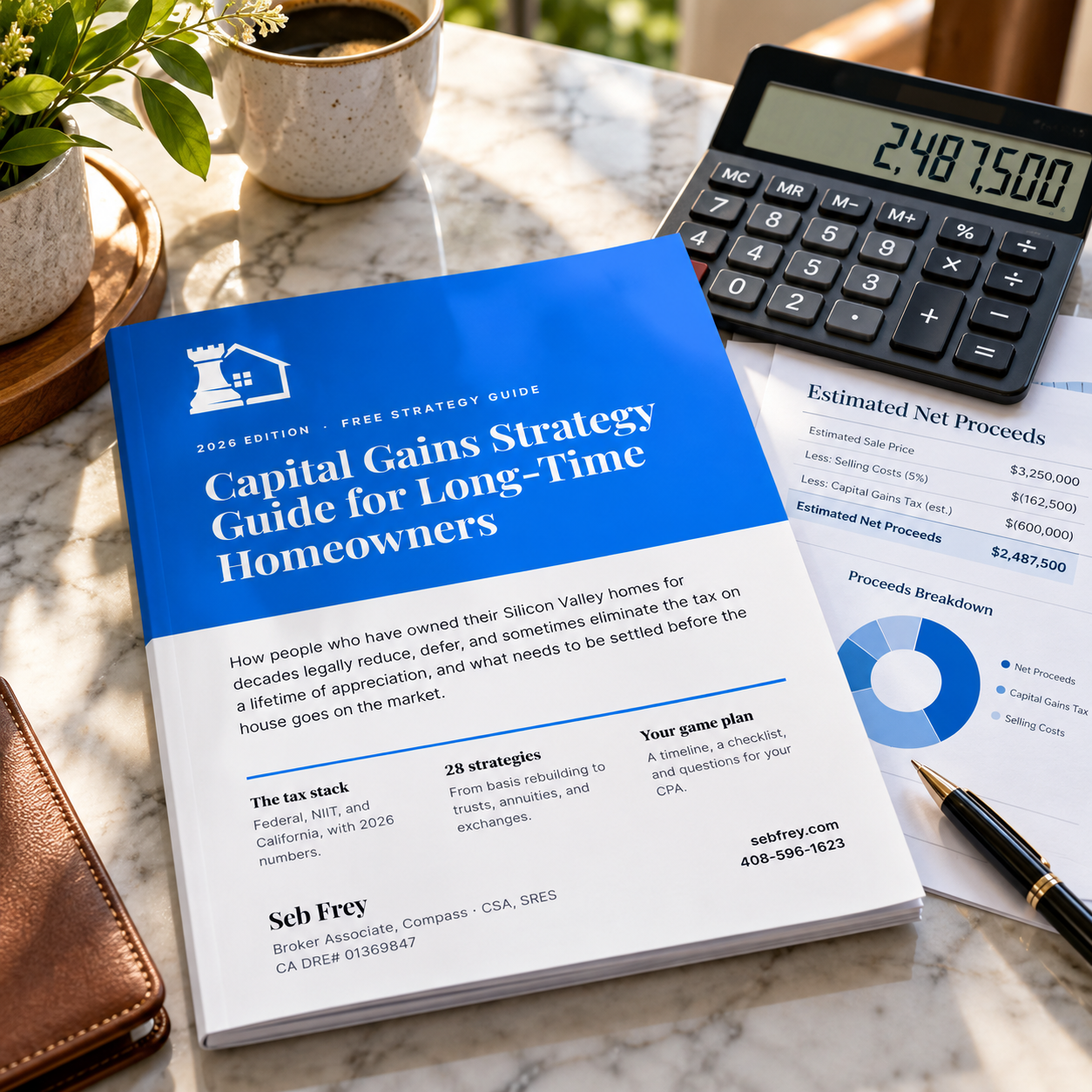
Free 2026 Strategy Guide
28 legal ways long-time owners cut their capital gains tax. Know your options before you list.
After decades in Silicon Valley, your gain can blow past the $250,000 and $500,000 exclusions. The guide walks through each strategy, a real bracket-by-bracket example, and what to settle before you list.
You're all set. Thanks! Your Capital Gains Strategy Guide is on its way to your inbox. If you don't see it in a few minutes, check your promotions or spam folder.
Community Property and the Full Step-Up in Basis
This is the rule that saves Silicon Valley widows and widowers the most money, and it’s the one most people have never heard of. When someone dies, the assets they owned generally get a new tax basis equal to fair market value at the date of death. California is a community property state, and under IRC §1014(b)(6) (see also IRS Publication 555), when a married couple holds a home as community property, the entire home, both halves and not just the deceased spouse’s half, gets stepped up when the first spouse dies. If the couple held title as joint tenants instead, only the deceased spouse’s half is typically stepped up, though a CPA or attorney may be able to show the home was actually community property. I go deeper on this in the community property double step-up.
Here’s an illustrative example of why this matters so much here. Say you and your husband bought your Saratoga home in 1985 for $300,000, and it was worth $3,000,000 when he passed. You sell 18 months later for $3,100,000.
| Held as community property | Held as joint tenants (half step-up) | |
|---|---|---|
| New tax basis | $3,000,000 | $1,650,000 ($150,000 + $1,500,000) |
| Sale price | $3,100,000 | $3,100,000 |
| Gain before exclusion (ignoring selling costs and improvements) | $100,000 | $1,450,000 |
| Exclusion (sold within 2 years) | $500,000 | $500,000 |
| Taxable gain | $0 | $950,000 |
That’s the same house, the same widow and the same sale price, with a $950,000 difference in taxable gain based on how the deed was worded. Many California couples hold title as “community property with right of survivorship” under Civil Code §682.1, which combines the full step-up with an easy transfer at death. Pull your deed and take it to your CPA before you sell. My capital gains guide for 30-year owners goes deeper on the math.

Capital Gains Calculator
Bought for $180K and worth $2.4M today? See what you'd owe in capital gains tax.
After decades in Silicon Valley, your gain can blow right past the $250,000 and $500,000 exclusions. Plug in your numbers and see your estimated tax bill and how much cash you'll walk away with.
Run My Numbers →Document the Date-of-Death Value Now
The step-up only helps if you can prove what the house was worth on the day your spouse died, and that gets harder every month as the market moves. Your CPA will want a number with support behind it. For a modest gap between that value and your eventual sale price, a detailed comparative market analysis built on sales from around the date of death is often enough, and it’s something I prepare for widowed clients as part of planning the sale. When the numbers are large, or an estate tax return is involved, I usually recommend a retrospective appraisal from a licensed appraiser as well, because it holds up better if the IRS ever asks. Either way, keep it with your records, along with receipts for any improvements made after the date of death, since those add to your basis too.
Clearing Title So You Can Sell
Before a title company will insure a sale, it needs to see that the house is legally yours alone. How that works depends on how the home was held.
| How title was held | What usually clears it |
|---|---|
| Joint tenancy or community property with right of survivorship | Record an affidavit of death with a certified death certificate (Probate Code §210) |
| Living trust | Successor trustee (often you) signs a certification of trust and records an affidavit of death of trustee |
| Community property without survivorship, or your spouse’s separate property left to you | A spousal property petition (Judicial Council form DE-221) under Probate Code §13650, which is much simpler than full probate |
| Spouse’s separate property left to someone else, or no will | Possibly probate; see an attorney |
In most cases I see, it’s the first or second row, and title can be cleared in a few weeks. California law (Probate Code §13540) does give a surviving spouse power to sell community property 40 days after the death, but in practice most title companies still want a recorded affidavit or a spousal property order before they’ll insure the sale, so plan for that. If a trust is involved, my post on what title and escrow need to sell a trust house walks through the documents. If you find the house was supposed to be in the trust but the deed never got moved, a Heggstad petition can often fix it without full probate.
Property Taxes, the BOE-502-D and Prop 19
When a home passes from one spouse to the other, including at death, it isn’t treated as a change in ownership for property tax purposes under Revenue and Taxation Code §63, so your Prop 13 base stays the same. You do still have to tell the county. Under Revenue and Taxation Code §480, a Change in Ownership Statement, Death of Real Property Owner (form BOE-502-D) is due to the assessor within 150 days of the date of death, and you claim the spousal exclusion on it. I explain that form step by step in the BOE-502-D guide for Santa Clara County. While you’re at it, check that the homeowners’ exemption is still on your tax bill ($7,000 off assessed value, per the Board of Equalization).
If you decide to sell and buy something smaller, and you’re 55 or older, Prop 19 lets you transfer your base to a replacement home anywhere in California, up to three times, as long as you buy within two years before or after the sale. If the new home costs more, the difference gets added to your base rather than disqualifying you. The Board of Equalization’s Prop 19 page and its Prop 19 fact sheet have the details, and so does my Prop 19 explainer for seniors. Both Prop 19 and the $500,000 exclusion use two-year windows, but they’re measured from different dates. The exclusion runs from your spouse’s date of death to your closing, while Prop 19 runs between the sale of your old home and the purchase of the new one, so if you think you’ll eventually move, map both on the same calendar before you list.

Prop 19 Calculator
Can You Take Your Low Property Tax With You?
If you're 55 or older, Prop 19 may let you carry your current tax base to a new home anywhere in California. Plug in your numbers and see what your property taxes could look like after you move.
Estimate My Property Taxes →A Paperwork Timeline From the First Week to Month 24
Here’s how the deadlines above line up on a calendar. None of this commits you to selling, but missing one of these dates can cost you money or delay a sale later.
| When | What to do | Why it matters |
|---|---|---|
| First two weeks | Order several certified copies of the death certificate, find your deed and any trust documents, and notify the mortgage servicer and your homeowners insurance carrier | Title, escrow, the county and the lender will each want a certified copy, and the deed tells you which title path and which step-up applies |
| After 40 days | Record the affidavit of death, or start the successor trustee or spousal property petition paperwork | Probate Code §13540 lets a surviving spouse sell community property after 40 days, but title will want the record cleaned up before it insures a sale |
| Within 150 days | File the BOE-502-D with the county assessor and claim the spousal exclusion | Revenue and Taxation Code §480 requires it, and it’s how the assessor confirms your Prop 13 base stays the same |
| First few months | Get a date-of-death valuation on the house | Comparable sales from around the date of death are easiest to document now, and that value becomes your new basis |
| Tax return for the year of death | Ask your CPA about filing jointly, and confirm the homeowners’ exemption is still on your tax bill | A sale that closes in the year of death can use the $500,000 exclusion through the joint return |
| Month 18 | Run the sell-now vs. sell-later numbers with your CPA and me | A sale needs time for prep, marketing and escrow, and the exclusion clock runs to the closing date, not the listing date |
| Month 24 | Last point to close and keep the full $500,000 exclusion | After this, the exclusion drops to $250,000. Prop 19’s two-year window runs separately, from the sale date |
When You’re Ready
When you do decide to sell, I’ll help you clear title, coordinate with your CPA on timing, handle the clean-out and estate sale if you need it, and sell the home without you having to manage contractors or open houses on your own. I’m happy to just talk with no agenda at all, whether that’s this month or a year from now. You can book a 30-minute call here, call my office at 408-413-3087, or learn more about how I work with seniors and their families.
Free 3-minute decision check
Stay, downsize, or move away? Find out which one costs you the least.
For longtime Bay Area owners, the wrong call can cost six figures in taxes, remodeling, or years of higher living costs. Answer a dozen quick questions and see all three paths side by side, with a rough dollar figure for what each one would cost you or free up.
See My Best Path →Rather talk now? Call or text 408.413.3087
Frequently Asked Questions
Can a widow or widower keep the $500,000 capital gains exclusion?
Yes, if the home is sold within two years of the spouse’s death, the surviving spouse hasn’t remarried as of the sale, and the ownership and use tests were met before the death, according to IRS Publication 523. After two years, the exclusion drops to $250,000.
Does my house get a step-up in basis when my spouse dies in California?
Usually. If the home was community property, the entire home generally gets a new basis equal to its value at the date of death under IRC §1014(b)(6). If it was held as joint tenants, typically only the deceased spouse’s half is stepped up, though a CPA may be able to establish that it was community property.
How do I prove what the house was worth when my spouse died?
Get a date-of-death valuation as soon as you reasonably can. A REALTOR® can prepare a market analysis based on sales around the date of death, and for larger estates or estate tax filings a retrospective appraisal from a licensed appraiser is the stronger record. Keep it with your tax files for when you sell.
Will my property taxes go up after my spouse dies?
No. Under Revenue and Taxation Code §63, transfers between spouses, including at death, aren’t a change in ownership, so the Prop 13 base stays the same. You still need to file form BOE-502-D with the county assessor within 150 days of the death to claim that exclusion.
How do I get my spouse’s name off the deed in California?
For joint tenancy or community property with right of survivorship, record an affidavit of death with a certified death certificate. For a trust, the successor trustee records an affidavit of death of trustee. For other community property, a spousal property petition under Probate Code §13650 usually works without full probate.
Can the bank call my mortgage after my spouse dies?
Generally no. The federal Garn-St Germain Act prevents lenders from calling a residential loan due because of a transfer to a surviving spouse at death. Keep making payments and notify the servicer. Reverse mortgages are different: if your spouse was the only borrower, contact the servicer right away.
Does Prop 19 help a widowed homeowner who wants to downsize?
If you’re 55 or older, Prop 19 lets you move your Prop 13 base to a replacement home anywhere in California, up to three times, as long as you buy within two years before or after selling. A more expensive replacement is allowed, with the difference added to your base.
Can I sell community property without a court order after my spouse dies?
California Probate Code §13540 gives a surviving spouse power to sell community property 40 days after the death, but most title companies still want a recorded affidavit of death or a spousal property order under Probate Code §13650 before they’ll insure the sale. Plan on clearing title before you list.

Simple Strategy Guide
The Downsizing Guide for Bay Area Seniors
What to keep, what to let go, and how to get your home ready for today's buyers without a costly remodel, so you protect your equity and move on your own timeline.
You're all set. Thanks! The Downsizing Guide is on its way to your inbox. If you don't see it in a few minutes, check your promotions or spam folder.
Senior Friendly Homes in Silicon Valley South
2
3
4
5
6
7
8
9
10
11
12
13
14
15
16
17
18
19
20
21
22
23
24
25