
Key Takeaways
Summary: Every dollar of documented capital improvements lowers your taxable gain, and on a large Silicon Valley sale that can mean tens of thousands of dollars in tax saved. If you’ve lost the receipts, you can usually rebuild your home’s cost basis from permits, county records, loan files, bank statements, contractors, and photos, then let your CPA decide what the documentation supports.
When I sit down with a couple who has owned their Silicon Valley home for 35 or 40 years, one of the most valuable things I can do before we list is help them find money they forgot they spent. The kitchen remodel in 1994, the second story in 2002, the new roof, the sewer line, the solar panels. Every documented dollar of capital improvements adds to the home’s tax basis and reduces the taxable gain when it sells, and almost nobody kept the receipts. This article explains what counts, what doesn’t, and where to find the evidence in Santa Clara County when the shoebox of receipts is long gone. It’s part of my guide to capital gains when selling a Silicon Valley home you have owned for 30 years or more.
What Cost Basis Means (and What It Isn’t)
Your basis starts with the purchase price plus certain settlement costs you paid when you bought, such as owner’s title insurance, recording fees, transfer taxes, legal fees, and survey costs. You add the cost of capital improvements, then subtract things like depreciation you took, casualty losses you deducted, insurance reimbursements, and certain energy credits. The IRS lays this out in Publication 551. One mix-up I hear all the time is people assuming their Prop 13 assessed value is their basis. It isn’t. Your property tax assessment and your income tax basis are two completely different numbers, even though both start from what you paid.
Here’s how the pieces fit together for a hypothetical San Jose couple who bought in 1986 and are selling now. The numbers are illustrative, not a prediction for your home.
| Line item | Amount |
|---|---|
| Purchase price (1986) | $185,000 |
| Purchase closing costs that add to basis | $4,000 |
| Documented capital improvements | $260,000 |
| Adjusted basis | $449,000 |
| Sale price | $2,300,000 |
| Selling costs | $115,000 |
| Amount realized | $2,185,000 |
| Gain ($2,185,000 minus $449,000) | $1,736,000 |
| Home sale exclusion, married filing jointly | $500,000 |
| Taxable gain | $1,236,000 |
If that same couple could only document $100,000 of their improvements instead of $260,000, their taxable gain would jump by $160,000. That’s why I treat rebuilding the improvement history as part of getting a house ready to sell, right alongside the repairs and staging. If you want to understand the exclusion itself, I cover it in reducing or eliminating capital gains tax on the sale of your primary home.
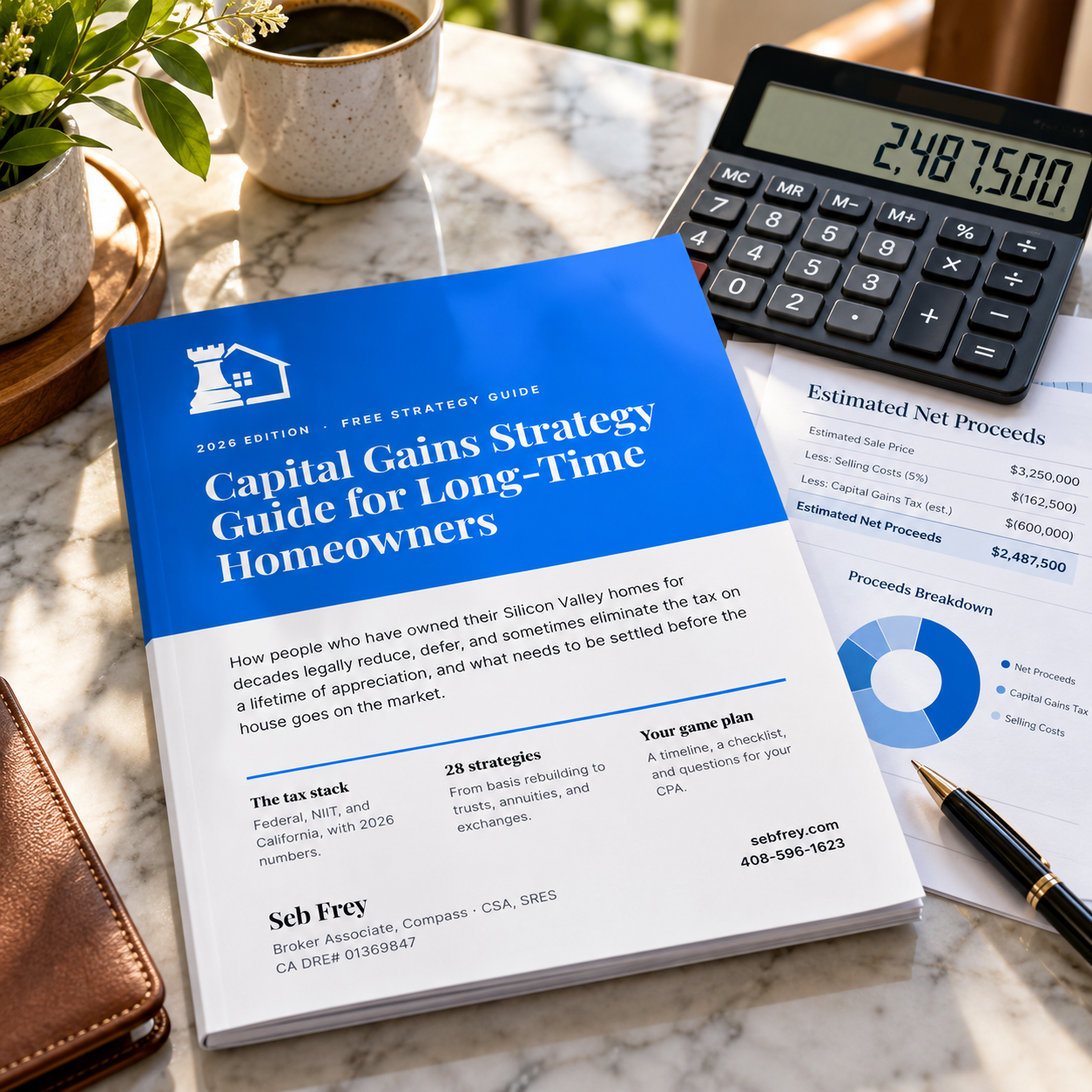
Free 2026 Strategy Guide
28 legal ways long-time owners cut their capital gains tax. Know your options before you list.
After decades in Silicon Valley, your gain can blow past the $250,000 and $500,000 exclusions. The guide walks through each strategy, a real bracket-by-bracket example, and what to settle before you list.
You're all set. Thanks! Your Capital Gains Strategy Guide is on its way to your inbox. If you don't see it in a few minutes, check your promotions or spam folder.
What Counts as a Capital Improvement
| Usually counts | Usually doesn’t count |
|---|---|
| Additions, second stories, decks, garage conversions, ADUs | Painting and patching, unless part of a larger remodel |
| Kitchen and bathroom remodels, built-in appliances, new flooring | Fixing a leak or replacing a broken window pane |
| A new roof, windows, siding, or insulation | Gutter cleaning, yard care, and other routine maintenance |
| New HVAC, water heater, electrical panel, rewiring, or water filtration | Repairs that only restore something to its original condition |
| Sewer lateral replacement, foundation work, seismic retrofit | Improvements that are no longer part of the home, such as a first roof that was later replaced by a second |
| Solar panels (reduced by any energy credit you claimed), landscaping and hardscape, fences, pools | Work paid for by insurance proceeds, to the extent you were reimbursed |
| Accessibility changes like ramps, widened doors, and grab bars, minus any portion you deducted as a medical expense | Furniture and freestanding appliances you take with you |
IRS Publication 523 has the official list, and your CPA will make the final call. The key distinction is between keeping the home in its current condition, which is a repair, and making it better, bigger, or longer-lasting, which is an improvement. Repairs done as part of a bigger project, like repainting the rooms after an addition, can usually be folded into the cost of that project. Accessibility work deserves a second look, because Publication 502 lets you treat the part of a medically necessary improvement that doesn’t raise the home’s value as a medical expense, and whatever you deducted can’t also go into basis. If you’re weighing that kind of project now, my breakdown of aging in place remodel costs in Silicon Valley is a good place to start.

Capital Gains Calculator
Bought for $180K and worth $2.4M today? See what you'd owe in capital gains tax.
After decades in Silicon Valley, your gain can blow right past the $250,000 and $500,000 exclusions. Plug in your numbers and see your estimated tax bill and how much cash you'll walk away with.
Run My Numbers →Where to Find the Evidence When the Receipts Are Gone
- Building permits. Most significant work required a permit. In San Jose you can search permit history by address on SJPermits.org, and the other cities in the county run their own building departments, while the County handles permits for unincorporated areas. Online systems often only reach back a few decades, so for older work ask the building department for its full address file. A permit shows the date, the scope, and often a job valuation, though that valuation can run lower than what you actually paid.
- Your original purchase records. The escrow or title company may still have your closing statement. If not, the Santa Clara County Clerk-Recorder’s Office issues copies of recorded deeds, and older deeds often show the documentary transfer tax paid. The county rate is $1.10 per $1,000, so $220 of county transfer tax points to a price of about $200,000. City transfer taxes and loans a buyer assumed can throw that math off, so treat it as a starting point for your CPA.
- Assessor records. Under Prop 13, permitted additions and other new construction get assessed and added to your property’s value in the year they’re completed. The Santa Clara County Assessor’s records can help confirm when a major project happened and roughly what it added.
- Loan records. A home equity loan or refinance taken out to pay for a remodel may include an appraisal describing the improvements.
- Bank and credit card statements. Payments to contractors, even from decades ago, sometimes survive in old statements or check registers.
- Contractors. Some contractors keep records for many years and can provide a letter describing the work and the cost.
- Photos and old listings. Before and after photos help show that the work happened and its scope, and the MLS listing from when you bought can document what the house looked like before you improved it. I can often pull that history for clients.
- Insurance and warranty records. Roof, window, and solar warranties show dates and installers.
- HOA records. For condos and townhomes, special assessments for capital improvements may be relevant.
- Local history collections. For older San Jose homes, the San Jose Public Library’s California Room keeps house and property research resources such as Sanborn maps and city directories that can help date a structure.
A reconstructed record won’t be perfect, and that’s okay. Courts have accepted reasonable estimates when there’s credible evidence the work was actually done, a principle that traces back to the 1930 Cohan case, but the less third-party proof you have, the less weight an estimate carries. What works best is a short memo for each project listing the year, the scope, the contractor if you know it, how you arrived at the cost, and copies of whatever supports it. Your CPA decides what the file supports.
From my practice: Permit records can fill in a lot of missing history. On one hillside house, I requested the full permit file from the county records room and it went all the way back to the original building permit. It showed a permitted garage-to-bedroom conversion and a reroof permit that dated the roof, which let us document the home accurately as four bedrooms and 2,050 square feet. That same kind of paper trail is what a CPA can use to support improvements when the receipts are long gone.

Does your home need some work first?
Let's get it market-ready, and pay for it at closing.
Paint, repairs, flooring and staging, all handled for you through Compass Concierge with nothing out of pocket up front and no contractors for you or your family to manage.
See How It Works →Rather talk now? Call or text 408.413.3087
How Much It Can Save
Federal long-term capital gains are taxed at 0, 15, or 20 percent, and higher-income sellers can owe the 3.8 percent net investment income tax on top. California has no special capital gains rate, so the Franchise Tax Board taxes gains as regular income at rates up to 13.3 percent. Put those together and each $100,000 of documented basis on a large sale is worth roughly $24,000 to $37,000 in tax, depending on where your gain lands in the brackets.
In my worked example of a San Jose couple with a $1,000,000 taxable gain, the combined federal, net investment income, and California tax came to about 29 percent. At that effective rate, documenting an additional $150,000 of improvements would save roughly $43,000, and possibly more because the last dollars of gain are taxed at the highest marginal rates. I walk through that example in how much capital gains tax you’ll pay selling a house in California.
Other Things That Affect Basis
- A prior step-up. If a spouse died while you owned the home, part or all of the basis may have been reset to the value at that time. Community property in California can get a full step-up on both halves, which I explain in the community property double step-up and in selling a house after your spouse dies in California.
- An older deferred gain. Before May 7, 1997, homeowners could roll the gain from one home into the next. If you did that, your current basis is lower than what you paid, and your CPA will want the old Form 2119 from that year’s return if you can find it.
- Depreciation. If you ever rented the home or used part of it as a home office and took depreciation, that reduces basis. The gain from depreciation taken after May 6, 1997 can’t be excluded and is federally taxed at up to 25 percent.
- Casualty losses and insurance payouts. Deducted losses and reimbursements you received reduce basis.
- Energy credits. If you claimed a federal credit for solar or other energy improvements, the amount added to basis is reduced by the credit.
Free 3-minute decision check
Stay, downsize, or move away? Find out which one costs you the least.
For longtime Bay Area owners, the wrong call can cost six figures in taxes, remodeling, or years of higher living costs. Answer a dozen quick questions and see all three paths side by side, with a rough dollar figure for what each one would cost you or free up.
See My Best Path →Rather talk now? Call or text 408.413.3087
If You’re Planning to Gift or Keep the House
Basis works differently depending on how the home leaves your hands. If you gift it to a child during your lifetime, they generally take over your basis, which means your improvement records become their records and the missing receipts become their problem. If they inherit it instead, they usually get a step-up to the value at your death, and the old improvements matter much less. I compare those paths in sell now or let the kids inherit and in my piece on gifting a house to a child under Prop 19. Either way, the IRS advises keeping property records until the tax year you sell has closed, so starting a basis file today, even a rough one, is a gift to whoever handles the sale.
Selling Costs Count Too
The gain is based on the amount realized, which is the sale price minus selling costs. Real estate commissions, escrow and title fees, transfer taxes, and certain costs the seller agrees to pay for the buyer all reduce the amount realized. Keep the final settlement statement from escrow with your tax records. For the full capital gains picture, go back to capital gains when selling a Silicon Valley home you have owned for 30 years or more.
A real example: More than a year after I closed a conservatorship sale, the family’s tax preparer needed the original purchase basis, and the purchase was more than two decades old. I worked with the title company to track down the recorded deeds from back then. Title companies and the county recorder can often reconstruct what a family’s files can’t, so they’re worth a call before you give up on a number.
Sources and Further Reading
- IRS Publication 551, Basis of Assets
- IRS Publication 523, Selling Your Home
- IRS Publication 502, Medical and Dental Expenses
- IRS, How Long Should I Keep Records?
- California Franchise Tax Board, Capital Gains and Losses
- City of San José, How to Check Permit Status on SJPermits.org
- Santa Clara County Clerk-Recorder’s Office
- San José Public Library, House and Property Research
Frequently Asked Questions
What home improvements increase cost basis?
Capital improvements that add value, prolong the home’s life, or adapt it to new uses, such as additions, remodels, a new roof, new windows, HVAC, sewer lines, and solar. Routine repairs and maintenance do not, unless they were part of a larger remodel.
What if I don’t have receipts for home improvements?
You can often reconstruct the history from building permits, recorded deeds, assessor records, old loan appraisals, bank records, contractor letters, warranties, and photos. Write a short memo for each project and let your CPA decide what documentation is sufficient.
Where can I find building permit history in Santa Clara County?
San Jose lets you search permit history by address on SJPermits.org. Other cities in the county have their own building departments, and the County handles permits for unincorporated areas. For older work, ask for the full address file, since online systems may not go back far enough.
Is my Prop 13 assessed value the same as my cost basis?
No. Your assessed value is used for property tax, while your cost basis is used for income tax when you sell. Both start from your purchase price, but they’re calculated differently and are usually not the same number.
How much tax can documenting improvements save?
On a large Silicon Valley sale, each $100,000 of documented improvements can reduce combined federal and California tax by roughly $24,000 to $37,000, depending on your income and how big the gain is.
Do selling costs reduce capital gains?
Yes. Commissions, escrow and title fees, transfer taxes, and similar costs reduce the amount realized and therefore the gain. Keep the final settlement statement from escrow.
Does a prior deferred gain affect my basis?
Yes. If you rolled over gain from a prior home under the rules in effect before May 7, 1997, your basis in the current home may be lower than your purchase price. The old Form 2119 from that tax year shows the adjustment.
Do my kids need my improvement records if they inherit the house?
Usually much less, because inherited property generally gets a step-up in basis to its value at death. If you gift the house during your lifetime, though, your children generally take over your basis, and your improvement records matter a lot.
Free Cash-Out Strategy Call
You've spent decades building equity. Let's make sure you take as much of it with you as possible.
Selling a long-held California home and moving somewhere new comes down to a few big questions. We'll look at what your home should sell for, what you'll actually net after taxes and costs, and how to time the sale with your next purchase so you're never stuck in between. You'll leave with real numbers and a plan, whether or not you hire me.
Book My Cash-Out Strategy Call →
Senior Friendly Homes in Silicon Valley South
2
3
4
5
6
7
8
9
10
11
12
13
14
15
16
17
18
19
20
21
22
23
24
25