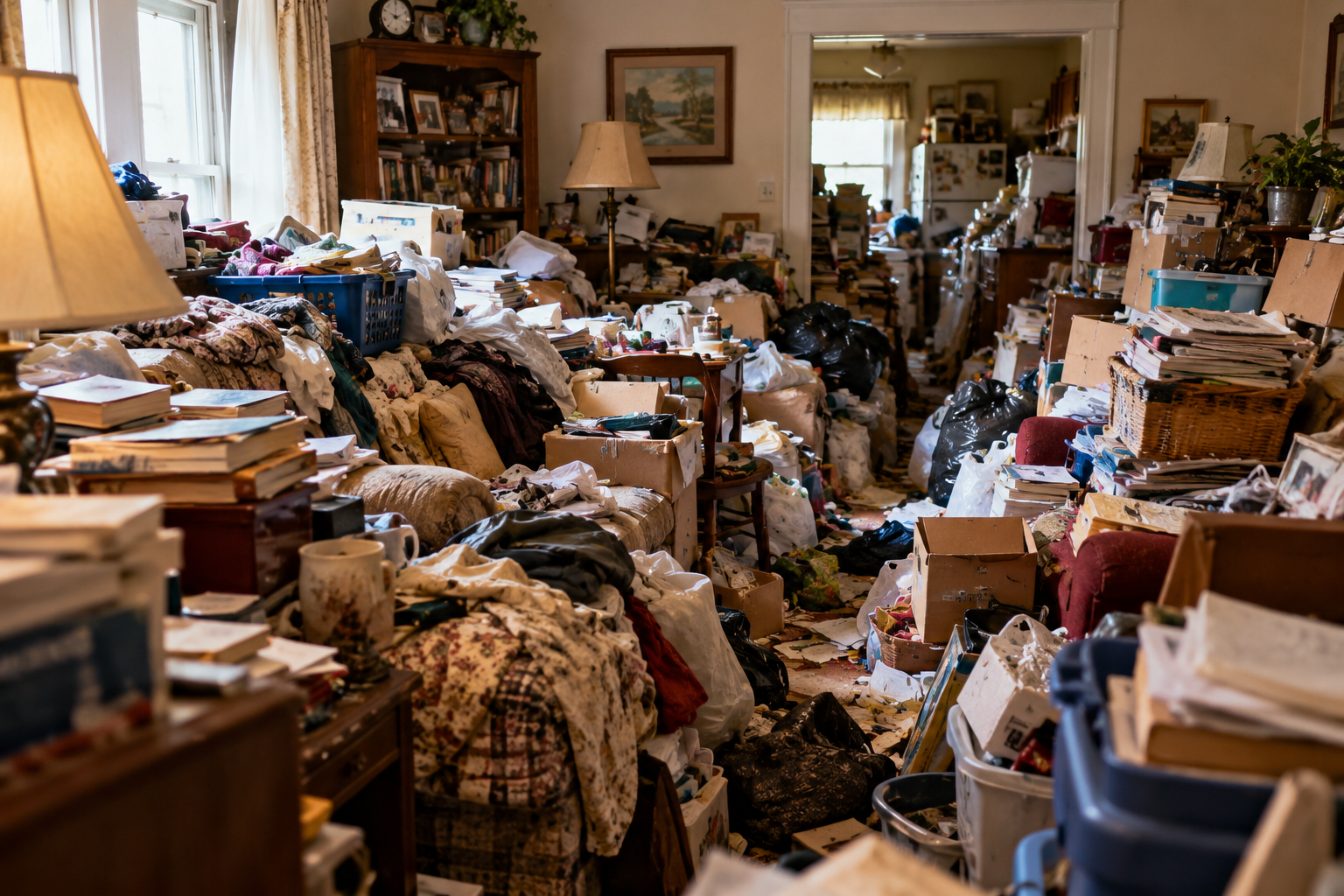
Every experienced agent in this area has walked into a house where the belongings have taken over: paths between stacks, rooms that can’t be entered, a kitchen that hasn’t been usable in years. Sometimes it’s a parent who has died, and the family is seeing the full extent for the first time. Sometimes the owner is still living there and needs to move for health or safety. These situations call for patience, respect, and a different plan than an ordinary cleanout. This article covers the practical side of selling a very full home in Silicon Valley, from safety and cleanup to pricing and whether to sell as-is. It’s part of my guide to getting rid of a lifetime of stuff before selling a Silicon Valley home.
Key Takeaways
Summary: A very full or hoarded house needs a safety-first approach, specialized cleanup, and a careful search for documents and valuables. Selling as-is is an option, but a basic cleanout often raises the price by far more than it costs, and an owner still living there deserves to be treated with dignity.
If the Owner Is Still Living There
Hoarding disorder is more common than most families realize. According to the International OCD Foundation, roughly 2 to 6 percent of people have it, and symptoms are almost three times as common in adults 55 to 94 as in adults 34 to 44, a pattern first documented in a Johns Hopkins community study by Samuels and colleagues in 2008. Symptoms also tend to get more severe with each decade when they go untreated, which is why so many of these situations surface when a parent is in their seventies or eighties and a fall, an illness, or a code enforcement visit forces the issue.
Hoarding is widely recognized as a condition that people don’t simply choose, and clearing a person’s home against their will, or all at once, often causes real distress and can backfire. If a parent is still living in the home and a move is needed, it helps to involve people with experience: a physician, a therapist familiar with hoarding, and a senior move manager or cleanup company that works respectfully with owners. If the situation is dangerous to the person’s health or safety, Adult Protective Services in Santa Clara County can be a resource. My role in these cases is to be patient, to plan the sale around the person’s needs, and to coordinate the professionals so the family isn’t carrying it all alone.
Does your place need a little work?
Sell As-Is. Sell for More.
No remodel, no lowball investor offer. Most Bay Area sellers net more selling as-is, and I'll show you how to get full market value without fixing a thing.
Show Me How →
If the Home Is Being Cleared After a Death
Families often feel shock and embarrassment on top of grief. There’s nothing to be embarrassed about. The practical steps are to secure the home, check the insurance, get an assessment for safety, and hire a company experienced with heavily filled homes. I also recommend an early search for the important papers, because wills, deeds, bank records, and even cash are often mixed in with everything else. See the documents list in my guide to getting rid of a lifetime of stuff before selling a Silicon Valley home.
Before anyone hauls anything away, make sure the right person has the authority to act. If the home is held in a living trust, the successor trustee can usually step in fairly quickly with a death certificate and a certification of trust, then hire the cleanup company and sell without going to court. If the home has to go through probate, nothing should be sold or thrown out until the Superior Court in Santa Clara or Santa Cruz County has appointed an executor or administrator and issued letters. The contents belong to the estate, and a sibling who feels something was tossed without their say can slow the sale down or start a fight that lasts much longer than the cleanout. An executor with full authority under the Independent Administration of Estates Act can usually sell with a Notice of Proposed Action rather than a court confirmation hearing, which can save months.
The order I usually walk families through goes like this. Change the locks and make sure the utilities are on. Call the homeowner’s insurance company, because many policies limit coverage once a home has been vacant for 30 to 60 days, and a packed house is a real fire and water risk. Photograph every room before anything moves, which protects the executor if anyone later asks what was in the house and helps with the estate inventory. Agree as a family on what the crew should be searching for, and only then bring in the cleanup company.
What Cleanup Looks Like
- Assessment: a walkthrough for structural concerns, mold, pests, and hazards.
- Sorting with a search: teams trained to look for documents, valuables, photos, and anything the family has asked them to find.
- Removal: often several large dumpsters or many truckloads.
- Remediation: pest control, mold treatment, odor removal, and deep cleaning as needed.
- Inspection: once cleared, a home inspection to see what is under everything, including floors, walls, plumbing, and the roof.
From my practice: One estate cabin I sold was full to the doors with debris, with no power, no water and no safe way in, and the executor lived out of state and hadn’t been inside in more than 15 years. He wanted an as-is cash sale, so we sold it that way, with the buyer taking on the septic by contract and signing a hold-harmless for the estate. It closed at $307,000, above the $300,000 list price, 26 days after listing.
How to Choose a Cleanup Company
Not every junk hauler is set up for this kind of job, and the difference shows up in what gets found, what gets lost, and what the final bill looks like. A company that handles heavily filled homes regularly will walk the house before quoting, will explain how they sort instead of just shoveling everything into a dumpster, and will be comfortable working around a grieving family or an owner who is still attached to what’s there. These are the questions I’d ask every company you’re considering:
- Will you walk the home and give me a written, itemized estimate? A firm price over the phone for a house like this is a red flag.
- Are you licensed and insured, including general liability and workers’ compensation? People get hurt on these jobs, and you don’t want an injury claim landing on the estate or the family.
- How do you handle what you find? Ask how cash, jewelry, documents, firearms, and medications are logged and turned over, and whether the crew photographs finds as they go.
- Can you handle biohazards? If there is animal or human waste, or there was an unattended death, California requires the company doing that part of the cleanup to be registered with the California Department of Public Health as a trauma scene waste management practitioner. Ask for their registration and check it.
- What happens to the contents? Good companies donate, recycle, and resell what they can, and some credit resale value against the bill.
- Who handles dumpster permits? Many cities require a permit for a bin on the street, and the neighbors will appreciate a crew that keeps the site tidy.
I’d steer clear of any company that offers to take the contents as payment before the family has searched the house, and any that wants full payment up front in cash. Many experienced crews use the Institute for Challenging Disorganization Clutter-Hoarding Scale to describe how severe a home is, and asking each company where they’d rate your house makes their quotes much easier to compare.
Sell As-Is or Clean First?
| Sell as-is with contents | Clear and clean, then sell | |
|---|---|---|
| Buyers | Mostly investors and builders paying cash | The full market, including families with loans |
| Price | Discounted for cleanup cost, unknown condition, and risk | Closer to market value for the home’s actual condition |
| Upfront cost | None | Cleanup and remediation costs |
| Time | Fastest | Adds weeks, sometimes months |
| When it makes sense | The home is a teardown, the family has no funds or time, or conditions are severe | Most homes where the structure is sound |
In my experience, buyers mentally subtract far more than the actual cleanup cost when they can’t see a house. A cleanout that costs $15,000 to $30,000 can often increase the sale price by much more than that, because it lets buyers see the house and brings in buyers who would never have considered it. Every situation is different, and I run both scenarios before recommending one.

Free Guide for Families
Selling Mom or Dad's Home to Pay for Care?
Bay Area assisted living runs $7,800 to $8,300 a month, and the house is usually the only asset big enough to cover it. This guide walks you through timing the sale, who has legal authority to sign, the capital gains rules for seniors in care, and how a sale affects Medi-Cal and VA benefits, so the decision gets made from strength instead of in a crisis.
Read the Family Guide →How the Math Usually Works
Here’s an illustration with round numbers. Say a three-bedroom ranch in Willow Glen would sell for around $1.6 million once it’s cleared and buyers can see its actual condition. An investor walking through it packed to the ceiling can’t see the floors, the walls, or the plumbing, so they price in the cleanup, a large cushion for whatever is hiding under everything, their holding costs, and their profit. Offers in the $1.25 to $1.35 million range wouldn’t surprise me. If the family spends $25,000 and a few weeks on a cleanout and sells to the full market, the difference between those two outcomes should easily top $200,000.
The exception is when the land is the value. In parts of Los Gatos, Saratoga, Cupertino, and Palo Alto, a small older house on a good lot is going to be torn down by whoever buys it, and builders price those by the lot, not the interior. In that case a full cleanout may add very little, and a sale to a builder with the contents still inside can be the simplest answer. Builders will still want the lot dimensions, the zoning, and any information on protected trees, so having those ready matters more than an empty house.
A real example: An owner reached out to me asking for a fast cash offer on a house that was full in every room, with a packed garage and debris stacked in the back yard. I tested the as-is market first by sending it to about 25 investors, and the best offer was $560,000 cash. Instead, I sourced $38,000 for cleanout, storage, paint, carpet and yard work, repaid at closing with no interest, and the house sold for $630,000 to an FHA buyer. She paid nothing upfront, and the sale came in $70,000 above the best as-is offer.
Disclosures and Condition
Once the home is cleared, conditions that were hidden may come to light, such as damaged floors, leaks, pest damage, or mold. In California, an owner who lived in the home normally completes the Transfer Disclosure Statement and the Seller Property Questionnaire, and every seller has to disclose known material facts that affect the value or desirability of the property. Executors and trustees selling in that role are exempt from the Transfer Disclosure Statement, but they are not exempt from disclosing what they actually know. If the cleanup crew found a roof leak, a rodent problem, or rot under the bathroom, that goes to the buyer in writing.
The listing agent also has a separate duty under California Civil Code section 2079 to do a reasonably competent visual inspection of the accessible areas and disclose what they see, which is one more reason to clear the home before listing. Nobody can disclose what nobody can get to, and buyers who find problems after they’re in contract tend to renegotiate hard or walk away. A general home inspection and a wood destroying pest inspection after the cleanout give everyone the same set of facts, and if mold is suspected, a separate mold assessment is worth the cost.
Some of these homes also involve a death, sometimes one that wasn’t discovered right away. Under California Civil Code section 1710.2, a seller isn’t liable for failing to disclose a death on the property that happened more than three years before the buyer’s offer, but a death within the last three years can be a material fact and should be discussed with the estate’s attorney, and no seller should ever answer a buyer’s direct question dishonestly. If there was an unattended death, keep the paperwork from the professional biohazard cleanup so it can be shared with buyers. For more on how condition affects pricing, see selling as-is or fixing it up.
Protecting Everyone’s Health
Family members shouldn’t try to clear a heavily filled home themselves without proper protection. Dust, mold, rodent droppings, and unstable piles are real hazards, especially for older family members. Let professionals do the heavy work, and let family focus on the search for important items and the decisions about what to keep. For the full clearing process, go back to my guide to getting rid of a lifetime of stuff before selling a Silicon Valley home.
Fire is the risk families tend to underestimate. A study of residential fires by the Metropolitan Fire Brigade in Melbourne, Australia (Lucini, Monk and Szlatenyi, 2009) found that hoarding homes accounted for only about 0.25 percent of preventable residential fires but 24 percent of preventable fire deaths. Blocked exits and the sheer amount of fuel keep occupants from getting out and keep firefighters from getting in, so if a parent is still living in the home, clearing paths to the doors and checking smoke alarms should happen right away, long before any conversation about selling.

Does your home need some work first?
Let's get it market-ready, and pay for it at closing.
Paint, repairs, flooring and staging, all handled for you through Compass Concierge with nothing out of pocket up front and no contractors for you or your family to manage.
See How It Works →Rather talk now? Call or text 408.413.3087
For the bigger picture on selling a longtime family home and moving somewhere smaller, start with my Bay Area downsizing guide.
Frequently Asked Questions
How do you sell a hoarder house in California?
Secure the home and assess safety, hire an experienced cleanup company, search for important documents and valuables, then decide whether to sell as-is to investors or clear and sell to the full market.
How much does it cost to clean out a hoarder house?
It varies widely with volume and condition, from several thousand dollars for a moderate cleanout to much more when remediation for mold, pests, or damage is needed.
Is it better to sell a hoarder house as-is?
Sometimes, especially for teardowns or severe conditions. For most structurally sound homes, clearing first brings more buyers and often a higher net price.
What if my parent is still living in a hoarded home?
Move slowly and respectfully, involve a physician and professionals experienced with hoarding, and consider Adult Protective Services if there’s danger to health or safety.
Do you have to disclose hoarding when selling?
Sellers must disclose known material facts about the property’s condition, such as damage or pest problems. A pre-listing inspection after clearing helps identify them.
Free Seller Strategy Session
Before we talk money, let's talk about you.
The biggest financial wins in a move happen long before a home hits the market, and they start with understanding your situation. In 30 minutes we'll talk through what's changing, who's involved, and what you need this move to do for you, then map out a plan that gets you there with a clear financial advantage.
Book My Strategy Session →
Senior Friendly Homes in Silicon Valley South
2
3
4
5
6
7
8
9
10
11
12
13
14
15
16
17
18
19
20
21
22
23
24
25