Every year in the 4th quarter, I have some version of the same conversation. A family has been thinking about selling the family home, it’s getting late in the year, and someone at the table says, “Why don’t we just wait for spring? The market should be better then.” It sounds sensible, and I understand why people say it. But after 23 years and more than 460 closed transactions, I’ve learned that “wait for spring” is usually a feeling more than a plan, and how much that feeling costs you depends on what the market does while you’re waiting.
This fall gave us a textbook example. Sellers who did the reasonable, seasonal thing and waited out the summer lull ran straight into a rate spike in September, and some of them paid dearly for it. So this article walks through how the fall versus spring decision works in any year, and uses what just happened as a real-world case study of the risk you take when you wait.
Key Takeaways
Spring’s advantage for Silicon Valley sellers comes from a brief window when buyers return before most new listings do, and in San Jose that window now opens in early February with a smaller premium than before. Fall 2026 showed what can happen in the meantime: sellers who waited out the summer for a September rebound instead met mortgage rates at a 28-month high, slower sales and price cuts. A home that’s priced right and well prepared can sell in the fall, and if you do wait, use the time to get ready.
Why Spring Is Usually Good for Sellers, and Why the Window Is Short
Nothing about sunshine in April makes a buyer write a stronger offer. Spring favors sellers for one reason: for a few weeks, buyers come back in force after the holidays before the full wave of new listings arrives. Realtor.com’s 2026 Best Time to Sell report found that during the best week of the year, listings got 16.7% more views and sold about nine days faster than average. Once new listings climb later in spring, that advantage shrinks fast.
In Silicon Valley the window comes early, and it keeps getting earlier. Zillow’s analysis of 2024 sales found San Jose sellers did best listing in the second half of March, earning 5.3% more, about $93,200. Its analysis of 2025 sales moved the peak to the first two weeks of February, with a smaller 3.1% premium of about $53,800. So if you wait for spring, you’re not waiting six months for a great market. You’re waiting for a window that may only last a few weeks in February, shared with every seller who made the same decision, and if the house isn’t prepped and the family isn’t aligned the moment it opens, it’s easy to miss.

The Pull-and-Relist Trap
We don’t have to guess how “pull it and try again in spring” plays out, because a lot of sellers ran that experiment at the end of 2025. Realtor.com reported that 2025 had the highest delisting rate since it started tracking, with 27 homes pulled off the market for every 100 new listings by October. Redfin’s data shows what happened next: a record wave of those homes came back in January 2026, and 36.1% of them returned at a lower price than they started at.
The local numbers are even more striking. The San Jose metro had the highest share of relistings of any major market Redfin tracks, at 12.5% of everything for sale that January. If you were one of those sellers, roughly one in eight homes competing with you belonged to someone who had the exact same idea. And buyers can see the history. A home that comes back in January at a lower price doesn’t look fresh. It looks like a home that didn’t sell, and buyers negotiate accordingly.
Fall 2026: A Case in Point
Anyone who has sold a home in Silicon Valley knows about the summer lull. Families travel, kids are between school years, and from the middl of June through the beginning of September, the market usually slows to a crawl. Then, right after Labor Day, buyers come back and the fall market springs back to life. It’s one of the most dependable seasonal patterns we have here, and a lot of sellers I talked to this summer made a perfectly reasonable decision based on it. They held off in July and August and planned to list in early September, when the buyers would be back.
This year, that plan backfired. Right as those homes hit the market, rates spiked. Compass’s September 2026 economic summary showed mortgage rates around 7.25%, the highest in 28 months, the Fed raising rates for the first time in three years, and pending sales running about 4% below a year earlier. On the ground, it felt like the market took a big step back almost overnight. Buyers didn’t disappear, but the urgency did. Showings thinned out, offers that would have come the first weekend didn’t come at all, and the buyers who were still looking took their time and negotiated harder. Days on market stretched out, price reductions picked up, and sale-to-list ratios sagged.
For many of those sellers, waiting turned out to be expensive. Homes that would likely have drawn solid offers in June ended up sitting, taking a price cut and selling for less, and at Silicon Valley prices it doesn’t take much of a shift to add up. Plenty of sellers gave up $100,000 or more compared to what they could have gotten by listing earlier in the summer. None of them did anything foolish. They followed a pattern that has worked for years, and the market changed underneath them.
That’s the real lesson. A seasonal pattern is a tendency, not a promise, and the longer the gap between deciding to wait and actually listing, the more room there is for rates, the stock market or the economy to move against you. If the fall of 2026 could catch sellers who were only waiting six or eight weeks, think about what a five or six month wait for spring could do. This isn’t a distressed market, but with rates up, the Fed signaling more hikes and another round of fall sellers likely to pull their homes and come back in January, nothing about today’s numbers points to a particularly strong spring market in 2027.
The Key Question to Ask Yourself
If your home isn’t listed yet and you’re deciding between now and spring, ask yourself one question. If I knew that by waiting I would lose $100,000, would I still have to wait? The sellers who waited for September this year learned that number isn’t hypothetical. If the answer is yes, because something real is standing in the way, then wait and use the time well. If nothing is really stopping you, give listing now some serious consideration.
Does your place need a little work?
Sell As-Is. Sell for More.
No remodel, no lowball investor offer. Most Bay Area sellers net more selling as-is, and I'll show you how to get full market value without fixing a thing.
Show Me How →
The Risks of Waiting That Nobody Puts on the Spreadsheet
The market risk is the one people argue about, but in my work with older adults and their families it’s rarely the biggest one.
Life doesn’t wait for the market. Most of my clients are selling because something real is happening. A parent is moving to assisted living, a spouse has passed, or a fall made the stairs impossible. Six months is a long time when someone is 82, and I’ve seen plenty of families who planned a calm spring sale end up selling under pressure in the middle of winter because a health event forced the timeline.
Carrying costs keep adding up. Every month the house sits, someone is paying property taxes, insurance, utilities, maintenance and often care costs for the parent who has already moved. Those dollars rarely show up when families compare “now” against “spring,” but they come straight out of the proceeds.
The family gets tired. Selling a longtime family home is emotional, and the decision often involves siblings in different cities with different opinions. When a family has done the hard work of agreeing to sell and then puts it on ice for six months, I often watch the consensus erode. Someone wants to try renting it out, and a decision that took a year to reach starts over from scratch.
The Case for Selling in the Fall
Fall and winter aren’t easy seasons to sell, but they have real advantages. Inventory thins out as the year winds down, so a well-prepared home stands out, and the buyers shopping in October and November tend to be serious ones who are relocating, have already sold, or don’t want to fight a spring bidding war. You also get to set the timeline on your own terms, with a rent back after closing if your parent’s move needs it.
The key is pricing it correctly from day one. Most of the homes delisted in 2025 didn’t fail because of the season. They failed because they were priced for the market the sellers wanted rather than the one they had. A home that’s priced right, prepared well and marketed properly will sell in October. A home priced for the 2022 market won’t sell this October or next April either.

Does your home need some work first?
Let's get it market-ready, and pay for it at closing.
Paint, repairs, flooring and staging, all handled for you through Compass Concierge with nothing out of pocket up front and no contractors for you or your family to manage.
See How It Works →Rather talk now? Call or text 408.413.3087
Q4 vs. Q2 Sales Over the Past 30 Years
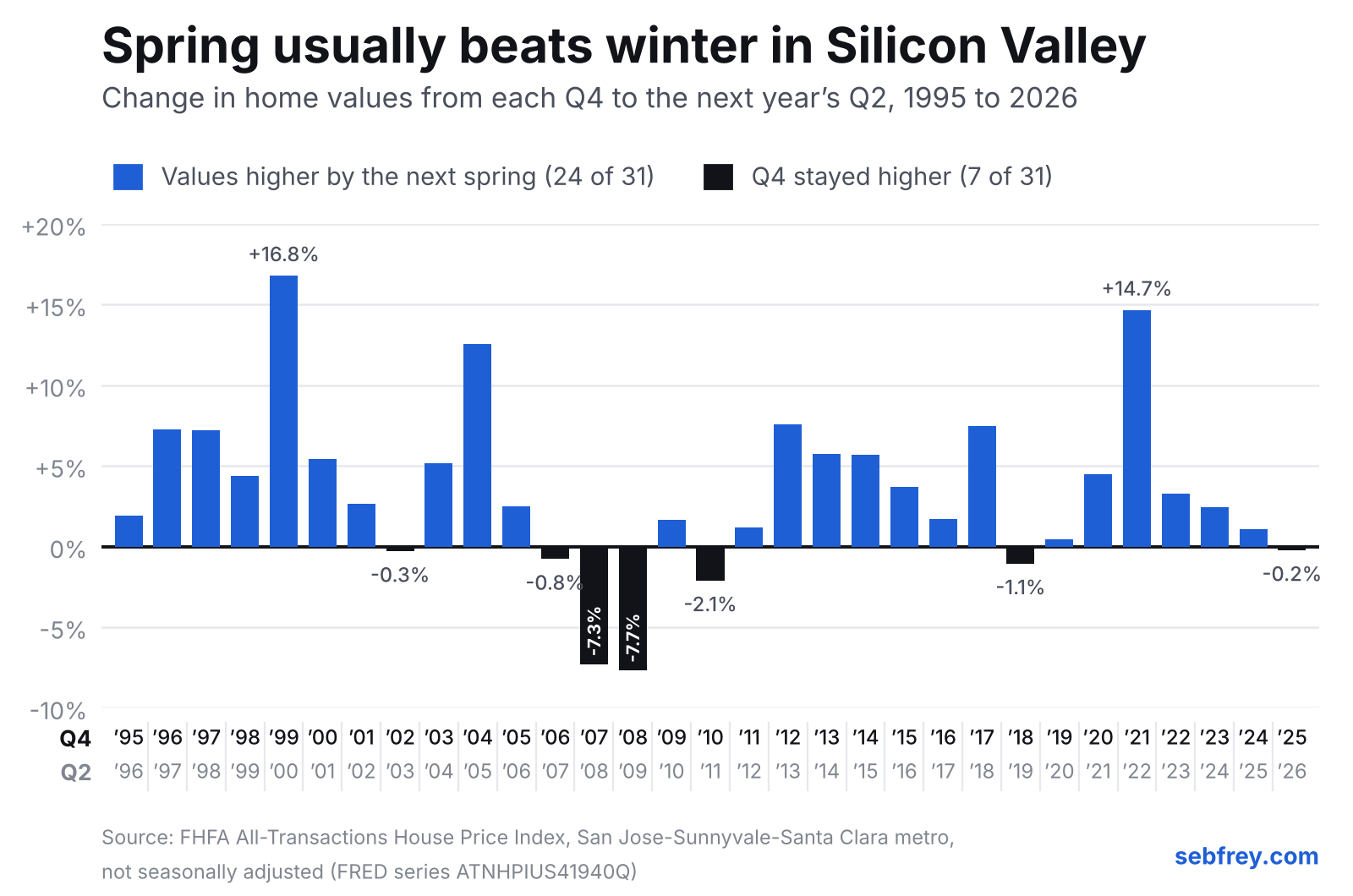
This chart takes every winter going back to 1995 and asks a simple question: were Silicon Valley home values higher by the following spring? Each bar compares the fourth quarter of one year (the bold year underneath) to the second quarter of the next year (the gray year below it). Blue bars mean values had climbed by spring, and black bars mean they hadn’t caught back up to where they were the prior winter. Out of 31 cycles, spring came in higher 24 times. In a typical year the gain was about 2.6%, and in the hot years it was a lot more, like the nearly 17% jump from late 1999 into spring 2000 and almost 15% from late 2021 into spring 2022.
The black bars are where it gets interesting. Four of the seven came during the 2007 to 2011 housing bust, when waiting for spring cost sellers as much as 7 to 8%. The others were small dips of about 1% or less, usually right after the market had peaked. What I’d point out to anyone thinking about waiting is the right side of the chart. The last two cycles were basically flat, with a 1.1% gain and then a 0.2% slip from Q4 2025 into Q2 2026. Spring still tends to win around here, but the margin has gotten thin, and a few months of mortgage, property taxes, insurance and upkeep can eat a 1% gain pretty fast. If you’re ready to sell now, the history doesn’t give you a strong reason to sit on your hands. These figures come from the Federal Housing Finance Agency’s house price index for the San Jose metro, which tracks repeat sales of the same homes, so it reflects actual changes in value rather than shifts in which homes happened to sell that quarter.
When Waiting Actually Makes Sense
I don’t think everyone should list tomorrow. Waiting can be the right call if the house needs work that will pay for itself, if the family truly isn’t ready emotionally, or if your loved one’s next home isn’t settled yet. In those cases, treat the next few months as preparation time. Get the repairs done, clear out decades of belongings, get the trust and estate paperwork in order, and plan to be ready to list by early February. What probably doesn’t make sense is pulling a listed home, doing nothing to it, and relisting at the same price in spring while hoping for a different result.
How I Help Families Make This Decision
When I sit down with a family, we look at three things: what’s actually happening in your neighborhood and price range right now, what it truly costs each month to hold the house, and whether the family’s timeline really has room to wait. Once those are on the table, the answer is usually pretty clear. If you’re weighing it, you can book a 30-minute strategy call here, or reach my office at (408) 413-3087.
Sources
- Compass International Holdings Market Research, Monthly Economic Summary, September 2026 (September 25, 2026)
- Zillow, Best Time to List 2026, analysis of 2025 home sales (March 18, 2026)
- Zillow, Best time to sell analysis of 2024 home sales (March 5, 2025)
- Redfin, Home relistings report, January 2026 (March 5, 2026)
- Realtor.com, November 2025 Monthly Housing Trends Report, as reported by The MortgagePoint
- Realtor.com, 2026 Best Time to Sell Report, as reported by National Mortgage News
Frequently Asked Questions
Is spring really the best time to sell a house in Silicon Valley?
Historically it has been, but the peak arrives earlier than most people expect. Zillow’s analysis of 2024 sales found the best window in San Jose was the second half of March, and its analysis of 2025 sales moved it to the first two weeks of February. By April or May you’re often competing with far more listings.
Is fall a good time to sell a house in Silicon Valley?
It can be. Inventory thins out late in the year, so a well-prepared, correctly priced home faces less competition, and fall buyers tend to be motivated ones, such as people relocating for work. The homes that struggle in the fall are usually the overpriced ones, and those tend to struggle in spring too.
Should I take my house off the market and relist in spring?
Only if you’re going to use that time to fix whatever kept it from selling, which is usually price, condition, or presentation. Redfin found that 36.1% of homes relisted in January 2026 came back below their original list price, and buyers can see a home’s full listing history.
How many homes were delisted in 2025?
Realtor.com reported that by October 2025 about 27 homes were being delisted for every 100 new listings nationally, and 2025 had the highest delisting rate since it began tracking in 2022. Redfin counted a record 112,788 delistings in December 2025 alone.
Will mortgage rates be lower in spring?
Nobody can say for sure, and recent history argues for caution. Many people expected rates to be lower by the fall of 2026, and instead Compass reported rates around 7.25% in September 2026, the highest in 28 months, with the Fed raising rates and markets expecting further hikes before year end.
What does it cost to wait six months to sell?
It depends on the home, but property taxes, insurance, utilities, maintenance, and any care costs for a parent who has already moved continue every single month. A vacant home adds security and insurance considerations, and all of it comes directly out of your proceeds.
Free Seller Strategy Session
Before we talk money, let's talk about you.
The biggest financial wins in a move happen long before a home hits the market, and they start with understanding your situation. In 30 minutes we'll talk through what's changing, who's involved, and what you need this move to do for you, then map out a plan that gets you there with a clear financial advantage.
Book My Strategy Session →
Senior Friendly Homes in Silicon Valley South
2
3
4
5
6
7
8
9
10
11
12
13
14
15
16
17
18
19
20
21
22
23
24
25